ChatGPT ads: how they work, what they cost, and whether your brand should advertise in ChatGPT
How ChatGPT ads work, who sees them, what they cost, which brands can run them, and how paid ads fit with getting cited in answers.
How ChatGPT ads work, who sees them, what they cost, which brands can run them, and how paid ads fit with getting cited in answers.
Real projects across branding, packaging, websites and growth.
Straight answers on this topic from the UnFoldMart team.
From branding and packaging to Webflow websites, SEO, AEO and GEO, UnFoldMart brings strategy, design and growth under one team for 250+ brands across 10 markets. Tell us where you want to grow and we'll show you the fastest way there.
From 9 November 2026, Target CPA replaces Max Bid for new conversion campaigns and Target CPC replaces Max CPC for new click campaigns. Existing campaigns keep their old bid strategy until Max Bid and Max CPC retire on 1 January 2027 (OpenAI's email to advertisers, quoted by Search Engine Roundtable).
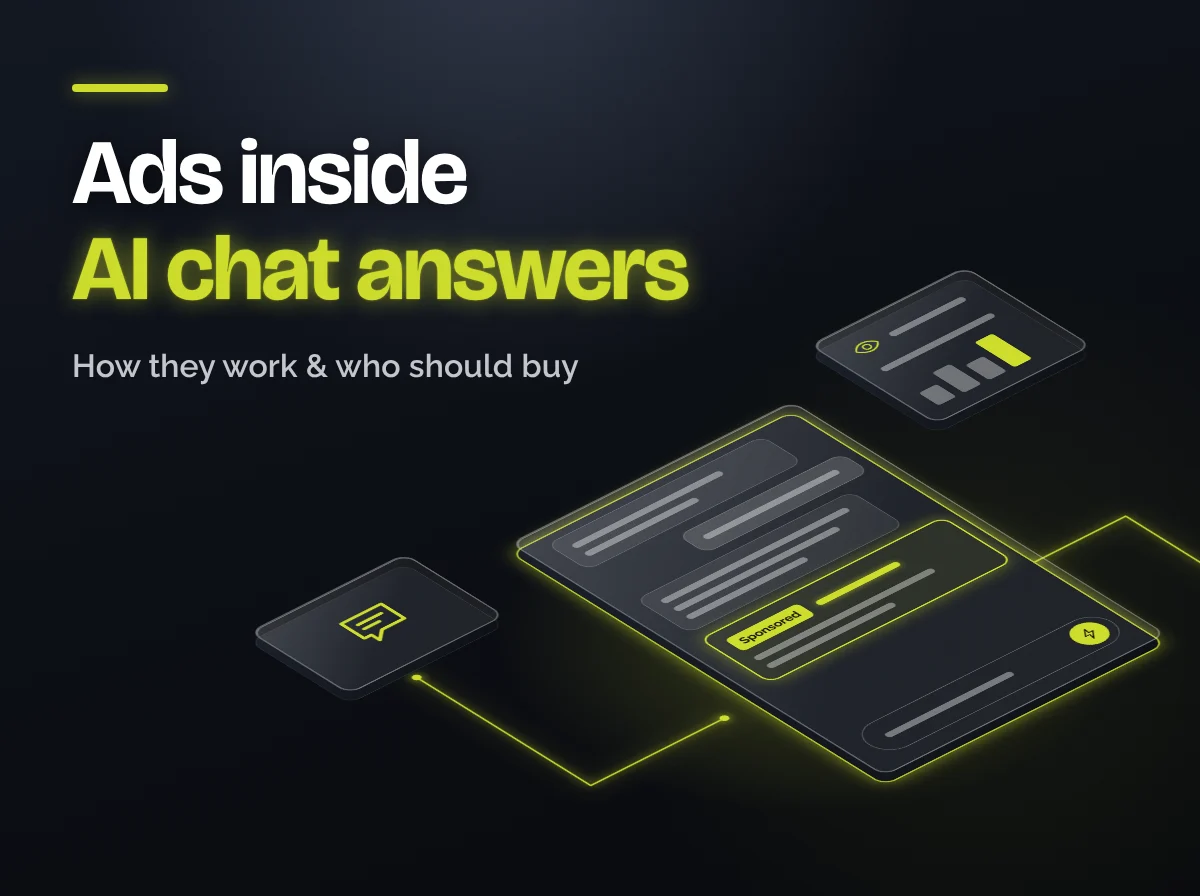
ChatGPT ads are sponsored units shown below ChatGPT's answers to adult users on the Free and Go plans. Businesses buy them in OpenAI's Ads Manager, paying per click (CPC) or per thousand impressions (CPM); campaigns optimised for conversions are still billed per click. The minimum daily budget is $25 per campaign in the US, with a separate minimum for each billing currency elsewhere. Ads are labelled "Sponsored", and OpenAI says they never change ChatGPT's answer.
Sources: Search Engine Journal on OpenAI's launch post, OpenAI Developers: Conversion-optimized campaigns, PPC Land on OpenAI's minimum-spend table.
ChatGPT now carries advertising. For marketing teams that already run Google and Meta campaigns, the question is no longer "will it happen?" but "is it worth a test budget, and how does it relate to being mentioned in ChatGPT's answers for free?" This guide answers both, using only what OpenAI has published or said on the record. It contains no invented benchmarks, because no public cross-advertiser benchmarks exist yet.
ChatGPT ads are paid placements that OpenAI shows next to, but separate from, ChatGPT's answers. Advertisers buy them through a self-serve tool and pay through an auction, in the same way they buy search or social ads.
The key terms, one line each:
ChatGPT Ads went from an announced test to a channel in 89 countries in about nine months. These are the dated milestones, each from OpenAI's own statements as reported at the time.
| Date | What happened | Source |
|---|---|---|
| 16 Jan 2026 | OpenAI announces it will test ads in the US on the Free and Go plans. | TechCrunch |
| 9 Feb 2026 | Testing begins in the US. | Search Engine Journal |
| 5 May 2026 | Self-serve Ads Manager (beta) opens to US businesses; CPC bidding added. By then ads also ran in Canada, Australia and New Zealand. | Search Engine Journal, Digiday |
| 6 Jun 2026 | Ads go live in the UK, announced by OpenAI's VP of Monetization. | PPC Land |
| 22 Jun 2026 | Ads go live in Japan and South Korea; self-serve buying opens to UK advertisers. | PPC Land |
| Mid-Aug 2026 | Ads go live in Mexico and Brazil. | PPC Land |
| 18 Aug 2026 | Expansion to 31 European countries announced, Germany included; ads ran there from the following week. | The Next Web, PPC Land |
| 31 Aug 2026 | Self-serve Ads Manager opens in India, Europe, the Middle East and North Africa. | Techwyse |
| 21 Oct 2026 | 26 more countries, 89 in total; OpenAI reports "over 100,000 advertisers" have run campaigns since launch. | PPC Land |
| 9 Nov 2026 | Target CPA replaces Max Bid for new conversion campaigns; Target CPC replaces Max CPC for new click campaigns. Max Bid / Max CPC retire on 1 Jan 2027. | Search Engine Roundtable |
| 10 Nov 2026 | With the launch of Business Hub, OpenAI says businesses can sponsor their Business Agent and use it as the destination of a ChatGPT ad. These Sponsored Agents are a limited test with selected US advertisers, as reported; sponsored placements are labelled and separate from ChatGPT's answers. | PPC Land |
On 31 August 2026 OpenAI also said that ChatGPT Ads had reached a $1 billion annualised revenue run rate, less than 200 days after launch (Techwyse). That is OpenAI's own figure, not an audited one, and a run rate projects current revenue over a year; it is not money already earned.
A ChatGPT ad is a single unit shown below the response, visually separated from it and labelled as sponsored (Search Engine Journal). It shows the advertiser's brand name and icon, a title, a body text, an image and a link to the landing page (OpenAI Developers: Account management, Campaign management). A multi-image format also exists, using 4 to 6 square images; your account has to be enabled for it (OpenAI Developers: Campaign management).
| Element | Limit |
|---|---|
| Title | 3–50 characters |
| Body text | up to 100 characters |
| Image | JPEG, PNG or WebP, at least 640 × 640 px; square (1:1) for multi-image ads |
| Advertiser icon | JPEG, PNG or WebP, at least 256 × 256 px |
| Landing page URL | HTTP or HTTPS, up to 2,048 characters, reachable by OpenAI's ad crawlers |
Sources: OpenAI Developers: Campaign management, OpenAI Developers: Account management.
Since late October 2026, OpenAI switches on "creative enhancements" by default for new and existing self-serve campaigns. It may write new or updated headlines and descriptions, resize images, optimise destination URLs and translate ad text, and these versions can run without you reviewing or approving each one. You can opt out for the whole account or for single campaigns in Ads Manager (OpenAI's email to advertisers, quoted by Search Engine Roundtable; PPC Land). For regulated claims, brand terms or legally approved wording, check this setting before launch and review how your ads actually render.
ChatGPT ads appear only on the Free and Go plans; Plus, Pro, Business, Enterprise and Edu are ad-free. Accounts that OpenAI identifies as belonging to someone under 18 do not see ads (Search Engine Journal on OpenAI's launch post). In the US, advertisers can also reach people using ChatGPT without logging in (Digiday).
Free users can switch ads off in exchange for fewer free messages per day (Search Engine Journal, The Decoder).
What this means for your targeting: the audience is people using ChatGPT on consumer plans. Someone who uses ChatGPT through a company Business or Enterprise seat will not see your ad at work. That makes the channel a more natural fit for B2C and e-commerce brands than for B2B companies whose buyers mostly use paid workplace accounts.
OpenAI says ads do not influence ChatGPT's answers and that conversations stay private from advertisers (TechCrunch, The Next Web).
According to OpenAI's published commitments:
Sources: Search Engine Journal on OpenAI's launch post, TechCrunch, The Next Web.
These are OpenAI's stated principles. No independent audit of them has been published that we could verify, so treat them as commitments, not as tested facts. For advertisers, the practical point is simple: buying an ad does not buy a mention in the answer.
There is no rate card. ChatGPT ad prices are set by auction, and there are no public cross-advertiser benchmarks: Ads Manager reports only your own numbers (PPC Land). Anyone quoting a "typical ChatGPT CPC" is guessing.
| Objective | What you pay for | Notes |
|---|---|---|
| Views | CPM (per 1,000 impressions) | Awareness |
| Clicks | CPC (per click) | Traffic; Target CPC for new campaigns from 9 Nov 2026 |
| Conversions | oCPC: per valid click | Optimised for conversions; you are not billed per conversion. Target CPA for new campaigns from 9 Nov 2026 |
Sources: OpenAI Developers: Conversion-optimized campaigns, OpenAI Developers: Bidding & budgets, Search Engine Roundtable.
Since late July 2026, a daily budget is an average over seven days, not a hard daily cap. OpenAI told advertisers that spend "may vary by day while staying within daily and seven-day limits", which means a week's spend stays within seven times the daily budget (PPC Land, quoting OpenAI's email).
Because there are no benchmarks, size your test from your own data. The figures below are illustrative arithmetic built on the confirmed $25 US minimum, not data and not a forecast of results. Outside the US, repeat the sums with the minimum Ads Manager shows for your billing currency.
Early press reports mentioned a "$60 CPM" and a "$200,000 minimum commitment". Both described the invitation-only pilot: Adweek reported that OpenAI confirmed the $200,000 minimum, and Digiday reported that media buyers were quoted about $60 per 1,000 views (Search Engine Journal). OpenAI dropped the minimum spend when self-serve buying opened on 5 May 2026 (Adtrak). Don't plan around those figures.
OpenAI's Ad policies ban some categories outright, allow some only after case-by-case review, and keep ads away from sensitive conversations (OpenAI Ad policies, as reported by Techwyse).
| Category | Can it run ChatGPT ads? |
|---|---|
| Most consumer retail, e-commerce, travel, software, education, home, food | Yes, subject to the general policy |
| Financial services | Case by case, after manual review; check OpenAI's Ad policies for your market |
| Healthcare | Case by case, after manual review; check OpenAI's Ad policies for your market |
| Legal services (advice, representation) | No; general legal education can qualify |
| Unsupported medical claims, unapproved treatments | No |
| Political content | No |
| Any other category not listed here | Check OpenAI's Ad policies for your market |
Sources: Techwyse, Relevant Audience.
Even an approved ad will not appear next to every conversation. OpenAI excludes sensitive contexts (for example, conversations about health, mental health or politics), so your reach depends on what users are talking about, not just on your bid (Search Engine Journal).
You can launch a ChatGPT ad campaign in eight steps, and the most important one happens before launch: install conversion tracking.
The biggest difference is how ads are matched: ChatGPT uses context hints and the conversation, while Google Search uses keywords.
| ChatGPT Ads | Google Ads (Search) | |
|---|---|---|
| How intent is matched | Context hints and the conversation; not exact-match keywords | Keywords and search queries |
| Buying models | CPM, CPC, oCPC (billed per click) | CPC and other bid strategies |
| Minimum budget | $25 per day in the US; set per billing currency elsewhere | No fixed minimum stated; you set an average daily budget (Google Ads Help) |
| Who sees it | Adults on ChatGPT Free and Go | Google search users |
| Creative format | One sponsored unit below the answer: brand name, icon, title, body, image(s) | Text ads, plus other formats |
| Measurement | Pixel and Conversions API; tools still new | Mature (Google tag, GA4, offline conversions) |
| Channel maturity | Self-serve beta since May 2026 | Decades old |
If you are also weighing Google Ads against Meta Ads, see our comparison of Google Ads vs Meta Ads. For how ChatGPT's answers differ from Google results in general, read ChatGPT search vs Google.
An ad sits below ChatGPT's answer; a citation sits inside it. Because OpenAI says paying for ads does not affect the answer, these are two separate jobs with two separate methods.
| Paid: ChatGPT Ads | Organic: citations in answers | |
|---|---|---|
| Who sees it | Adults on Free and Go only | All ChatGPT users, including Plus, Pro, Business and Enterprise |
| Cost model | Auction: CPC or CPM, plus daily budget | No media cost; investment is in content, technical SEO and reputation |
| Time to results | Days, once the ads are approved | Weeks to months |
| Control over the message | High: you write the ad (subject to creative enhancements) | Low: ChatGPT writes the answer |
| Stops when you stop paying | Yes | No; it builds over time |
The two work best together. Ads give you guaranteed placement on the consumer plans now. Citations reach the paid-plan users who never see ads, and they keep working without a media budget. You can track your AI search visibility to see whether the organic side is moving. On the organic side, you can now also claim your business profile in ChatGPT through Business Hub: it is free at launch, shows mentions and website clicks, and OpenAI says claiming does not guarantee higher placement (see how to claim your business in ChatGPT).
Test ChatGPT ads if all four of these are true:
Wait if any of these is true:
If you are waiting, the organic side (being cited in answers) still applies to you, including for B2B.
UnFoldMart works on both sides of ChatGPT visibility: the paid placement under the answer and the organic citations inside it.
ChatGPT Ads is a new channel, and we will not show you invented case studies or benchmarks for it. We will help you run a clean test and tell you honestly what your own numbers say.
UnFoldMart has 10 offices: Frankfurt, Zürich, London, Amsterdam, Paris, Madrid, Warsaw, Singapore, Vancouver and Gurugram. UK brands can work with our performance marketing team in London and AEO team in London.
Plan a ChatGPT ads test with us: paid placement and organic citations from one team. Book a free call.
Got Questions? We’ve Got Answers – Clear, Simple, and Straight to the Point
Business Hub is OpenAI's free dashboard, launched in beta on 10 November 2026, where a business can claim and verify its ChatGPT profile, update its details and see aggregated mentions and website clicks. It is separate from ChatGPT Ads, and OpenAI says claiming a profile does not guarantee higher placement in answers.
No. Ads are paid and sit below the answer. Being cited inside the answer is earned through AEO and GEO, and paying for ads does not affect it.
No. OpenAI says conversations stay private from advertisers, who receive only aggregated performance data, and that it does not sell user data.
OpenAI's Ad policies ban political ads and legal services, and approve financial and healthcare advertisers only case by case after review. Other categories are restricted or banned too, so check OpenAI's current Ad policies before planning a campaign.
Yes. ChatGPT ads went live in the UK on 6 June 2026, and self-serve buying in Ads Manager opened to UK advertisers later that month.
OpenAI says no. Ads are shown separately below the response and do not change what ChatGPT answers.
Prices are set by auction: you pay per click (CPC) or per thousand impressions (CPM), and conversion-optimised campaigns are billed per click. The minimum daily budget is $25 per campaign in the US and is set separately for each billing currency elsewhere. When CPC bidding launched in May 2026, OpenAI recommended starting bids of $3–$5 per click.
No. ChatGPT Plus, Pro, Business, Enterprise and Edu are ad-free; ads appear only on the Free and Go plans.
Yes. OpenAI began testing ads in the US on 9 February 2026, and as of 21 October 2026 ChatGPT Ads is available in 89 countries, on the Free and Go plans only.