What Is AEO, and Why Do Brands in Germany Need It in 2026?
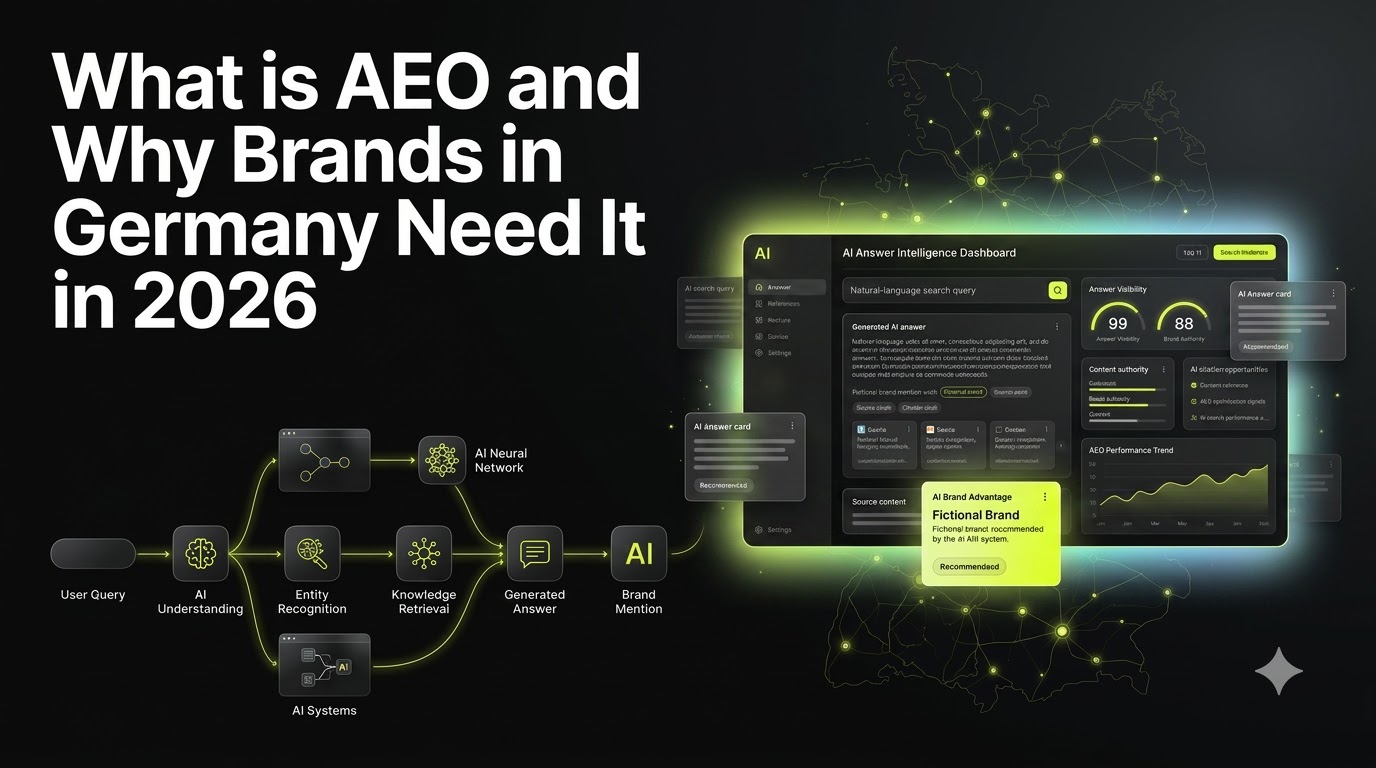
What Is AEO, Exactly?
Traditional SEO competes for a ranking position — a blue link on page one. AEO competes for something narrower and more valuable: the sentence an AI engine actually says out loud, and the source it credits for saying it.
Instead of asking "how do we rank #1 for this keyword," AEO asks "how do we become the source ChatGPT or Google's AI Overview reaches for when someone asks this question."
It's worth separating three terms that get used almost interchangeably, because they aren't the same discipline:
- SEO (Search Engine Optimization): Winning visibility in traditional search results — rankings, impressions, clicks — through keywords, backlinks, and technical health.
- AEO (Answer Engine Optimization): Structuring content so featured snippets, voice assistants, and AI-generated answers select it as the direct answer.
- GEO (Generative Engine Optimization): The broader discipline of optimizing for generative AI platforms specifically (ChatGPT, Gemini, Claude), of which AEO is a core part.
In practice, most agencies — UnFoldMart included — treat AEO and GEO as two sides of the same coin: SEO builds the foundation of authority and technical trust; AEO/GEO makes that authority legible to a model that's summarizing, not scrolling. For a deeper side-by-side breakdown of all three disciplines, see our guide to SEO vs. AEO vs. GEO.
Why Germany, Specifically, in 2026
Germany is a useful case study precisely because it was a cautious AI market for years — and is now moving fast enough that the caution itself has become the story.
AI Overviews are no longer an edge case in German search. Google officially rolled out AI Overviews in Germany in March 2025, followed by AI Mode that October. Within roughly a year, AI-generated summaries were appearing on close to 20% of all German-language keyword searches, up from 17% in mid-2025 — and the share keeps climbing, not plateauing. (We break down the mechanics further in Google AI Overviews: SEO Impact 2026.)
The click-through damage is measurable and steep. Analysis from SISTRIX, covering more than 100 million German keywords, found that AI Overviews cut the click-through rate of the #1 organic position by around 59% — from roughly 27% down to about 11%. Average German search-result CTR falls from around 57% to 33% once an AI Overview appears on the page. Across the market, that's been estimated at hundreds of millions of lost organic clicks per month.
The pain isn't evenly distributed. Informational and YMYL ("your money or your life") categories — health, finance, legal, education — are absorbing the heaviest losses, with AI Overviews showing up on the large majority of health-related queries in Germany. Transactional and e-commerce searches, by contrast, are barely touched, with AI Overview presence in the low single digits. If your brand lives in an advice-driven, informational content space, this is not a future problem — it's already reshaping your traffic.
There's an upside, and it's a big one. Being the source an AI Overview actually cites doesn't just protect you from the traffic loss — German sites cited within AI Overviews see roughly an 80% uplift in click-through rate compared to being merely ranked but uncited. That's the entire strategic argument for AEO in one statistic: the goal isn't to survive AI Overviews, it's to become the answer they give.
German consumers are cautious adopters — which changes what "trustworthy" content looks like. In an OECD/Cisco study surveying more than 14,000 people across 14 countries, only 19% of German respondents said they use generative AI regularly — one of the lowest rates in Europe, and far behind India's 66%. That's consistent with Germany's broader culture around data privacy, source transparency, and institutional trust — the same instincts that shaped GDPR. The practical implication for AEO: German audiences (and by extension the models trained to satisfy them) reward content that is precise, sourced, and unambiguous far more than content that's merely confident. Vague claims and marketing fluff are exactly what gets skipped when an AI system is choosing what to cite.
Google still dominates — so AEO doesn't replace SEO, it extends it. Google holds close to 90% of German search, and roughly 92–99.5% of AI Overview citations still come from domains that were already ranking in the organic top 10. Traditional SEO fundamentals — domain authority, backlinks, technical health, page speed — remain the entry ticket. AEO is what happens after you've earned that seat at the table.
What Happens If a German Brand Ignores This
Three things, roughly in order:
- You lose clicks you used to get for free. If your content answers informational questions and you're not optimized for extraction, an AI Overview will likely answer the question using someone else's content instead of yours — while your page quietly drops in the SERP as AI summaries push organic results down by several hundred pixels on average.
- You lose the compounding trust signal. Being cited doesn't just drive a click — it lifts both organic and paid CTR for that domain going forward. Not being cited means a competitor is quietly building that halo effect while you aren't.
- You're optimizing for a search behavior that's shrinking. Zero-click search — where the user gets their answer and never visits a website — is already the norm for over half of German searches, and climbs sharply higher inside AI Mode. Content built purely to "win the click" is chasing a smaller and smaller share of total search behavior. For the fuller picture, see Why Websites Will Lose Traffic After Google AI Search.
How German Brands Actually Implement AEO
This is where AEO becomes concrete, not conceptual. For a tactical, step-by-step version of this checklist, see How to Rank in AI Answers: SEO 2026. Brands operating across the wider DACH region should also read our International SEO for DACH and European Markets guide, since Austria and Switzerland are seeing a similar AI Overview rollout on a slightly different timeline.
1. Keep the SEO foundation strong — it's the prerequisite, not an alternative.Since nearly all AI Overview citations come from pages already ranking well organically, backlinks, domain authority, and technical SEO aren't optional extras. Sites with a strong referring-domain profile are measurably more likely to be cited by AI systems than thin, low-authority pages.
2. Answer the question in the first 30% of the page.A large share of what LLMs quote from a page comes from its opening section — not the conclusion, not a buried FAQ at the bottom. Put your clearest, most directly-worded answer near the top, then use the rest of the article to build depth and credibility.
3. Write long, not thin.Counterintuitively, longer articles are cited more, not less. Content well over 2,000 words is meaningfully more likely to be cited by ChatGPT and AI Mode than short, headline-optimized pieces — because depth signals comprehensiveness, and models prefer sources that fully resolve a question.
4. Use real numbers and named sources.Content that includes specific statistics, citations, and named data points sees a measurable lift in AI visibility. Vague claims get paraphrased into oblivion or skipped; specific, sourced claims get quoted.
5. Keep it current.Pages updated within the last two to three months are meaningfully more likely to be cited than stale ones. A blog calendar built for AEO needs a refresh cadence, not just a publish-and-forget schedule.
6. Don't neglect page speed.Fast-loading pages are cited noticeably more often than slow ones. This is a technical SEO task that quietly doubles as an AEO lever.
7. Build presence beyond your own domain.Third-party trust surfaces — review platforms, industry directories, LinkedIn, and (increasingly, per current data) forums like Reddit and Quora — are being cited at rising rates across AI platforms. For German B2B brands specifically, LinkedIn is currently the single most-cited domain across ChatGPT, AI Overviews, AI Mode, Copilot, and Perplexity, which makes an active, substantive LinkedIn presence a genuine AEO asset, not just a networking one.
8. Optimize for more than one AI platform, deliberately.ChatGPT holds the large majority of AI-chatbot usage among German users specifically, but overlap between what gets cited in Google's AI Overviews versus its own AI Mode is surprisingly low — under 15%. Winning visibility in one AI surface doesn't guarantee visibility in another. Brands need a structured, platform-aware approach rather than assuming one optimization pass covers everything.
9. Write for German trust norms, not just German keywords.Given how privacy- and accuracy-conscious German audiences are, content that clearly states sourcing, avoids overclaiming, and reads as editorially independent will tend to perform better — both with human readers and with models trained to weigh credibility signals.
How to Measure Whether AEO Is Working
Traditional SEO has mature measurement: rankings, impressions, clicks, conversions. AEO measurement is younger and noisier, but not unmeasurable.
- Manually query the AI platforms on a schedule. Ask ChatGPT, Perplexity, and Google's AI Overview the exact questions your content is built to answer, and check weekly or biweekly whether your brand is cited, and where in the answer it appears.
- Segment AI referral traffic in analytics. Most analytics tools can now isolate traffic from chatgpt.com, perplexity.ai, and Gemini as distinct referral sources. The absolute numbers are small today, but the trend line is the signal worth watching.
- Track branded search lift. Being cited by an AI system, even without a click, can drive people to search for your brand name directly afterward — a lagging indicator that's easy to miss if you're only watching direct AEO metrics.
- Don't expect classic rank-tracking tools to capture this fully. Most rank trackers were built for blue-link rankings, not AI citation. A handful of AEO-specific monitoring tools have emerged, but manual spot-checks remain the most reliable method for most teams right now.
The Bottom Line
Germany's AI-search shift isn't a forecast anymore — it's a measured, ongoing change to how a nearly-90%-internet-penetrated market finds information. Brands that keep publishing purely for rankings will keep losing ground quietly, one AI Overview at a time. Brands that combine strong SEO fundamentals with deliberate, source-backed, freshly-updated content are the ones AI systems are choosing to cite — and citation, not ranking, is quickly becoming the real currency of visibility.
Building an AEO strategy for a German or DACH-market audience? UnFoldMart's AEO agency works with brands on the full SEO, AEO, and GEO stack — from technical foundations to the content structure that gets cited, not just ranked. Get in touch to talk through where your current content stands.
Sources

FAQs
Got Questions? We’ve Got Answers – Clear, Simple, and Straight to the Point
No — a separate strategy isn't the goal, and duplicating effort usually backfires. Since the large majority of AI citations still come from pages that already rank well organically, the right approach is to extend your existing SEO content with AEO-specific structure (a clear direct-answer opening, real statistics, current dates) rather than building a parallel content track.
There's no fixed timeline, since AI citation depends on factors outside your control (a page's existing domain authority, how often the model refreshes its index, competitive density on the topic). As a practical benchmark, pages updated within the last two to three months are cited meaningfully more often than stale ones — so the fastest lever most brands have is a disciplined content refresh cadence, not a one-off rewrite.
No — if anything, AEO rewards specificity and depth over brand size. A well-sourced, thoroughly answered piece from a smaller brand can out-cite a shallow page from a larger competitor.
Informational and advice-heavy sectors — health, finance, legal, and education — see the steepest click-through losses from AI Overviews. E-commerce and transactional queries are comparatively insulated, since AI Overviews appear far less often on purchase-intent searches.
Largely, yes. Different AI platforms pull from different data sources and citation logic, so a strategy built only around Google AI Overviews won't automatically transfer to ChatGPT, Perplexity, or Copilot.
No. Nearly all AI citations still come from pages that already rank well organically, so SEO remains the foundation. AEO is the layer on top that determines whether that ranking authority actually gets used inside an AI-generated answer.

Want to Turn Your Brand Into a Scalable Growth Engine?
We help modern businesses unify branding, websites, SEO, and paid media into one performance-driven system designed to scale.