Why 90% of Websites Will Lose Traffic After Google AI Search
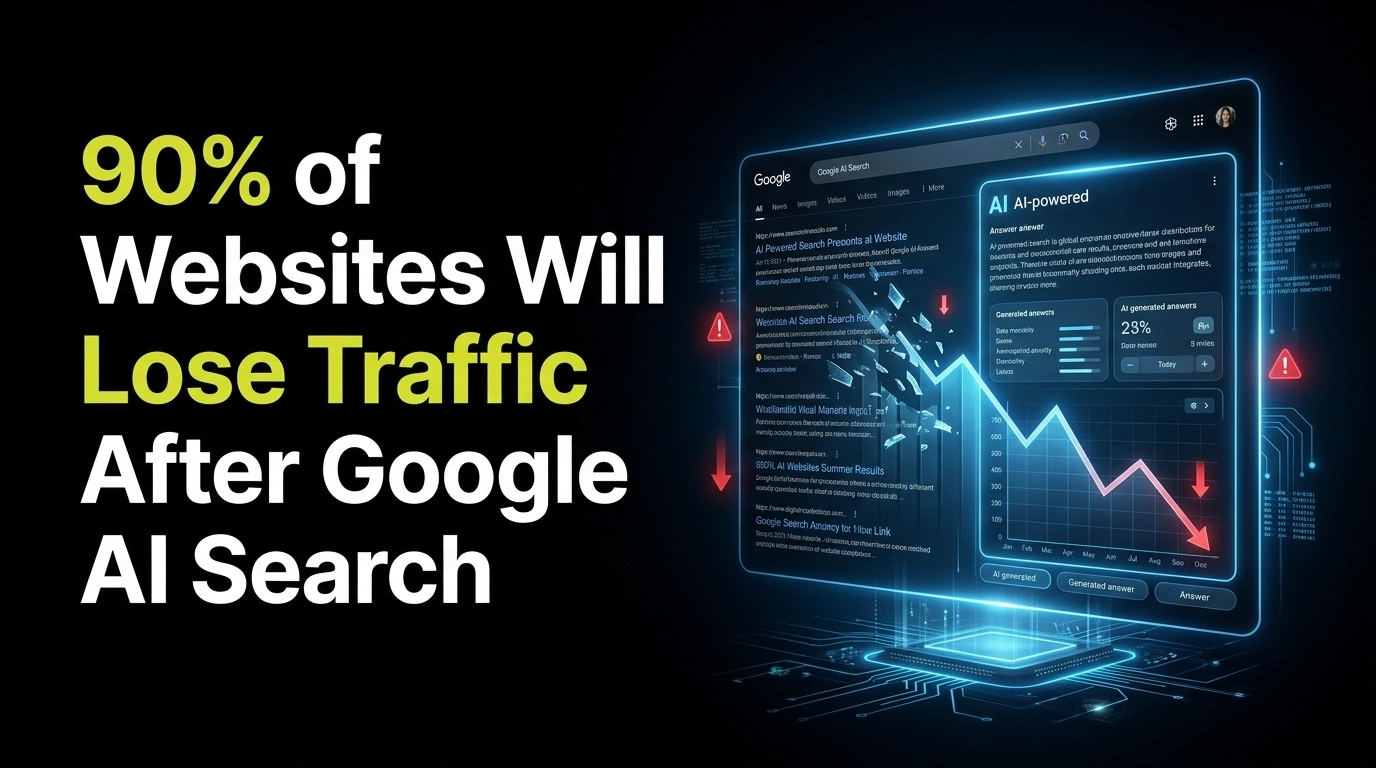
Something big is happening in search.
Traffic patterns are shifting.
Click-through rates are dropping.
Even top-ranking pages are seeing fewer visits.
And most websites aren’t ready.
Here’s the uncomfortable truth:
Google AI Search will reduce traffic for the majority of websites.
Not because SEO is dead.
Not because Google is broken.
But because search itself has changed.
Google used to send traffic.
Now it answers questions.
And that single shift changes everything.
Let’s break down why most sites will lose traffic - and what separates the 10% that won’t.
What Is Google AI Search?
Google has integrated AI-powered summaries directly into search results.
Instead of just showing links, search results now include:
- AI-generated summaries
- Direct answers
- Consolidated explanations
- Context pulled from multiple sources
Users often get what they need without clicking a website.
This is no longer just a search engine.
It’s an answer engine.
And when answers live on the results page, website visits naturally decline.
The Rise of Zero-Click Searches
Zero-click searches are not new.
But AI search has accelerated them.
A zero-click search happens when:
- A user searches
- Gets the answer directly
- Leaves without visiting a site
Informational queries are hit hardest.
Examples:
- “What is content marketing?”
- “How does SEO work?”
- “Best time to post on Instagram?”
If your content only summarizes common knowledge, AI can do that instantly.
And it will.
Which means fewer clicks for commodity content.
Why 90% of Websites Are at Risk
Now let’s get honest.
Most websites are built on predictable SEO tactics.
And those tactics are vulnerable.
1. Most Content Is Commodity Content
The majority of blogs online:
- Rewrite existing ideas
- Rephrase competitors
- Follow the same templates
- Add little original value
AI can summarize that content in seconds.
If your article doesn’t add unique insight, experience, or authority, it becomes replaceable.
AI search thrives on summarization.
And generic content is easy to summarize.
That’s the first wave of traffic loss.
2. Informational Content Gets Cannibalized First
Basic guides are most exposed.
Think about content like:
- Definitions
- Step-by-step beginner guides
- Surface-level comparisons
AI can merge ten similar articles into one clear answer.
If your content only explains basics, it becomes invisible behind AI summaries.
This doesn’t mean educational content is useless.
It means it must go deeper.
3. Rankings No Longer Equal Clicks
For years, SEO was simple:
Rank higher → get more traffic.
Now?
You can rank #1 and still lose clicks.
Because above you might be:
- AI summary
- Featured snippet
- People Also Ask box
- Video carousel
Search real estate has changed.
Clicks are no longer guaranteed - even at the top.
Which means traffic isn’t just about ranking anymore.
It’s about differentiation.
4. Weak Brands Disappear First
AI search prefers trusted, authoritative sources.
If your brand:
- has no recognition
- limited backlinks
- low authority
- thin presence
You’re less likely to be cited or surfaced.
Strong brands survive because:
- users recognize them
- Google trusts them
- they’re referenced across the web
Weak brands? They fade into the background.
Authority matters more than ever.
5. Poorly Structured Content Gets Ignored
AI systems pull information from clearly structured pages.
If your content:
- lacks headings
- buries answers deep in paragraphs
- has no clear formatting
- lacks schema
It’s harder to extract value from.
Well-structured, concise, answer-first content has an advantage.
Lazy formatting now costs visibility.
Who Will Be in the 10% That Wins?
This isn’t doom.
It’s filtering.
The websites that thrive after Google AI Search share specific traits.
They:
- Publish original insights
- Share real experience
- Add proprietary data
- Build recognizable brands
- Structure content clearly
- Develop authority in specific niches
- Build communities beyond search
They don’t rely on recycled information.
They create value AI cannot easily replicate.
And that’s the key.
SEO Is Shifting from Traffic to Authority
Traffic is still important.
But authority is becoming the real asset.
Modern SEO focuses on:
- brand visibility
- mentions
- topical authority
- experience-driven content
- user trust
Tools like Google Search Console and Google Analytics now show an interesting pattern:
Impressions may rise.
Clicks may flatten.
That doesn’t mean failure.
It means search behavior evolved.
The goal is no longer just to “get clicks.”
It’s to be recognized as the source.
How to Protect Your Website from Traffic Loss
Here’s what smart teams are doing now.
1. Publish Experience-Based Content
Share real case studies, lessons, failures, and frameworks.
2. Add Unique Angles
Don’t repeat what’s already ranking. Add depth.
3. Structure for AI Visibility
Use:
- clear headings
- short answers
- FAQ sections
- schema markup
4. Build Brand Authority
Invest in:
- PR
- backlinks
- founder visibility
- community engagement
5. Go Beyond Informational Content
Create:
- opinion pieces
- comparisons
- thought leadership
- data-backed insights
6. Diversify Traffic Sources
Relying only on organic search is risky.
Build:
- email lists
- LinkedIn presence
- partnerships
- referral networks
AI search punishes dependence.
Diversification protects growth.
Why Startups Must Adapt Faster
Large brands can absorb traffic drops.
Startups can’t.
With:
- fewer backlinks
- lower domain authority
- limited brand recognition
They are more exposed.
Which means startups need smarter, not bigger, strategies.
Hyper-focused authority in one niche beats shallow coverage across many topics.
Specialization wins.
Ready to Future-Proof Your Traffic?
Search isn’t collapsing.
It’s evolving.
But lazy SEO is dying.
At UnFoldMart, we help startups build AI-aware SEO strategies that focus on authority, differentiation, and long-term growth — not just rankings.
Because in the AI search era, traffic doesn’t reward volume.
It rewards value.
👉 Talk to our team and future-proof your website before traffic shifts further.

FAQs
Got Questions? We’ve Got Answers – Clear, Simple, and Straight to the Point
Absolutely, but with a smarter, AI-aware approach.
Focus on structured, experience-driven, authoritative content.
AI summaries and zero-click searches may be reducing clicks on informational content.
No. It will eliminate low-value, generic SEO strategies.

Want to Turn Your Brand Into a Scalable Growth Engine?
We help modern businesses unify branding, websites, SEO, and paid media into one performance-driven system designed to scale.