SEO vs AEO vs GEO: What’s the Difference and How to Rank Higher in 2026
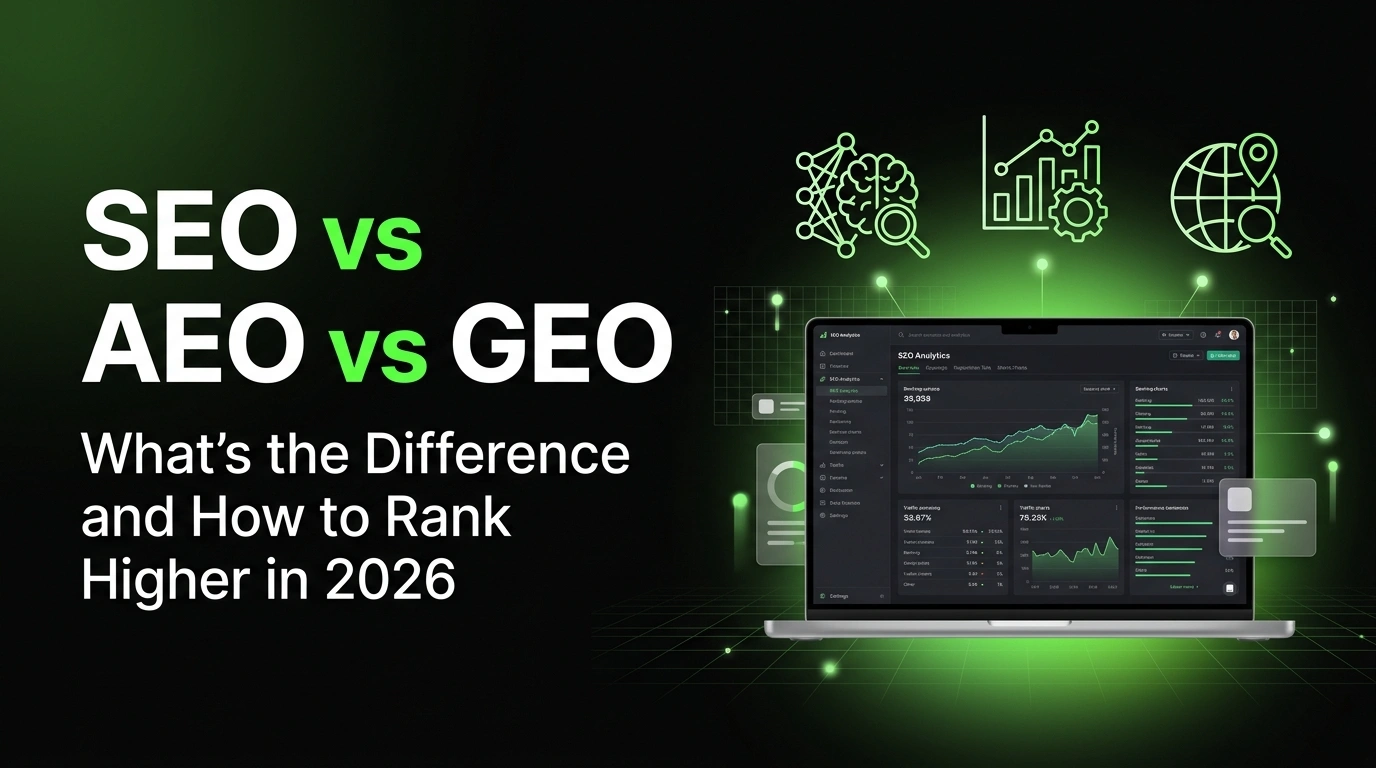
Search is no longer just about Google's 10 blue links. In 2026, businesses are optimizing for three distinct search environments: SEO for traditional search, AEO for answer engines, and GEO for generative AI platforms. Understanding the differences between these disciplines is essential for building a comprehensive search visibility strategy.
This guide breaks down what separates SEO, AEO, and GEO, how they overlap, and how to allocate your efforts across all three channels.
What is SEO?
Search Engine Optimization focuses on ranking web pages in traditional search results. It involves technical optimization, content quality, link building, and user experience improvements to earn higher positions on Google and other search engines.
SEO remains foundational because the majority of search traffic still originates from traditional search engines. A strong SEO strategy builds domain authority and creates a sustainable base for all other search visibility efforts.
What is AEO?
Answer Engine Optimization prepares content to appear directly in answer boxes, featured snippets, and AI-generated summaries. It focuses on structuring content to directly answer specific questions that users are asking.
As more searches result in zero-click answers, AEO helps brands maintain visibility even when users don't click through to a website. Clear, authoritative answers that directly address user intent are the foundation of effective AEO.
What is GEO?
Generative Engine Optimization focuses on getting cited and referenced by large language models and generative AI platforms like ChatGPT, Gemini, and Perplexity. It involves building the kind of authoritative, well-structured content that AI systems draw upon when generating responses.
GEO is increasingly important as users turn to AI assistants for research and recommendations. Brands that appear in AI-generated responses gain visibility at a critical stage of the buyer journey.
Key Differences Between SEO, AEO, and GEO
SEO targets search engine algorithms and ranking signals. AEO targets the structured extraction of direct answers. GEO targets the training data and citation preferences of generative AI systems.
Each discipline requires different content approaches, technical implementations, and measurement frameworks. However, they share common foundations: high-quality content, strong authority signals, and clear topical relevance.
How to Build a Combined Strategy
The most effective approach integrates all three disciplines. Start with a strong SEO foundation, then layer AEO-optimized content structures, and build toward GEO visibility through authoritative content that AI systems will cite.
For a deeper understanding of how to optimize specifically for AI-powered search, see our guide on the role of SEO in website development.
Conclusion
SEO, AEO, and GEO each address different dimensions of search visibility in 2026. Brands that understand these distinctions and build strategies that address all three will be better positioned for sustainable growth as search continues to evolve.

.jpeg)
FAQs
Got Questions? We’ve Got Answers – Clear, Simple, and Straight to the Point
AI impacts SEO by powering search personalization, predictive keyword clustering, and Google’s AI Overviews. Generative AI platforms like ChatGPT and Perplexity also influence GEO. Businesses must combine traditional SEO with AEO and GEO strategies to stay visible across all AI-driven platforms.
To optimize for GEO, businesses should: Publish original research and fact-driven content. Maintain fresh, regularly updated articles. Gain mentions in authoritative sources (PR, guest posts). Provide multi-format content (blogs, videos, infographics). This increases the likelihood of being cited by AI engines.
UnFoldMart helps businesses future-proof digital visibility by combining SEO strategies, AEO-focused schema-rich content, and GEO authority building. With expertise in E-E-A-T, structured data, and AI-driven optimization, UnFoldMart ensures your brand ranks higher across Google, AI Overviews, and generative engines like ChatGPT and Gemini.
Structured data (schema markup) helps search engines understand content contextually. Adding FAQ, HowTo, and Product schema improves chances of ranking in AI Overviews and rich snippets. Sites using schema markup can achieve a 20–30% higher click-through rate by appearing with enhanced results.
E-E-A-T stands for Experience, Expertise, Authoritativeness, and Trustworthiness. It’s part of Google’s quality guidelines to evaluate if content is reliable and helpful. Building E-E-A-T with expert authors, fact-checked content, and credible backlinks is crucial for SEO, AEO, and GEO success in 2025.
GEO (Generative Engine Optimization) is the practice of optimizing content so it’s cited by generative AI engines like ChatGPT, Gemini, and Perplexity. It requires publishing fact-based, authoritative content supported by E-E-A-T principles and structured data to increase the chances of being referenced in AI-generated answers.
AEO stands for Answer Engine Optimization. It focuses on optimizing content for direct answers in Google AI Overviews, featured snippets, and voice search. Brands can improve AEO by using FAQ schema, concise answers, and conversational keywords to capture zero-click traffic.
SEO focuses on ranking websites in traditional search engines, AEO (Answer Engine Optimization) helps content appear in Google’s AI Overviews and featured snippets, and GEO (Generative Engine Optimization) ensures your brand is cited as a source in AI-driven platforms like ChatGPT and Gemini.

Want to Turn Your Brand Into a Scalable Growth Engine?
We help modern businesses unify branding, websites, SEO, and paid media into one performance-driven system designed to scale.