What Is Google's Search Console Multimodal Report?
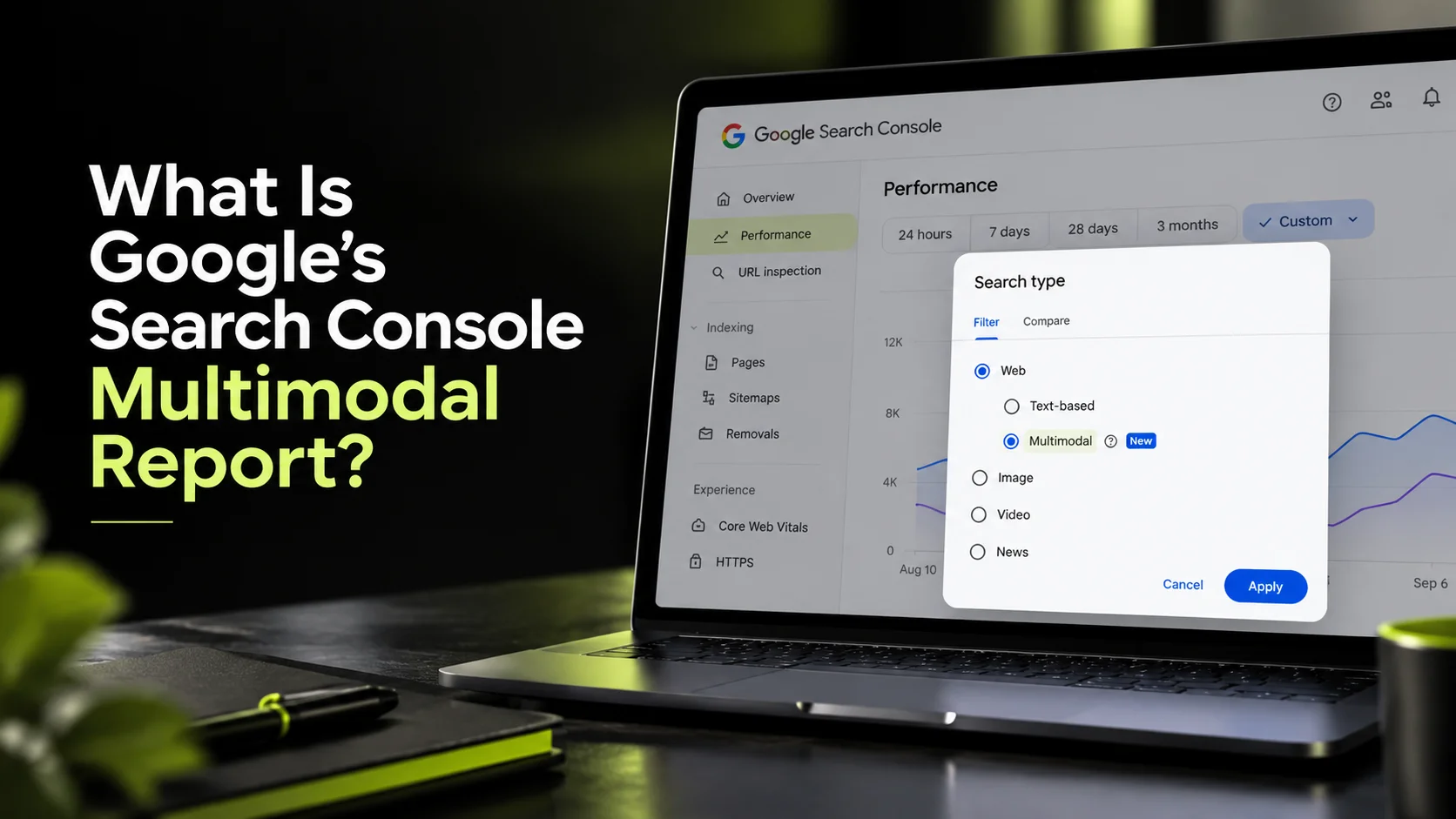
On September 24, 2026, Google gave every site owner a new way to see how people find them through images. The Google Search Console multimodal report adds a Web multimodal search type to your performance data, separating visual and camera-led searches from ordinary typed queries for the first time. If your customers point a camera at a product, circle something on a screen, or upload a screenshot to search, that behaviour now has a line in your reporting. This guide explains exactly what the update tracks, why it matters commercially, and how to act on it.
What the Google Search Console multimodal report actually tracks
The multimodal report tracks web search results triggered by a query that uses an image, photo, or screenshot, as described in Google's Search Console Help documentation from September 2026. Text-only queries stay in the Web text-based category. In practice, Google has split one bucket of web traffic into two, so you can finally tell image-led discovery apart from keyword-led discovery.
“Search Console reporting for web multimodal search” is now live across performance and Generative AI reports.
- Google Search Central Blog, September 2026
The new search type appears in two places: the Performance report for Search results, and the Generative AI features report Google introduced in June 2026. Four visual entry points feed the data, and knowing which is which changes how you read the numbers.
What each multimodal source captures
If you have never separated visual traffic from text traffic before, this is the moment to build it into your reporting. Our SEO agency team sets up multimodal tracking as part of every performance review, so you see the channel clearly from day one.
Why multimodal search matters now: the numbers behind visual discovery
Google Lens handles more than 20 billion visual searches every month, according to Google's October 2024 Lens update, and roughly 20 percent of those carry shopping intent. Visual search is no longer a fringe behaviour. It is one of the fastest growing ways people begin a search, especially among younger buyers.
Visual search is the fastest growing query type, and 18 to 24 year olds engage with it most.
- Brendon Kraham, VP of Search and Commerce, Google (2025)
The trajectory is what makes this update strategic rather than cosmetic. Lens has grown from a niche feature into a primary discovery surface in a few short years, and the underlying visual search market is expanding with it.
The growth of visual search on Google Lens
For any brand selling visually distinctive products, food, fashion, interiors, vehicles, or design, this is a channel with direct commercial implications. The multimodal report is the first native way to measure your share of it.
How to find and read the new multimodal filter in Search Console
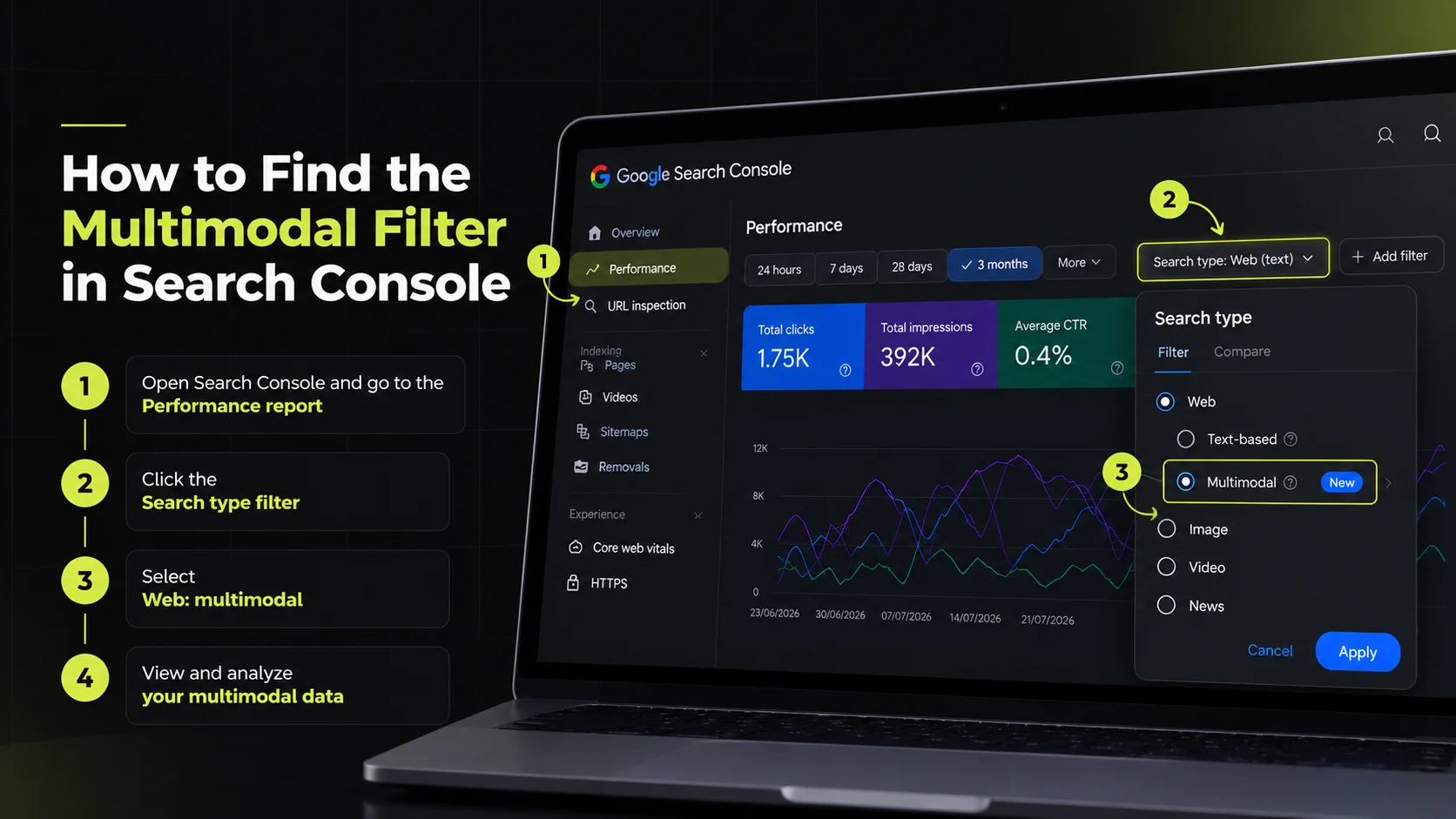
The filter rolled out globally from September 24, 2026, so most properties now have access. Finding it takes four steps, and reading it correctly takes one more.
- Open Search Console and go to the Performance report for Search results, or the Generative AI features report.
- Click the Search type filter at the top of the report, where you normally switch between Web, Image, Video, and News.
- Select Web: multimodal to isolate image-led and camera-led searches from Web: text-based results.
- Review clicks, impressions, and the Pages tab to see which URLs earn visual search visibility.
- Click Export to pull the data into a spreadsheet or your own dashboard for deeper analysis.
The Pages view is where the value lives. Because you cannot see the query, the page becomes your unit of analysis. Sort by impressions to find which pages Google already serves into visual results, then compare their click performance against your text-based baseline. For a broader view of what changed in Search Console this year, see our guide to what is new in Google Search Console in 2026.
What the missing query data means for your SEO reporting
The single most important limitation is that multimodal searches return no query data. Because the search starts with an image rather than typed words, the queries dimension is not available when you select this search type, a point confirmed by Search Engine Land's coverage of the launch in September 2026.
Because multimodal searches mostly use images rather than text, specific text query data is not available.
- Search Engine Land, September 2026
This changes your workflow in three ways. First, the page replaces the keyword as your primary lens, so page-level clarity matters more than ever. Second, image quality and on-page context become the levers you can actually pull, since Google is matching what it sees in an image to what your page is about. Third, structured data becomes the tie-breaker, telling Google exactly what a product or entity is when the visual signal alone is ambiguous. This is the same discipline that powers Answer Engine Optimisation and Generative Engine Optimisation, where clean entities and structured signals decide whether you get surfaced.
Multimodal search, text search, and generative AI: how the three reports differ
Search Console now separates three distinct discovery surfaces. Reading them side by side prevents the common mistake of judging visual and AI traffic by text-search rules.
Comparing the three Search Console search surfaces
Treat each column as a separate scoreboard. A page can be weak on typed keywords yet strong in visual search because its imagery is clean and its structured data is precise. The multimodal report is how you finally see that difference.
Seven ways to optimise your content for multimodal and visual search
Google has not published a Lens ranking formula, and it does not guarantee that any single change produces visibility. What it rewards is coherence: the image, the page around it, and the structured data should all describe the same thing. These seven actions build that coherence.
Visual search signals mapped to action and outcome
Make the page, not just the image, do the work
Because there is no query data, the page carries the meaning. Every image should sit inside copy that confirms what it shows, with a clear heading, a specific description, and matching structured data. When those signals conflict, the context Google shows searchers can drift from what you intended. A strong website development foundation makes this consistency the default rather than a manual fix.
Prioritise your visually distinctive and high-intent pages first
Products that are hard to name, visually unique, or encountered away from a keyboard benefit most from visual search. Use the multimodal Pages report to find which of these Google already serves, then tighten their imagery and schema before expanding to the rest of the catalogue.
How to turn multimodal Search Console data into a commercial advantage
The commercial value is not the filter itself. It is the context it gives you about how buyers discover a page. With roughly 20 percent of Lens searches carrying shopping intent, visual discovery sits close to the point of purchase, so small gains compound.
- Find revenue pages that already earn visual impressions but few clicks, then improve their imagery and structured data.
- Compare multimodal and text performance on the same page to spot demand you were not measuring before.
- Export the data on a schedule and track visual search as its own line in your growth reporting.
- Feed visual search insight into product photography and packaging briefs, so new assets are built to be recognised.
Turn visual search into a channel you can measure.
Google is now reporting how people find you through images, but the data is only useful if someone acts on it. UnFoldMart audits your multimodal performance, fixes your images, alt text, and structured data, and builds SEO, AEO, and GEO reporting you can run on. We work with startups and global brands across Germany, the Netherlands, the USA, India, and Singapore. Book a 30-minute SEO strategy call.


FAQs
Got Questions? We’ve Got Answers – Clear, Simple, and Straight to the Point
The filter began rolling out globally on September 24, 2026, so most properties now have it. If you do not see Web: multimodal in your Search type filter yet, it is still reaching your account, and access typically follows within the rollout window.
Yes. Around 20 percent of Google Lens searches carry shopping intent, so product, fashion, food, interiors, and design pages see the clearest impact. Visually distinctive products that are hard to name in text benefit most from strong visual search optimisation.
Make your images, page copy, and structured data all describe the same thing. Use high-resolution images, descriptive alt text, Product and Image schema, and meaningful file names. Coherence between the visual and the page is what helps Google match your content to a visual query.
Because the search starts with an image instead of typed words, there is no text query to report. Google therefore removes the queries dimension for this search type. You analyse performance through pages, clicks, and impressions, and export the data for deeper work.
Multimodal covers searches from Google Lens, Circle to Search on Android, image uploads to Google Search, and the Chrome right-click Search this image feature. Any web search where an image forms part of the query is tracked as Web multimodal rather than Web text-based.
It is a Web multimodal search type added to Search Console on September 24, 2026. It reports web searches that begin with an image, photo, or screenshot, separating visual and camera-led discovery from ordinary typed queries in both the Performance and Generative AI reports.

Want to Turn Your Brand Into a Scalable Growth Engine?
We help modern businesses unify branding, websites, SEO, and paid media into one performance-driven system designed to scale.