Branding Agency Pricing in Europe 2026: Complete EUR Cost Guide for Brands and Founders
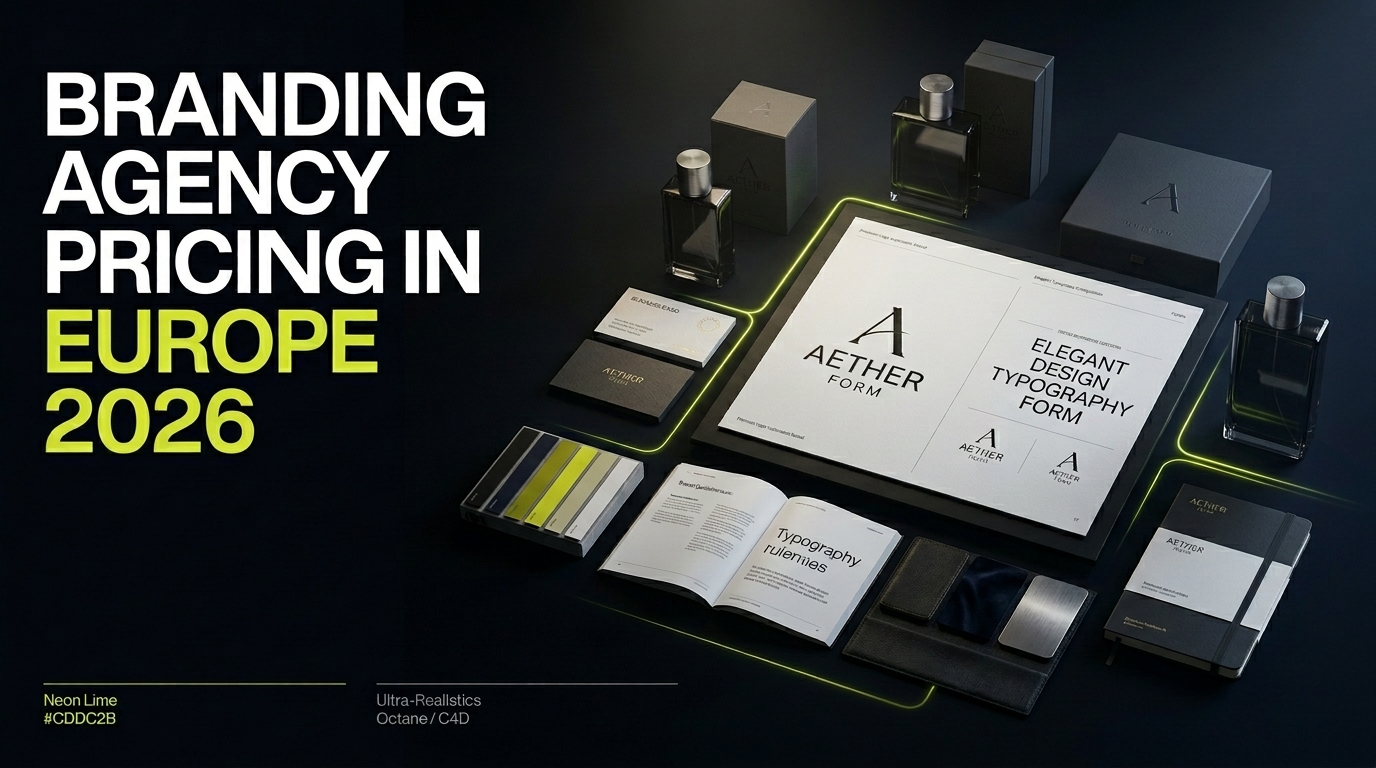
Branding agency pricing in Europe in 2026 ranges from 1,500 EUR for a basic logo to 500,000 EUR plus for a complete brand programme covering strategy, identity, applications, and launch.
The range is wide because branding covers fundamentally different scopes. A logo refresh on an existing brand is entirely different work from a full strategy plus identity programme that includes audience research, positioning, naming, identity system, applications across digital and print, guidelines, and launch support.
Most mid-market brands spend 18,000 to 90,000 EUR for a defined brand identity programme, or 4,500 to 14,000 EUR per month for ongoing brand stewardship.
Three factors drive most of the price variance: scope (logo only vs visual identity vs strategy plus identity vs complete system), agency tier, and market footprint.
Top-tier global firms charge 60,000 to 500,000 EUR plus for brand identity programmes. Mid-market specialised agencies charge 18,000 to 150,000 EUR for comparable scope. Boutique studios charge 8,000 to 60,000 EUR with narrow-scope creative direction. Freelancers serve sub-15,000 EUR briefs.
UnFoldMart delivers branding across six tiers: audit, brand identity package, full brand identity, strategy plus identity, complete brand system, and brand retainer — from 2,500 EUR for an audit to 150,000 EUR for a complete brand system.
This guide covers what branding actually includes, project-type pricing, engagement models, cost drivers, common pricing mistakes, regional differences across Europe, and where UnFoldMart fits.
What branding actually includes
Brands often misjudge branding cost because they conflate logo design with the broader branding discipline. Logo design (mark creation in isolation) costs substantially less than complete brand programmes that include strategy, identity system, brand guidelines, and applications.
Brand strategy and positioning. Audience research, competitive analysis, positioning territory development, brand archetype work, value proposition definition. Typical scope: 5,000 to 35,000 EUR depending on research depth.
Brand naming. Linguistic exploration, name generation, trademark screening, domain availability, cultural and linguistic check across markets. Typical scope: 5,000 to 25,000 EUR for a single name; 12,000 to 60,000 EUR for naming systems with sub-brands or product names.
Brand architecture. Parent brand and sub-brand hierarchy, masterbrand vs house-of-brands decisions, naming conventions for sub-brands and products. Typical scope: 12,000 to 60,000 EUR for established brand portfolios.
Logo and identity system. Primary mark, mark variations, lockups, typography pairing, colour system, identity flexibility across formats. Typical scope: 4,000 to 35,000 EUR depending on system complexity.
Visual system. Typography hierarchy, colour palette extensions, illustration style, photography direction, grid and layout systems, iconography, motion principles. Typical scope: 6,000 to 35,000 EUR.
Brand voice and verbal identity. Tone of voice principles, vocabulary guidelines, tagline and key messaging, verbal identity in different contexts. Typical scope: 4,000 to 25,000 EUR.
Brand guidelines and documentation. Documentation that allows internal teams or future agencies to maintain consistency. Typical scope: 4,000 to 18,000 EUR.
Applications and rollout. Digital touchpoints (website, social, email), print collateral (business cards, stationery, brochures), environmental (signage, retail, exhibition), packaging integration where relevant. Typical scope: 8,000 to 60,000 EUR depending on touchpoint count.
Brand launch support. Internal launch communications, external launch campaign, communications strategy, employee activation. Typical scope: 8,000 to 50,000 EUR.
A complete strategy plus identity plus applications programme for a mid-complexity brand typically runs 45,000 to 180,000 EUR.
Pricing by branding project type
The following table shows typical European market ranges for branding projects in 2026.
| Project type | Typical EUR range | Top-tier EUR range |
|---|---|---|
| Logo only (mark and basic application) | 1,500 to 8,000 | 8,000 to 30,000 |
| Visual identity (logo plus basic system) | 5,000 to 25,000 | 25,000 to 80,000 |
| Full brand identity (logo, system, guidelines, applications) | 15,000 to 60,000 | 60,000 to 200,000 |
| Brand strategy plus identity (research, positioning, identity) | 25,000 to 90,000 | 90,000 to 300,000 |
| Complete brand system (strategy, identity, guidelines, applications, launch) | 35,000 to 150,000 | 150,000 to 500,000 |
| Major rebrand (existing brand, complete refresh) | 40,000 to 180,000 | 180,000 to 700,000 |
| Brand audit (existing brand assessment, strategic recommendations) | 2,500 to 12,000 | 10,000 to 35,000 |
| Brand naming (linguistic exploration, generation, trademark screening) | 5,000 to 25,000 | 25,000 to 90,000 |
| Brand architecture (parent, sub-brand hierarchy) | 12,000 to 60,000 | 60,000 to 250,000 |
| Multi-market brand localisation | Add 30 to 60 percent on base | Add 40 to 70 percent on base |
The top-tier column reflects pricing from globally recognised branding firms such as Pentagram, Wolff Olins, Landor, DesignStudio, Saffron, Bond, Moving Brands, and similar. Most mid-market brands work in the typical range; the top-tier range is relevant primarily for established brands with substantial budgets and brand-defining programmes where the agency’s reputation contributes directly to brand positioning.
Pricing by engagement model
Five engagement models are common in 2026, each with different cost structure and risk profile.
Project-based engagement for defined-scope brand work with clear deliverables and timeline. Agency scopes the project, agrees on deliverables and timeline, prices as a fixed package or capped time-and-materials. Typical range: 8,000 to 90,000 EUR depending on scope. Risk: scope changes mid-project produce change orders, and brand strategy often expands beyond the original brief.
Strategy-led engagement where strategy phase happens first as a defined project, with identity work scoped and priced after strategy completion. Common for brands where positioning is not yet clear. Typical range: 15,000 to 35,000 EUR for strategy phase, then 25,000 to 120,000 EUR for identity work. Reduces risk of identity work that does not connect to clear strategy.
Foundation plus retainer engagement combines initial brand build with ongoing brand stewardship. Foundation work establishes the brand; retainer ensures ongoing application consistency, system extensions, and brand evolution. Typical range: 35,000 to 150,000 EUR foundation plus 4,500 to 14,000 EUR per month retainer. Best for brands committing to long-term brand evolution.
Brand-plus-other-discipline combined engagement integrates branding with packaging design, digital design, or campaign work into a single programme. Reduces friction between separate agencies and produces more coherent brand expression across touchpoints. Typical range: 25,000 to 200,000 EUR for combined scope. Common for D2C and consumer brands launching with packaging and digital simultaneously.
Embedded brand director model places a senior brand strategist or creative director inside the brand for an extended engagement (3 to 12 months). Senior strategic capacity without committing to a full agency engagement. Typical range: 8,000 to 22,000 EUR per month. Best for funded startups and growth-stage brands needing senior brand thinking but not full agency resource.
For most mid-market brands, project-based or strategy-led engagement models produce better outcomes than ad-hoc work because branding compounds when scope and strategy are well-defined upfront.
What drives branding cost up or down
Eight factors explain most of the price variance for similar-sounding branding projects.
Scope of brand strategy work. Brand strategy can range from a half-day workshop to a multi-month research programme with audience interviews, competitive landscape analysis, positioning territories, and stakeholder alignment. Strategy depth often determines whether identity work has a coherent foundation. Typical strategy work adds 5,000 to 35,000 EUR.
Identity system complexity. A single mark with two lockups is fundamentally simpler than a multi-mark system spanning parent brand, sub-brands, product brands, and partner co-brands. System complexity scales identity cost roughly geometrically.
Number of touchpoints and applications. Digital-only brand application is the cheapest baseline. Adding print increases cost. Adding environmental (signage, retail, exhibition) increases more. Adding packaging integration, vehicle livery, or apparel adds additional layers. Each additional touchpoint category adds 5,000 to 25,000 EUR.
Multi-market localisation. Each additional market typically adds 20 to 35 percent on top of base design cost for translation, regulatory compliance, regional design adaptation, and country-specific naming or messaging. Three-market launches across DACH (DE, AT, CH) typically add 40 to 60 percent on top of single-market base.
Naming work. Whether brand naming is in scope dramatically affects pricing. Naming includes linguistic exploration, generation of candidate names (typically 200 plus before short list), trademark screening, domain availability, and cultural checks across markets. Naming as a discrete service adds 5,000 to 60,000 EUR.
Photography and illustration commissions. Custom photography for brand launches, illustration systems, custom typography, and iconography commissions can add 8,000 to 80,000 EUR depending on commission depth.
Brand launch support. Internal launch communications, external launch campaign, employee activation, and stakeholder communications add 8,000 to 50,000 EUR. Some brands handle launch in-house; others want agency support throughout.
Agency tier. Top-tier global firms charge 280 to 600 EUR per hour. Mid-market specialised agencies charge 100 to 240 EUR per hour. Boutique studios charge 80 to 180 EUR per hour. Freelancers charge 40 to 120 EUR per hour for narrow briefs but rarely scale to systematic brand programmes.
Common branding pricing mistakes brands make
Six mistakes account for most of the budget overruns and project failures in branding programmes.
Buying a logo when you needed a brand system. The most common mistake. Brands brief for a logo, receive a logo, then realise mid-launch they need typography decisions, colour palette extensions, photography direction, illustration style, brand guidelines, and applications. By that point the original budget is exhausted and additional work is scoped reactively.
The fix: scope brand identity (logo plus system) at minimum, and ideally full brand identity (logo, system, guidelines, applications) from the start.
Skipping brand strategy and going straight to visual design. Visual design without strategic foundation produces brands that look polished but do not connect to clear positioning or audience. The fix: invest in strategy (even a compressed strategy phase of 5,000 to 15,000 EUR) before commissioning identity work.
Underestimating application and rollout cost. Brands often budget for the brand build but not for application across digital, print, and environmental touchpoints. Application work often costs as much as or more than the original brand build. The fix: scope applications from the start as a discrete budget line.
Choosing the cheapest quote without scope normalisation. Three quotes for brand identity can range from 8,000 to 90,000 EUR because the agencies are scoping different work. The fix: provide all bidders the same detailed brief covering strategy depth, identity system complexity, applications scope, naming work, photography commissions, and launch support.
Not budgeting for ongoing brand stewardship after launch. Brand consistency requires ongoing work: new application contexts, system extensions, guideline updates as the brand evolves. Brands that treat brand work as a one-time project see brand consistency drift within 12 to 18 months. The fix: budget for retainer or planned check-ins after launch.
Treating brand guidelines as the deliverable instead of brand activation. Brand guidelines are necessary but not sufficient. Brand activation determines whether guidelines actually shape work. The fix: budget activation as part of the brand programme, not as a separate later workstream.
UnFoldMart branding service tiers
UnFoldMart delivers branding services across six engagement tiers tailored to mid-market and growth-stage brand needs in European markets.
| Service tier | Scope | EUR pricing | Timeline |
|---|---|---|---|
| Brand Audit | Existing brand assessment, strategic gap analysis, positioning recommendations, opportunity roadmap | 2,500 to 9,000 | One-time, 2 to 3 weeks |
| Brand Identity Package | Logo, basic identity system, light guidelines, core applications | 8,000 to 30,000 | 6 to 10 weeks |
| Full Brand Identity | Logo, complete identity system, brand guidelines, digital and print applications | 18,000 to 65,000 | 10 to 16 weeks |
| Strategy plus Identity | Research, positioning, identity system, guidelines, core applications, launch readiness | 28,000 to 90,000 | 14 to 20 weeks |
| Complete Brand System | Full strategy, identity, applications across digital and print, launch support, post-launch retainer setup | 40,000 to 150,000 | 18 to 32 weeks foundation plus retainer |
| Brand Retainer | Ongoing brand stewardship, system extensions, application work, NPD support | 4,500 to 14,000 | Per month, 3 month minimum |
UnFoldMart specialises in branding for D2C, B2B SaaS, consumer brands, and growth-stage technology brands across European markets, with vertical strengths in brand-plus-packaging integrated programmes, brand-plus-digital integrated programmes, and multi-market localisation across DACH and Benelux.
Regional pricing context across Europe
Branding pricing varies meaningfully across European regions even for comparable scope. The following regional patterns are typical for 2026.
DACH (Germany, Austria, Switzerland). The reference baseline for European mid-market pricing. Mid-market specialised agencies in Berlin, Munich, Hamburg, and Vienna typically price comparable work in the ranges shown in the tables above. Switzerland (Zurich, Geneva) trends 10 to 20 percent higher than Germany for comparable scope, reflecting higher cost base.
United Kingdom. Comparable work typically prices 15 to 30 percent higher in EUR equivalent than DACH baseline, reflecting GBP cost base and higher London market rates. Top-tier London firms (Pentagram London, Wolff Olins, Landor, Moving Brands) anchor the upper range of European branding pricing globally.
France (Paris). Comparable to DACH baseline for mid-market work. Top-tier French firms (Carre Noir, Dragon Rouge, Saguez and Partners) price similarly to DACH equivalents. Paris boutique studios trend slightly higher than equivalent DACH boutiques.
Benelux (Netherlands, Belgium). Comparable to DACH baseline. Amsterdam and Rotterdam mid-market agencies price similarly to Berlin or Munich equivalents. Brussels trends slightly higher reflecting EU institutional client base.
Nordics (Sweden, Denmark, Finland, Norway). Comparable work typically prices 10 to 20 percent higher in EUR equivalent than DACH baseline. Stockholm Design Lab, Bond, Kurppa Hosk anchor the upper range with distinctive Nordic minimalism positioning.
Southern Europe (Spain, Italy, Portugal). Comparable work typically prices 10 to 20 percent lower in EUR equivalent than DACH baseline. Madrid, Barcelona, Milan, and Lisbon studios serve regional and increasingly international clients at lower price points than Northern European equivalents.
For brands considering multi-region work or comparing quotes across regions, normalise on scope first and adjust for regional cost base second.
Where UnFoldMart fits
UnFoldMart sits in the international mid-market specialised branding tier, serving DACH, Benelux, India, and global D2C, B2B SaaS, and consumer brands through unfoldmart.com, unfoldmart.nl, and unfoldmart.ch domains.
Service line focus: D2C consumer brands, B2B SaaS, growth-stage technology brands, and consumer goods. Vertical strengths in brand-plus-packaging integrated programmes (where brand and packaging are commissioned together for D2C launches), brand-plus-digital integrated programmes (where brand and Webflow website launch together), and multi-market localisation across DACH and Benelux.
Differentiators for European market: bilingual EN and DE delivery for German market work, integrated capability across branding, packaging, UI/UX, and Webflow disciplines, multi-market footprint matching DACH plus Benelux, and EUR pricing transparency from audit through complete brand system engagement.
UnFoldMart is appropriate for mid-market brands needing senior brand talent without top-tier overhead, multi-market launches across European markets, integrated brand and packaging or brand and digital programmes, and EUR-denominated work with transparent scoping.
Pre-engagement qualification checklist
Before investing time in a full branding RFP cycle, qualify each shortlisted agency against the 10-question checklist below. Agencies passing 8 plus questions are worth a full RFP. Agencies passing 6 to 7 may be worth a clarifying conversation. Agencies passing fewer than 6 should be cut.
- Strategy capability: Do you have brand strategy capability in-house, or do you partner with strategists?
- Vertical experience: Do you have at least 3 case studies in our category (D2C, B2B SaaS, consumer, etc.) with named brands and outcomes?
- Scope clarity: Does the proposal specify strategy depth, identity system complexity, applications scope, naming work, and launch support explicitly?
- Identity system depth: What does your identity system typically include beyond the primary mark (typography, colour, illustration, photography, motion)?
- Applications and rollout: Is application work across digital, print, and environmental touchpoints in scope, and what is the budget for it?
- Multi-market capability: Can you handle multi-market localisation across DACH, Benelux, and other European markets?
- Naming work: If naming is needed, do you have naming capability in-house, including linguistic checks and trademark screening?
- Brand guidelines depth: What does your brand guidelines deliverable include, and how do you support brand activation post-launch?
- Team continuity: Will you name the specific strategists, designers, and creative directors who will work on our project?
- References: Can you provide 2 to 3 client references for similar branding programmes in our category and market?
Branding pricing in Europe spans more than two orders of magnitude — 1,500 to 500,000 EUR plus — because branding covers fundamentally different work at different scopes.
The strongest brands match engagement model to programme maturity: project-based for defined-scope work, strategy-led for brands needing positioning clarity, foundation plus retainer for long-term brand evolution, brand-plus-other-discipline combined for D2C and consumer launches, and embedded brand director for funded startups needing senior strategic capacity.
For mid-market brands, mid-market specialised agencies in the 18,000 to 90,000 EUR identity programme range or 4,500 to 14,000 EUR per month retainer typically deliver the best price-to-quality ratio.
Top-tier firms make sense for brand-defining programmes where the agency’s reputation contributes directly to brand positioning. Boutique studios serve narrow-scope creative direction. Freelancers serve narrow briefs but rarely scale to systematic brand programmes.
Regional pricing differences across Europe (DACH baseline, UK 15 to 30 percent higher, Nordics 10 to 20 percent higher, Southern Europe 10 to 20 percent lower) matter when comparing quotes, but scope normalisation matters more than regional adjustment when evaluating proposals.
A 30-minute scoping call with UnFoldMart establishes your scope, strategy needs, market footprint, and engagement model preference — with an honest assessment of what the specific EUR range looks like for your work.
.jpeg)
FAQs
Got Questions? We’ve Got Answers – Clear, Simple, and Straight to the Point
Integrated branding and digital programmes are becoming increasingly popular because modern brands need consistency across websites, social media, packaging, performance marketing, ecommerce, UI/UX, and customer communication systems. When branding, digital design, and packaging are handled separately by disconnected teams, the result is often fragmented customer experiences and inconsistent positioning. In 2026, many growth-stage companies prefer agencies that can combine branding with Webflow development, UI/UX design, packaging systems, and launch strategy within one coordinated workflow. This creates stronger alignment between the brand identity, digital experience, conversion strategy, and long-term scalability of the business. Integrated programmes also improve operational efficiency because typography systems, messaging frameworks, design systems, and visual guidelines are built to work cohesively across all touchpoints from the start. For D2C brands, SaaS companies, and multi-market businesses, this consistency has become increasingly important for SEO, AI-search visibility, user trust, and conversion performance. As AI-generated content and templated design become more widespread, businesses are investing more heavily in cohesive brand ecosystems that create stronger recognition, differentiation, and long-term brand equity across increasingly crowded digital markets
Several factors can significantly increase branding project costs, but the biggest drivers are strategy depth, identity system complexity, multi-market localization, and the number of brand applications required. A simple visual refresh for a local business requires far less work than a complete international brand system spanning multiple markets, languages, product lines, and customer touchpoints. Branding costs also increase when projects involve naming, extensive audience research, multilingual messaging systems, custom photography, illustration systems, motion design, packaging integration, or launch campaigns. Multi-market brands operating across Germany, Netherlands, Austria, Switzerland, or other European regions often require localized messaging, cultural adaptation, and region-specific design adjustments that substantially increase the strategic and operational scope. Another major cost factor is the level of brand rollout support required after the identity system is created. Applying the brand consistently across websites, sales collateral, packaging, presentations, social media, retail environments, and advertising often requires as much work as building the identity system itself. Businesses evaluating branding proposals should therefore compare strategic depth, deliverables, rollout scope, and long-term usability instead of focusing only on the logo or visual outputs.
Brand strategy is important because visual identity without strategic positioning often creates brands that look polished but fail to communicate a clear reason for customers to trust, remember, or choose them. A logo and visual system can only become effective when they are built on a strong understanding of audience behavior, market positioning, competitive differentiation, and long-term business direction. In 2026, successful branding projects usually begin with research, positioning workshops, audience analysis, and messaging development before any visual exploration starts. This strategic phase helps define what the brand should stand for, how it should communicate, and how it should differentiate itself within crowded markets. Without strategic clarity, many brands end up redesigning their identity repeatedly because the visuals are disconnected from the underlying business narrative. Strong strategy-led branding reduces inconsistency, improves messaging alignment across teams, and creates more cohesive customer experiences across websites, advertising, packaging, and social platforms. As competition increases across digital channels and AI-generated content becomes more common, brands with clearly defined positioning and recognizable systems are becoming significantly more valuable than brands relying only on aesthetic trends
A complete branding project includes much more than designing a logo or selecting brand colors. Professional branding programmes typically begin with strategy and positioning work, where agencies define the brand’s audience, market positioning, competitive differentiation, messaging structure, and long-term identity direction before visual design begins. The branding process usually includes brand strategy, naming, verbal identity, logo and identity systems, typography frameworks, color systems, photography direction, illustration style, brand voice guidelines, digital applications, print assets, and rollout support. For growing brands, the project may also include brand architecture decisions that define how parent brands, sub-brands, and product lines relate to one another. Modern branding systems are designed to scale across websites, social media, packaging, advertising, presentations, ecommerce platforms, and physical environments. Because brands now operate across dozens of customer touchpoints simultaneously, strong branding projects focus on building flexible systems rather than isolated creative assets. Many businesses underestimate how much operational and strategic work is involved beyond visual aesthetics. In reality, the most effective branding programmes align positioning, communication, design consistency, and customer perception into one scalable business system.
Branding costs in Europe in 2026 range from approximately 1,500 EUR for a basic logo design project to more than 500,000 EUR for a complete enterprise-level brand transformation programme. Most mid-market businesses and growth-stage brands typically invest between 18,000 and 90,000 EUR for a professional brand identity programme that includes strategy, visual identity, brand systems, and rollout support. Ongoing brand retainers generally range from 4,500 to 14,000 EUR per month. The wide pricing range exists because branding now includes far more than logo creation. Modern branding projects often involve audience research, positioning strategy, naming, messaging systems, visual identity development, typography systems, verbal identity, digital and physical applications, launch strategy, and long-term brand stewardship. A startup requesting a simple logo and a multi-market company rebuilding its entire brand architecture are fundamentally different engagements requiring different levels of strategic depth and execution. In 2026, branding is increasingly viewed as a growth infrastructure investment rather than a purely creative exercise. Strong brand systems influence customer trust, pricing power, conversion performance, recruitment, investor perception, and long-term market differentiation across both digital and physical channels.

Want to Turn Your Brand Into a Scalable Growth Engine?
We help modern businesses unify branding, websites, SEO, and paid media into one performance-driven system designed to scale.