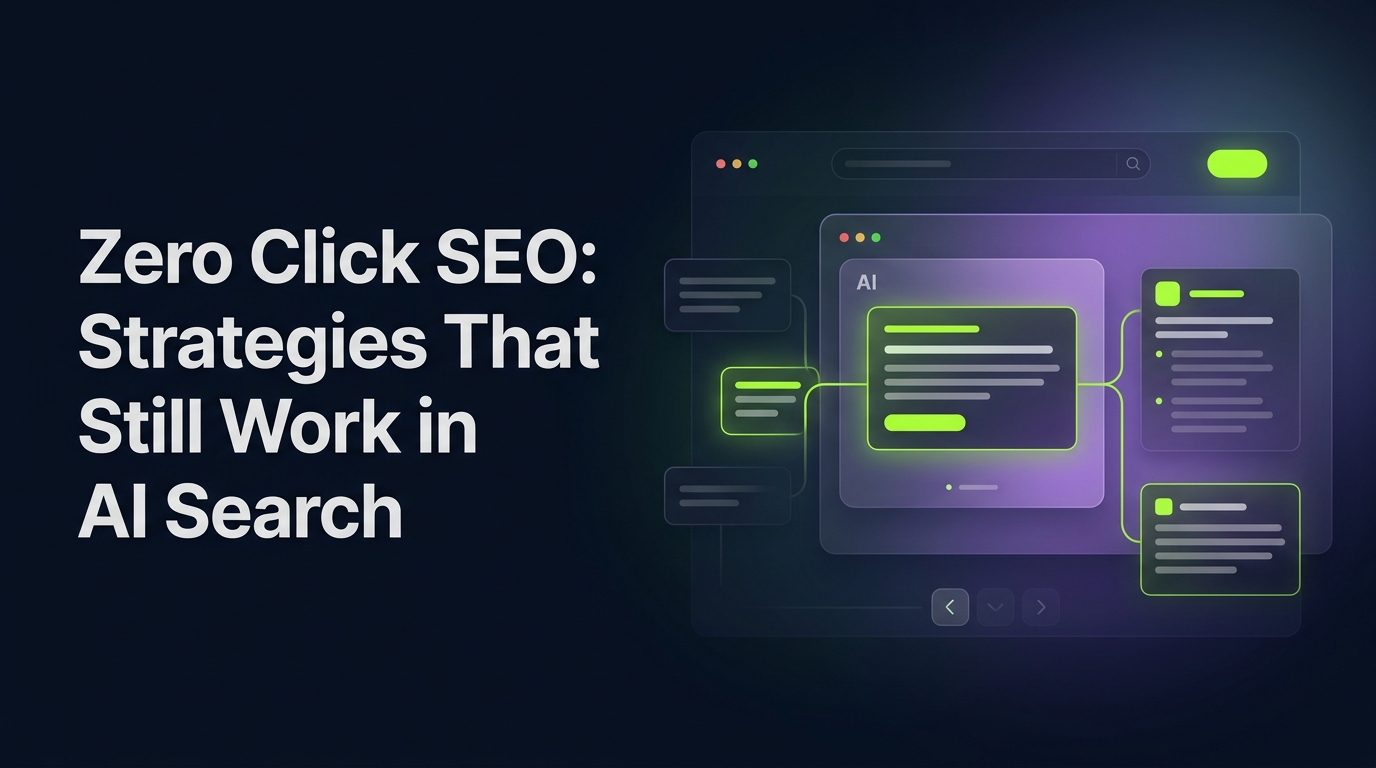
Zero Click SEO: Strategies That Still Work in AI Search
Learn how to win visibility without clicks. Discover proven zero-click SEO strategies for AI search, featured snippets, and modern SERP dominance
Learn how to win visibility without clicks. Discover proven zero-click SEO strategies for AI search, featured snippets, and modern SERP dominance
Real projects across branding, packaging, websites and growth.
Straight answers on this topic from the UnFoldMart team.




From branding and packaging to Webflow websites, SEO, AEO and GEO, UnFoldMart brings strategy, design and growth under one team for 250+ brands across 10 markets. Tell us where you want to grow and we'll show you the fastest way there.
Search traffic used to be the ultimate measure of SEO success.
Rank higher → get more clicks → grow business.
That formula worked for two decades.
In 2026, it no longer tells the full story.
Today, a growing number of searches end without a click. Users get answers directly on the search page through AI summaries, snippets, knowledge panels, and interactive results.
For businesses that depend on organic traffic, this shift feels alarming.
But zero-click search does not mean zero impact.
It simply means SEO has evolved from traffic acquisition to influence creation.
Modern search engines aim to solve problems instantly.
Users increasingly want:
AI-powered search accelerates this behavior. Instead of showing links, search platforms now synthesize information into complete answers.
As a result, many informational queries never lead to website visits.
However, users still notice which brands appear in those answers. Visibility builds familiarity, and familiarity drives decisions later.
SEO success is no longer defined only by who gets the click, but by who shapes the answer.
Zero-click search refers to queries where the user’s intent is satisfied directly on the results page, without visiting any external site.
Common zero-click formats include:
In these cases, search engines extract information from websites and present it in a structured, digestible format.
Your content may power the answer even if the user never clicks.
AI systems analyze multiple sources and generate unified responses. This reduces the need to browse multiple pages.
Small screens favor concise answers. Scrolling through long articles is less appealing on mobile devices.
Search results pages now contain maps, videos, product cards, FAQs, and summaries. Traditional organic listings occupy less space.
Voice assistants provide spoken answers. There is no interface to click through.
These factors reinforce each other. As users adapt to faster answers, search engines double down on instant delivery.
No. It means the role of SEO has expanded.
Clicks are only one stage in the decision process. Many purchasing journeys involve multiple touchpoints before a visit occurs.
Users often:
This phenomenon is known as assisted conversion.
Visibility builds trust even without immediate interaction.
These appear at the top of results and extract concise answers from a page.
AI-generated summaries synthesize multiple sources into a single response.
These highlight entity information such as company details, founders, and key facts.
Expandable questions allow users to explore related queries without leaving the page.
For location-based searches, maps and listings dominate attention.
Conversions, weather, definitions, and quick facts satisfy intent immediately.
Traditional SEO focused on rankings and clicks.
Modern SEO prioritizes presence across the entire results page.
Zero-click search does not eliminate opportunity. It redistributes it.
Winning in 2026 means:
Traffic is still valuable, but influence determines who ultimately earns business.
If your organic traffic is stagnating despite strong rankings, the problem may not be SEO performance. It may be a shift in search behavior.
At UnFoldMart, we help businesses adapt to AI-driven search with strategies focused on visibility, authority, and conversion impact rather than vanity traffic.
Book a Zero-Click SEO audit and discover where your brand is gaining influence or losing it.
Got Questions? We’ve Got Answers – Clear, Simple, and Straight to the Point
Six content types still convert reliably in the zero-click era. Comparison content ("X vs Y") where users click through to see full side-by-side detail. Pricing pages, since users almost always click when researching to buy — AI engines rarely quote specific prices confidently. Detailed product pages with schema and specifications that convert users arriving from an AI shortlist. Long-form guides that AI engines cite as authoritative reference but that users still click through for the full depth. Case studies with named clients, since AI engines can quote high-level results but users click through for the full narrative. And original research or proprietary data, which AI engines cite heavily and users click through to for the source. Content types that lose most in the zero-click shift: quick answers to definitional queries, generic how-to content, and thin category pages. UnFoldMart's 2026 content strategies weight the durable formats above and reduce investment in the ones AI increasingly answers directly.
Traffic and clicks are still important but no longer sufficient. Add four measurements alongside them. Citation share — how often the brand appears inside AI Overviews, ChatGPT, and Perplexity for target queries, tracked through tools like Profound, Otterly, or Peec. Brand-search lift — volume of branded queries in Google Search Console before and after AI-visibility work, since being cited in AI answers often produces delayed branded search rather than immediate clicks. Assisted conversions from AI-referred visitors — users who arrive on the site after seeing the brand in an AI answer typically convert at higher rates than classical organic visits. And Knowledge Panel and Google Business Profile impressions — both are zero-click surfaces where users get information without visiting the site but still take commercial action (calls, direction requests, save). Together these four give a fuller picture than clicks alone.
Five strategies still deliver real business value even when clicks fall. Earning brand citations inside AI answers — users see the brand named, and downstream branded search increases even without a click. Optimising for high-intent bottom-of-funnel queries where users click through to convert regardless of AI Overviews (pricing, comparison, buy-now queries). Investing in category-defining content that AI engines cite as authoritative reference, building long-term topical authority. Building direct-audience channels (email, community, podcast) that don't depend on search click volume. And measuring citation share and brand-lift alongside classical traffic — the same visibility that produces zero-click reads also produces measurable commercial impact when tracked properly. Businesses treating zero-click as pure loss usually miss the compensating gains happening in adjacent metrics.
Not for every business, but the picture is more nuanced than raw numbers suggest. Sites cited inside AI Overviews or featured snippets often see modest CTR gains on those specific queries — users click through to verify or dig deeper into a source they've just seen recommended. Sites not cited but ranking on the same queries can lose 20–40% of their clicks as users read the AI summary and never scroll. The net traffic impact depends on whether the site consistently earns the citation slot. And for many businesses, zero-click also increases brand impressions on high-intent queries — users see the brand named in the AI answer, then arrive later via direct or branded search. Measuring only classical organic clicks now understates the full commercial impact of search visibility.
Zero-click search happens when a user finds their answer directly on the search results page or inside an AI-generated answer, without clicking through to any website. In 2026 the majority of informational queries end this way, driven by Google AI Overviews, featured snippets, People Also Ask, Knowledge Panels, and answers directly generated by ChatGPT and Perplexity. Users still get the information; the source often gets the visibility but not the click. This has shifted the SEO job: sites now need to earn citation and brand exposure inside the zero-click surface rather than only chasing the click, and measurement has to expand beyond traffic to capture the impact of being seen without being visited.