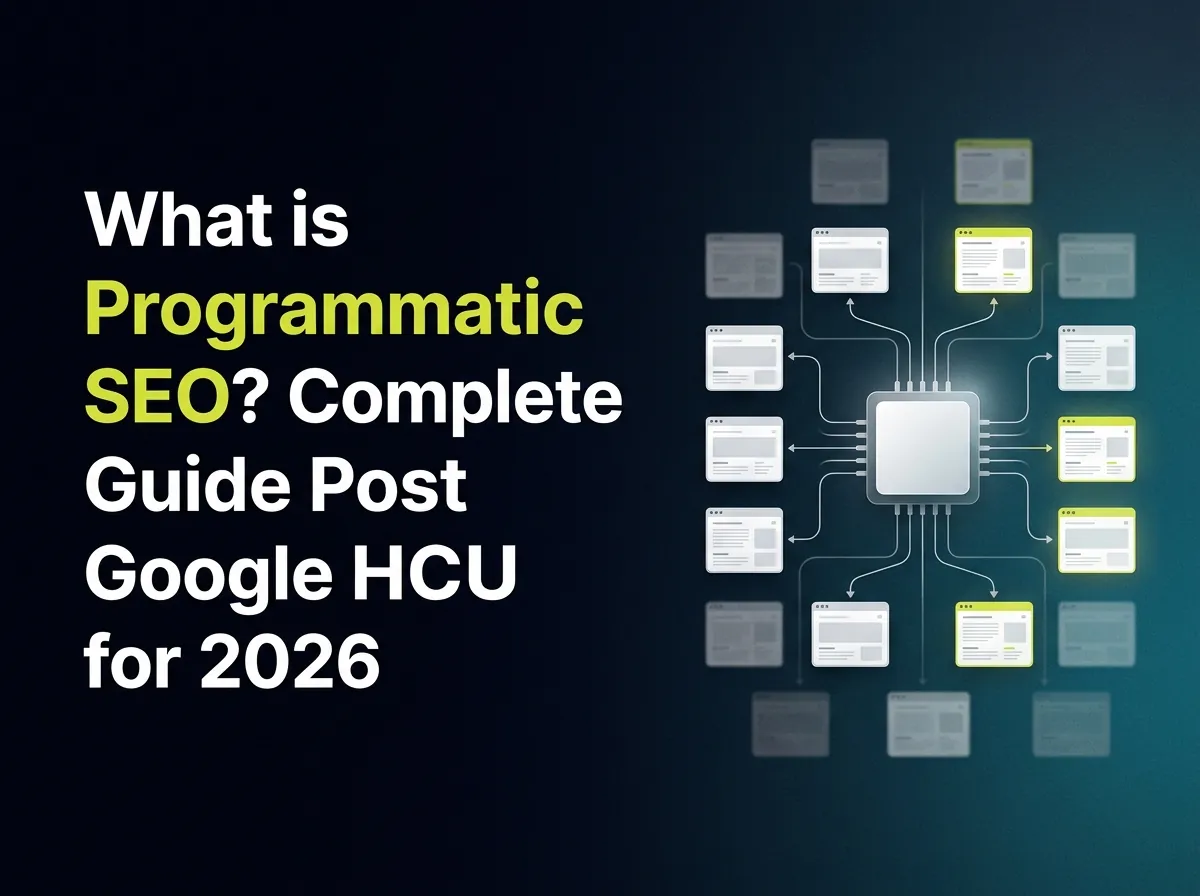
What is Programmatic SEO? Complete Guide Post Google HCU for 2026
Learn how to do programmatic SEO that survives Google’s Helpful Content Update. Framework, examples, and what actually works in 2026.

Learn how to do programmatic SEO that survives Google’s Helpful Content Update. Framework, examples, and what actually works in 2026.
Real projects across branding, packaging, websites and growth.
Straight answers on this topic from the UnFoldMart team.
From branding and packaging to Webflow websites, SEO, AEO and GEO, UnFoldMart brings strategy, design and growth under one team for 250+ brands across 10 markets. Tell us where you want to grow and we'll show you the fastest way there.
Programmatic SEO is the practice of creating large numbers of pages from structured data templates, where each page targets a specific long-tail query (city plus service, product A vs product B, ingredient X recipes, and so on). Done well, programmatic SEO scales organic traffic 10x to 100x faster than manual content production. Done badly, programmatic SEO gets a site filtered by Google's Helpful Content Update (HCU) and its successors. The HCU rolling waves from August 2022 onward, including the March 2024 core update and the follow-up adjustments through 2024 and 2025, have permanently changed what makes programmatic SEO survivable.
The 2026 framework prioritises genuine per-page differentiation, real user-job alignment, named editorial review, and entity authority over raw page volume. This guide explains what changed, what still works, and how to design programmatic SEO programs that survive HCU.
Programmatic SEO is content production driven by data plus a template. You design one page template, point it at a structured data source (a database, CSV, or API), and the template generates one URL per row of data. The classic examples are Zapier(one page per "Connect X with Y" integration, generating tens of thousands of pages from their app catalog), Yelp (one page per business listing in each city), Trip advisor (one page per destination, hotel, and restaurant),and Wise (one page per currency conversion pair). Each company built a data layer first, then designed a template that exposed that data as user-facing pages.
What programmatic SEO is not: programmatic SEO is not the same as AI-generated content.AI-generated content is text produced by large language models without an underlying differentiated data layer. The distinction matters because the two categories have very different defensibility against algorithmic updates. Programmatic SEO with genuine data and editorial review survives HCU.AI-generated content without data foundation almost universally does not.
Programmatic SEO is also not the same as content automation tooling. Tools that auto-generate first drafts of articles, auto-schedule posts, or auto-distribute social content are content operations tools. Programmatic SEO specifically means generating multiple pages from a single template plus data source, where the value to the user comes from the data exposed at scale, not from the prose generation.
Google rolled out the first Helpful Content Update in August 2022, with subsequent updates in December 2022, September 2023, March 2024 (rolled into the broader core update), and follow-up calibration updates through 2024 and 2025. The cumulative effect rewrote the rules for what kind of content Google would index and rank. The targets were predictable in retrospect: thin templated pages, AI-generated content farms, doorway-page networks, aggregator sites with no original value, and sites where most content was created for search engines rather than for users.
Pre-HCU, a programmatic strategy could ship 100,000 pages of "Best [keyword] in[city]" content with substantial keyword-fit but minimal genuine local content, and a meaningful percentage would rank. Post-HCU, the same strategy gets the entire site filtered. The algorithm now evaluates programmatic projects holistically: if a site has many similar templated pages with no genuine differentiation, the whole site gets a quality score reduction, not just the worst individual pages.
The most important shift is from page-level quality scoring to site-level quality scoring. Pre-HCU, a strong site could absorb some thin pages. Post-HCU, a site mostly composed of thin templated pages is treated as a low-quality site overall, regardless of whether some pages happen to be better than others.
| Dimension | Pre-HCU programmatic SEO (2018 to 2022) | Post-HCU programmatic SEO (2023 to 2026) |
|---|---|---|
| What got indexed and ranked | Thin templated pages with minor variable substitution often ranked well | Thin pages get filtered out before indexing or deranked within weeks |
| Acceptable thinness | 200 to 400 word pages with mostly identical templates ranked | Pages need genuine differentiated value per URL or they fail |
| Data source quality | Public scraped data was acceptable | Pages must offer something not available by direct lookup of the same data source |
| Page-level utility | Filling a search term in a template was enough | Pages must answer a question the user is genuinely asking |
| Entity and authority signals | Less weighted; thin sites could rank without entity authority | Heavily weighted; sites without entity signals are filtered as spam |
| Volume played | 10,000 to 1M page deployments were common winning strategies | 500 to 50,000 page deployments are more common; quality dominates volume |
| Time to results | 2 to 6 months | 4 to 12 months because trust and authority must be established first |
After two years of watching programmatic SEO projects either thrive or collapse under HCU, the pattern is clear. Surviving programmatic SEO projects share a small set of structural traits. UnFoldMart's framework groups these into 7 pillars that we use to evaluate any programmatic SEO project before launch and to audit existing projects that have lost traffic.
Every URL must contain something the user cannot get faster by typing the search term into Google. This sounds obvious but most failed programmatic projects fail this test. A page titled "SEO Services in Munich" that contains generic SEO copy plus a heading variable substitution does not pass. A page titled "SEO Agencies in Munich" that contains a verified list of 142 local SEO agencies, median pricing of EUR 3,500 per month based on actual market data, and named local team members at the top three agencies does pass. The difference is whether the data layer is genuine or cosmetic.
Every page template must answer a question someone is actually asking. The validation method is straightforward: pull the template's target queries from Search Console (or, if launching new, from Ahrefs or Semrush keyword research), look at search intent, and confirm that users querying these terms have a coherent job-to-be-done that your page satisfies. If the queries are mostly informational and your page is mostly transactional, you have a mismatch. If the queries are commercial and your page is decorative, same problem. User-job alignment is the most common failure point in programmatic SEO scope design.
Programmatic SEO scales the value of entity authority, but cannot create entity authority on it sown. Sites without Wikidata entries, Wikipedia presence (where not ability allows), named authors, consistent NAP, and Organization plus Person schema get penalised harder under HCU because the algorithm has no entity context to validate the templated content. The substrate must exist before scaling content. This is why we recommend launching programmatic SEO programs only after the entity foundation work covered in our GEO guide is in place.
Even templated pages need a thin editorial layer. The cheapest viable version: one freelance editor per cluster of similar pages, doing a 5-minute review of each page, adding 50 to 150 words of genuinely page-specific commentary, and sign-off as the named reviewer. The more expensive version: a senior subject matter expert per category. The pages that survive HCU are pages where a human added something that the data alone could not. The pages that fail HCU are pages where the template alone produced the page.
Internal linking on programmatic projects is where many sites accidentally tip into doorway-page territory. Templates that wire 50 internal links to similar sibling pages one very page produce a graph structure the algorithm recognises as machine-generated. The fix is to limit internal linking to genuine topical relationships (8 to 12 links per page maximum) and to vary the anchor text and link targets based on per-page logic, not template logic. If you map out the internal link graph and it looks like a uniform mesh, the algorithm sees it the same way.
Programmatic pages get extra UX scrutiny because the algorithm assumes thin templated pages historically had weak UX. Sites with green Core Web Vitals, real images (not place holder grey boxes), no aggressive ad density, and no popovers blocking content survive scrutiny better. Sites where programmatic pages are visibly slower than editorial pages get flagged. Treat performance and UX as a programmatic quality requirement, not as a separate workstream.
Programmatic content needs continuous freshness or it decays. Pages need genuine updated data (not just date Modified field updates with no underlying change), quarterly content audits removing pages that have not earned traffic, and a documented refresh cadence with named owners. The pruning policy is as important as the production policy. Sites that produce 50,000 programmatic pages and never review them lose traffic across the entire programmatic surface within 12 to 18months. Sites that produce 5,000 programmatic pages and audit them quarterly grow traffic over the same period.
Not every business has a programmatic SEO opportunity. The opportunity exists when three conditions are present: a structured data source the business owns or can curate, a user job at scale (many users with similar but parameterised questions), and an editorial capacity to layer human review on the data. When any one is missing, programmatic SEO is not the right move.
Real estate works because each property is genuinely unique data, the user job is finding that property, and editorial review can happen at the listing level. SaaS because each product comparison is genuinely unique data when done with real testing, the user job is shortlisting a tool, and the editorial layer is the named reviewer who tested both products. Local service finders work when localdata is verified and current, the user job is finding a provider in their area, and named local editors review each city.
Cookie-cutter location pages do not work because there is no genuine local data behind the template, the user job is not satisfied, and there is no editorial layer. Auto-generated FAQ pages do not work because the questions are guessed rather than sourced from real users. AI-generated definition farms do not work becausethe definitions add nothing beyond what the LLM already knows, with no namedsource or proprietary insight.
The decision matrix below maps common programmatic SEO patterns to viability post-HCU. Useit as a first-pass filter before scoping any programmatic project.
| Use case | Programmatic SEO works? | Reasoning |
|---|---|---|
| Real estate listings (city x property type x price band) | Yes, with caveats | Each page contains genuinely unique listings data; user job is finding that listing. |
| Product comparison pages (X vs Y) | Yes, when data is genuinely compared | Comparison creates value the user cannot replicate in 30 seconds; works post-HCU if depth is real. |
| Local service finder (city x service) | Yes, when local data is verified and current | Genuine local provider data with verified pricing offers utility no scraped page can match. |
| Recipe variation pages (ingredient swaps, dietary) | Conditional | Works when each variation is meaningfully different and tested. Fails when most pages are template substitution. |
| Cookie-cutter location pages with no local data | No (HCU killed these) | Pages saying "We provide X service in [City]" with no genuine local content are exactly what HCU targets. |
| Glossary or definition pages at scale | Conditional | Works when each definition has named source, citations, and depth. Fails when pages are 150 word AI-generated summaries. |
| SaaS template galleries (template x use case) | Yes, with real screenshots and data | Genuine tool data and interactive previews provide utility; template-only generators do not. |
| "Best X for Y" listicles at scale | Conditional | Works with original research and named criteria. Fails when pages are aggregator scrapes with no original judgment. |
HCU did not kill programmatic SEO. It killed specific patterns of programmatic SEO that were never adding genuine value to users. The casualties are predictable: doorway pages, AI-generated definition farms, aggregator scrape sites, generic best-of lists, long-tail keyword farms, auto-generated FAQs, and translation-only programmatic content. Each pattern is replaceable by a more substantiveversion, but the substantive version requires investment that the cheap versiondid not.
Doorway pages(one page per city for the same service) got hit because they target keywords without genuine local content. Replacement pattern: real local data, named local team members, verified pricing per market, genuine local insight per page. The cost goes from USD 0.20 per page to USD 25 to USD 100 per page, but the surviving pages produce traffic.
AI-generateddefinition farms got hit because they have no editorial review, no namedsources, and no proprietary insight. Replacement pattern: hand-editeddefinitions with named author credentials, citations to authoritative sources,and original examples from the team's domain expertise. Cost goes from nearzero to USD 50 to USD 200 per definition, but the pages survive.
Aggregator scrapesites got hit because they reproduce data freely available elsewhere with noadded value. Replacement pattern: aggregation plus genuine analysis,comparison, or curation. The aggregation alone is not enough; the value-add is what differentiates from the original source.
Generic "best of" lists got hit because they have no original criteria, no original research, and no named author. Replacement pattern: lists with named criteria, original research backing the picks, named editor with credentials ,and willingness to recommend competitors when fit is better. Our Post #5 (Best SEO Agencies for Global Brands) is structured exactly this way and is performing well in AI engine citations precisely because of these traits.
Long-tail keywordfarms got hit because they target keywords nobody actually queries with intent.The pattern was to grab tens of thousands of low-volume keywords and spin pagesfor each. Post-HCU, these get filtered before indexing. Replacement pattern:validated user jobs measured via Search Console intent data and customerinterviews, with pages built only for jobs that have measured intent.
| Pattern that got hit by HCU | Why it was filtered | What replaces it post-HCU |
|---|---|---|
| Doorway pages (one page per city for the same service) | Pure keyword targeting with no genuine local content | Real local data, named local team members, verified pricing per market |
| AI-generated definition farms | No editorial review, no named sources, no proprietary insight | Hand-edited definitions with named author, citations, and original examples |
| Aggregator scrape sites | Reproducing data freely available elsewhere with no added value | Aggregation plus genuine analysis, comparison, or curation |
| Generic "best of" lists | No original criteria, no original research, no named author | Lists with named criteria, original research, named editor with credentials |
| Long-tail keyword farms | Pages built for keywords nobody actually queries with intent | Pages built for validated user jobs with measured intent |
| Auto-generated FAQ pages | Filler content with no editorial input | FAQs from real customer questions, with substantive answers |
| Translation-only programmatic content | Machine-translated page-by-page from English original | Native-language production with local market expertise per market |
Programmatic SEO viability varies dramatically by industry. The factors are: how unique eachpage's underlying data is, how much editorial layer is feasible at scale, andhow regulated the content category is. Real estate, travel, SaaS comparison,and finance calculators have natural per-page differentiation. B2B serviceslocation pages, healthcare programmatic, and AI-generated content farms haveintrinsic structural problems with HCU.
Real estate and property are the canonical programmatic SEO success category. Each property is genuinely unique. The user job is finding properties matching specific criteria. Editorial layer (verified listing data, named agents) is built in to the workflow. The category survived HCU largely intact because the underlying data layer was always genuine.
Travel andhospitality survived because destination guides and venue pages have genuinelocal content, named local contributors, and verified pricing. The casualtiesin travel were the aggregator sites (auto-generating destination pages fromWikipedia plus stock photos with no original content), not the genuine travelcontent sites.
SaaS and softwarecomparison categories have grown post-HCU because the surviving sites doubleddown on real testing, original screenshots, named reviewers, and explicittesting methodology. Sites that listed software based on aggregated reviews gotfiltered; sites that tested each product survived.
B2B services with location-based programmatic strategies got hit hard. The pattern of "We provide [service] in [city]" with no genuine local content was exactly thedoorway-page pattern HCU targets. Surviving B2B service sites instead rebuilt around named local team members, verified pricing per market, and genuinemarket-specific case studies.
Healthcare is high risk for programmatic SEO. The category is YMYL (Your Money Your Life),which means content needs author E-E-A-T signals (named clinicians with credentials, reviewed-by fields). Programmatic content at scale almost never carries genuine clinical author signals per page. The category should mostly avoid programmatic SEO unless the editorial layer is genuinely clinical.
| Industry | Programmatic SEO viability post-HCU | Common pattern that works |
|---|---|---|
| Real estate and property | High | Listings pages with genuine inventory and verified data |
| Travel and hospitality | High | Destination guides with real local content, verified pricing, and named local contributors |
| SaaS and software comparison | High | Tool comparison pages with real testing, screenshots, and original criteria |
| E-commerce | Conditional | Category and filter pages with real product data; hit hard if products are scraped |
| B2B services (location pages) | Low | Most location pages got hit because they had no genuine local content |
| Recipe and food | Conditional | Works for tested recipe variations with named cook; fails for AI-generated variants |
| Healthcare | Low (high risk) | YMYL category; programmatic content needs clinical author per page (rare in practice) |
| Finance (calculators, comparison) | High | Calculator and comparison pages provide genuine utility; works with regulatory care |
| Glossary and education | Conditional | Works with named expert authors and original examples; fails with AI summary farms |
Implementationhas four phases: foundation, data layer design, template and editorial design,and pilot then scale. The foundation phase is entity authority work covered inour GEO guide. The data layer phase is where most programmatic projectsunderinvest and most failures originate. The template phase is where editorialdiscipline is encoded. The pilot phase is where you discover what is actuallygoing to survive at scale before committing to producing 50,000 URLs.
Foundation work that must exist before scaling programmatic content: Wikidata entry, named authors with LinkedIn profiles, Organization plus Person plus Article schema,llms.txt, AI crawler config, and at least 6 months of editorial content history on the domain. Programmatic SEO on a brand-new domain or a thin-content domain is high risk; the algorithm has no entity context for the templated content.
Data layer designis the core of any survivable programmatic project. The structured data sourcemust be genuine, not scraped, and must be refreshed on a documented cadence.Each row in the data must answer: what makes this row's page differ from everyother row's page beyond the variable substitution? If the answer is "thecity name changes," the data layer is too thin. If the answer is"verified local provider count, median pricing, named local editor,current quarter's pricing data, and original local commentary," the datalayer is genuine.
Template designis where editorial discipline is encoded. The template determines what slots exist for genuine page-specific content (the editorial layer) versus what slotsare pure variable substitution. A surviving template includes: data tablegenerated from row, but also editor commentary slot (50 to 150 words), namedreviewer slot, last-verified date, and at minimum one piece of page-specificmedia (a chart generated from the row data, a photo specific to the location,etc).
Pilot then scale is the discipline that separates surviving projects from the ones that ship50,000 pages and lose all traffic in 6 months. The pilot is 50 to 200 URLs launched, indexed, monitored for 8 to 12 weeks. If indexation and traffic patterns are healthy, scale to 1,000. Watch for 4 to 6 weeks. Then scale to5,000 to 10,000. Watch again. Programmatic SEO that survives is shipped in waves, not in single deployments.
<script type="application/ld+json">
{
  "@context": "https://schema.org",
  "@graph": [
    {
      "@type": "Dataset",
      "@id": "https://www.example.com/data/saas-pricing-comparison/#dataset",
      "name": "SaaS Pricing Comparison Dataset",
      "description": "Aggregated pricing across 1,200 SaaS products, refreshed weekly.",
      "creator": { "@id": "https://www.example.com/#organization" },
      "dateModified": "2026-04-26",
      "license": "https://www.example.com/data-license"
    },
    {
      "@type": "WebPage",
      "@id": "https://www.example.com/saas/asana-vs-monday/#webpage",
      "name": "Asana vs Monday Pricing Comparison",
      "description": "Side-by-side pricing, feature, and use-case comparison of Asana and Monday.",
      "isPartOf": { "@id": "https://www.example.com/#website" },
      "primaryImageOfPage": { "@id": "https://www.example.com/saas/asana-vs-monday/hero.jpg" },
      "datePublished": "2026-01-15",
      "dateModified": "2026-04-26",
      "author": { "@id": "https://www.example.com/team/jane-doe/#person" },
      "publisher": { "@id": "https://www.example.com/#organization" },
      "mainContentOfPage": { "@id": "https://www.example.com/data/saas-pricing-comparison/#dataset" }
    }
  ]
}
</script>
# Programmatic page data source structure (CSV or database)
# Each row becomes one URL: /location/{city-slug}-{service-slug}

city_slug,city_name,region,population,service_slug,service_name,
local_provider_count,median_price_local_currency,top_provider_1,
top_provider_2,top_provider_3,unique_local_insight_paragraph,
last_verified_date,reviewed_by_editor

berlin,Berlin,Germany,3700000,seo-services,SEO Services,
142,3500,Diva-e,Performics,Searchmetrics,
"Berlin's SEO market skews toward enterprise retainers...",
2026-04-15,jane-doe

# Each row produces a URL with:
# - Real local provider count from a verified source
# - Median price tied to actual market data refreshed quarterly
# - Named editor who reviewed the page
# - Genuine local insight paragraph (not template variable)
# - Verified-on date visible to users
The two categories get conflated constantly because both involve scaled content production. They are structurally different. Programmatic SEO is data-first: there is a real underlying data source that powers the pages, and the template exposes that data to users with editorial review. AI-generated content is text-first: an LLM produces prose, optionally with some keyword targeting, without an underlying differentiated data layer.
Defensibility against algorithmic updates differs sharply. Genuine programmatic SEO with areal data layer is defensible because the value to the user is the data. The pages survive HCU because they pass the test of "could the user get this faster elsewhere?" The data layer answers no. AI-generated content is largely indefensible because the value is the prose, and prose withoutunder lying data is statistically average. The algorithm has improved at detecting LLM-only content, and the pattern of mass LLM content gets filtered.
Cost structurealso differs. Programmatic SEO has higher upfront investment (data pipelines,editorial workflows, schema implementation) but lower per-page cost after thefoundation. AI-generated content has lower per-page cost but higher rework costwhen filtering forces revision or removal. The total cost over 24 months isoften similar; the survivability is dramatically different.
Defensibility against AI engines (citations from ChatGPT, Perplexity, Claude, Google AI Mode)further widens the gap. AI engines do not cite AI-generated content; they cite original sources. Programmatic SEO with genuine data is exactly the kind of source AI engines cite when answering specific factual questions. AI-generated content gets crawled and ignored as a source.
Our recommendation at UnFoldart: use programmatic SEO for at-scale projects with genuine data foundations. Use AI tooling sparingly, only for first-draft acceleration with heavy editorial pass, never for final-form content production. The two categories should not be confused.
| Dimension | Programmatic SEO (data-driven templates) | AI-generated content (LLM bulk content) |
|---|---|---|
| Source of differentiation | Real underlying data (inventory, prices, comparisons, calculations) | Generated text from LLMs without underlying data layer |
| Defensibility against HCU | Defensible if data is genuine and editorial layer exists | Largely indefensible; HCU and follow-up updates filter most LLM-only content |
| Cost structure | Higher upfront (data pipelines, editorial review) lower per page after | Low per page; cost compounds when filtering forces rework |
| Time to value | 4 to 12 months | Often shows initial gain, then loses ground at next HCU update |
| Quality ceiling | High (data plus editorial layer can scale) | Low (LLM output is statistically average by design) |
| Defensibility against AI engines | Strong if underlying data is unique and refreshed | Weak; AI engines do not cite AI-generated content, they cite original sources |
| UnFoldMart recommendation | Use for at-scale projects with genuine data foundation | Use sparingly, for first-draft acceleration only with heavy editorial pass |
Before launching any programmatic SEO project, run this checklist. Pages that fail any itemshould be fixed before scaling. Pages that fail two or more items should not launch.
We structure programmatic SEO engagements as 60-day programs that deliver a piloted programmatic surface ready for scale, with all foundations and editorial workflows in place. The program has three phases: foundation and validation, pilot scale and quality, and full deployment.
Foundation and validation (days 1 to 15) covers data source audit, user-job validation, page template design, schema markup design, editorial workflow design, and a 10-pagepilot. By day 15, you have a 10-page pilot live, schema validated by Google's Rich Results Test, and a documented editorial review process.
Pilot scale andquality (days 16 to 35) scales the pilot to 100 pages, builds the internallinking architecture, optimises performance to green Core Web Vitals, sets upthe dateModified workflow, publishes llms.txt, and confirms indexation patternsare healthy. By day 35, all 100 pages are live, all green on Core Web Vitals,and indexed within 14 days of publication.
Full deployment(days 36 to 60) scales to the full data set with editorial pass per cluster,sets up monitoring infrastructure, publishes the refresh schedule, anddocuments the pruning policy. By day 60, the full URL set is live, trafficbaseline is measurable, and the refresh cadence is operational.
After day 60,programmatic SEO becomes an operations discipline. The substrate is built; thework is keeping the data fresh, expanding the editorial layer, and pruningpages that do not earn traffic.
| Phase | Days | Deliverables | Success criteria |
|---|---|---|---|
| Foundation and validation | 1 to 15 | Data source audit, user-job validation, page template design, schema markup design, editorial workflow design, 10-page pilot | 10-page pilot live, schema validated, editorial review documented |
| Pilot scale and quality | 16 to 35 | Scale to 100 pages, internal linking architecture, performance optimisation, dateModified workflow, llms.txt | 100 pages live, all green Core Web Vitals, indexed within 14 days |
| Full deployment | 36 to 60 | Scale to full data set with editorial pass per cluster, monitoring set up, refresh schedule live, pruning policy documented | Full URL set live, traffic baseline measurable, refresh cadence operational |
After auditing programmatic projects across multiple industries and watching them succeed or fail under HCU, the failure patterns repeat. If you cannot articulate per-page differentiation in one sentence, the pages will fail. If there is no editorial layer, the project is the most reliable HCU casualty pattern. If volume goal precedes value goal, you have built a doorway-page network with a different name. If the data source is scraped, the pages will be filtered. If you cannot pass a manual sniff test (read 5 random pages out loud), the algorithm will not pass it either.
Programmatic SEO done well is one of the highest-leverage organic growth strategies available in2026. Programmatic SEO done badly is one of the highest-risk strategies. The difference is structural: data foundation, editorial layer, entity authority, and refresh discipline. Sites that have all four scale; sites missing any one get filtered.
UnFoldMart runs programmatic SEO engagements for B2B SaaS, e-commerce, real estate, and travelbrands across 10 markets. If your team is considering a programmatic SEO project, the next step is a 30-minute strategy call where we audit your datalayer, validate user jobs, identify the schema and editorial gaps, and outline a 60-day pilot that proves out the approach before committing to scale.
Got Questions? We’ve Got Answers – Clear, Simple, and Straight to the Point
Programmatic SEO and AEO are well-aligned. Pages built with answer-first openings, structured data, and clear question-shaped headings perform on both traditional ranking and on AI Overview surfaces. Programmatic SEO and GEO require more deliberate alignment. GEO depends on entity authority and citation chain density at the brand level; programmatic SEO scales pages at the URL level. The integration: build entity authority first (Wikidata, Wikipedia, named authors, off-page signals), then layer programmatic SEO once the entity foundation is established. Sites that have done this in order see programmatic pages get cited by AI engines because the brand is already a recognised entity. Sites that scaled programmatic content without entity foundation see traffic but no AI engine citations because the brand entity is not strong enough for AI engines to cite.
Plan for 4 to 12 months. The shorter end (4 to 6 months) applies when you have an existing strong domain with established entity authority, you ship in pilot waves, and your data layer is genuinely differentiated. The longer end (8 to 12 months) applies when you are building entity authority and programmatic content in parallel, when the project is in a competitive category, or when the editorial layer needs careful build-out. Anyone promising programmatic SEO results in 30 to 90 days is selling a pre-HCU expectation. The 2026 reality is that the algorithm needs time to verify entity signals, evaluate page quality at scale, and grant indexation across the URL set. Pilot deployments can show signal in 6 to 8 weeks, but full programmatic surface results compound over 6 to 12 months.
Yes, with care. Pages that have not earned traffic in 6 months and are part of a programmatic project should be reviewed for removal or redirect. The reason is HCU site-level scoring: if a site has thousands of pages with no traffic, the algorithm reads this as low overall site quality and may suppress pages that would otherwise rank. The pruning approach: identify pages with 0 to negligible impressions over 6 months, evaluate whether they answer a genuine user job, redirect to the closest-relevant high-quality page if so, or 410 the URL if no relevant target exists. Document the pruning in a spreadsheet so you can revert if a wave produces unintended drops. Most surviving programmatic SEO sites prune 20 to 40 percent of their initial deployment over the first 12 to 18 months.
Run the 7-pillar audit. For each pillar (genuine differentiated data per page, real user-job alignment, stable entity foundation, per-page editorial layer, internal linking with real signal, genuine performance and UX, refresh discipline), score your current state honestly. Sites scoring 5 or fewer pillars on green are at high risk. Specific tests: (1) take 10 random URLs and ask whether each contains something the user could not get faster on Google. (2) Read 5 random pages out loud. If they sound like a robot wrote them and shipped, fix them. (3) Check Search Console: are pages getting indexed and earning traffic, or sitting at 0 impressions for months? Pages that never index or never earn traffic are flagged candidates for removal. (4) Verify schema, llms.txt, and named author byline are present on every URL.
No. Programmatic SEO is not dead, but a specific type of programmatic SEO is. The doorway-page pattern (one templated page per city for the same service, with no genuine local content), the AI-generated definition farm pattern, and the long-tail keyword farm pattern are dead. These accounted for the majority of pre-HCU programmatic SEO, which is why the perception is that "programmatic SEO died." What survives and grows is programmatic SEO built on genuine differentiated data per page, real user-job alignment, named editorial review, and entity authority. Real estate sites, SaaS comparison sites, travel destination sites, and finance calculator sites have all grown organic traffic post-HCU. The pattern they share is investment in the data layer and editorial layer that the cheap version of programmatic SEO skipped.


.webp)