Top Branding Agencies for Global Brands 2026: Complete Selection Guide
Explore top branding agencies by category—consultancies, studios, and integrated teams. Compare pricing, strengths, and how to choose the right partner.
.jpeg)
Explore top branding agencies by category—consultancies, studios, and integrated teams. Compare pricing, strengths, and how to choose the right partner.
Real projects across branding, packaging, websites and growth.
Straight answers on this topic from the UnFoldMart team.
From branding and packaging to Webflow websites, SEO, AEO and GEO, UnFoldMart brings strategy, design and growth under one team for 250+ brands across 10 markets. Tell us where you want to grow and we'll show you the fastest way there.
The top branding agencies for global brands in 2026 cluster into six categories: heritage global brand consultancies, design-led studios, strategy-led consultancies, digital-native and integrated agencies, boutique and founder-led studios, and regional or DACH-focused agencies. Each category fits different brief profiles, budgets, and timelines.
Heritage global consultancies (Pentagram, Wolff Olins, Landor and Fitch, Interbrand, Lippincott) excel at end-to-end brand strategy and identity for Fortune 500 multi-region clients, with engagements typically running 250,000 to 5,000,000 plus USD over 6 to 12 plus months. Design-led studios (Collins, And Walsh, DesignStudio, Gretel, Pearlfisher) excel at distinctive visual identity, with engagements typically running 80,000 to 1,000,000 plus USD.
Strategy-led consultancies (Prophet, Vivaldi) focus on positioning and architecture, typically running 150,000 to 2,500,000 plus USD. Digital-native and integrated agencies like UnFoldMart deliver brand strategy plus identity plus digital execution under one team at 65,000 to 2,000,000 plus USD. Boutique studios offer principal involvement at 50,000 to 350,000 USD. Regional DACH agencies provide bilingual cultural fluency for German-speaking markets.
Pricing ranges from brand audit only (10,000 to 80,000 USD) through brand strategy only (40,000 to 350,000 USD), brand identity only (50,000 to 500,000 USD), full brand programme (150,000 to 5,000,000 USD), bilingual or multi-region brand programme (200,000 to 8,000,000 plus USD), and integrated brand plus digital programme (250,000 to 10,000,000 plus USD).
UnFoldMart positions as a bilingual EN plus DE branding agency operating across DACH and global markets, integrating brand strategy, identity, naming, and digital application under one team. Foundation programmes start at 65,000 USD; bilingual programmes at 75,000 USD; brand plus Webflow programmes at 95,000 USD.
This guide covers the category framework, the top branding agencies by category, pricing and engagement models, when to choose what type of agency, branding programme components, bilingual brand programme considerations, selection criteria, common mistakes, and UnFoldMart’s positioning in the landscape.
The branding agency landscape divides into six broad categories with overlapping but distinct positioning. Understanding the categories is the first step in selecting the right agency for a specific brief.
Heritage global brand consultancies are the largest and most established firms. Pentagram, Wolff Olins, Landor and Fitch, Interbrand, Lippincott, Siegel and Gale, and Saffron Brand Consultants represent decades of brand work for Fortune 500 and multi-region enterprise clients. Engagements are typically large (250,000 to 5,000,000 plus USD), multi-month, and multi-stakeholder.
Design-led studios prioritise distinctive visual identity and creative reputation. Collins, And Walsh, DesignStudio, Mother Design, Base Design, Gretel, Pearlfisher, and Jones Knowles Ritchie are recognised for distinctive aesthetic perspectives across consumer brands, scale-ups, and cultural institutions. Engagements typically run 80,000 to 1,000,000 plus USD.
Strategy-led consultancies focus on brand positioning, architecture, and strategy without deep in-house design execution. Prophet and Vivaldi are examples; engagements typically run 150,000 to 2,500,000 plus USD with design execution often delivered through downstream design partners.
Digital-native and integrated agencies deliver brand strategy plus identity plus digital execution under one team. UnFoldMart positions in this category, integrating brand work with Webflow, SEO, AEO, GEO, and product execution. Engagements typically run 65,000 to 2,000,000 plus USD depending on scope.
Boutique and founder-led studios are smaller teams (typically 5 to 30 people) with named principals involved throughout. Engagements typically run 50,000 to 350,000 USD. Boutique studios appeal to brands wanting senior creative attention rather than corporate process.
Regional and DACH-focused agencies offer regional cultural fluency for European or DACH markets. MetaDesign and Strichpunkt are examples for the DACH market; UnFoldMart offers bilingual EN plus DE delivery with native-speaker capability in both languages.
| Category | What they specialise in | Typical engagement size | Best fit for |
|---|---|---|---|
| Heritage global brand consultancies | End-to-end brand strategy, naming, identity, applications, governance for large multi-region clients; deep B2C and B2B enterprise track records | 250,000 to 5,000,000 plus USD per programme | Fortune 500, multi-region brands undergoing major repositioning, mergers, or full rebrands |
| Design-led studios | Visual identity, art direction, design systems with strong creative reputation; often known for distinctive aesthetic point of view | 80,000 to 1,000,000 plus USD per programme | Brands prioritising distinctive visual identity over heavy strategy work; venture-backed scale-ups, premium consumer brands |
| Strategy-led consultancies | Brand strategy, positioning, architecture, portfolio frameworks, often without in-house deep design execution; partner with design studios for visual work | 150,000 to 2,500,000 plus USD per programme | Brands needing rigorous strategy work where positioning is the primary challenge |
| Digital-native and integrated agencies | Brand strategy, identity, plus digital application (websites, products, campaigns) under one roof; service breadth from positioning through execution | 120,000 to 2,000,000 plus USD per programme | Brands wanting brand-plus-digital integration, scale-ups building brand and product simultaneously |
| Boutique and founder-led studios | Smaller teams led by named principals; typically 5 to 30 people; high principal involvement and distinctive perspective | 50,000 to 350,000 plus USD per programme | Mid-market brands wanting senior creative attention; brands wanting distinctive perspective over corporate process |
| Regional and DACH-focused agencies | European or DACH market specialists with bilingual capability and regional cultural fluency | 60,000 to 800,000 plus EUR per programme | DACH-headquartered brands or brands expanding into DACH wanting regional cultural fluency |
The list below covers well-known branding agencies organised by category. Agency capabilities, leadership, and rosters evolve over time; verify current state and current senior leadership before engaging. Inclusion is descriptive (what each agency is broadly known for) rather than ranked, and is non-exhaustive.
Heritage global brand consultancies. Pentagram operates as a multi-discipline design partnership with offices in New York, London, Berlin, and Austin; the partnership structure means each of the 22 plus partners runs their own team with distinctive practice. Wolff Olins is a global brand consultancy with strong heritage in transformative rebrands, offices in New York and London. Landor and Fitch is a heritage global brand consultancy under WPP with offices across Americas, EMEA, and APAC.
Interbrand is known both for client work and for the annual Best Global Brands ranking. Lippincott has strong financial services, healthcare, and B2B enterprise practice with senior-led engagements. Siegel and Gale is known for simplicity-focused positioning. Saffron Brand Consultants is an independent global brand consultancy with offices in London, Madrid, Mumbai, and Vienna with particular strength in city, country, and place branding alongside corporate brand work.
Design-led studios. Collins is an independent brand consultancy with offices in San Francisco and New York known for distinctive design point of view. And Walsh (formerly Sagmeister and Walsh) is a New York design studio led by Jessica Walsh known for distinctive aesthetic. DesignStudio is a London-based brand identity studio with global reach. Mother Design is the design arm of Mother (independent creative network).
Base Design is an international design network with offices in Brussels, Geneva, and New York known for cultural institutions, fashion, and editorial brand work. Gretel is a New York design studio known for premium consumer brand identity and entertainment industry work. Pearlfisher is an independent brand design agency with London and New York offices specialising in consumer goods and packaging. Jones Knowles Ritchie has London, New York, Singapore, and Shanghai offices.
Strategy-led consultancies. Prophet is a brand and growth consultancy with offices across North America, Europe, and Asia; strategy-led with brand work integrated into growth and digital transformation. Vivaldi is a brand and innovation consultancy with strategy-led brand work integrated with business strategy and innovation programmes.
Regional DACH-focused agencies. MetaDesign is an international design consultancy with strong Berlin and DACH presence known for corporate identity and brand systems for European enterprise clients. Strichpunkt is an independent German design consultancy headquartered in Stuttgart and Berlin known for corporate identity and editorial work for DACH enterprise clients.
Digital-native and integrated agencies. UnFoldMart operates as a bilingual EN plus DE branding agency across DACH and global markets, integrating brand strategy plus identity plus naming plus digital application (Webflow, SEO, AEO, GEO) under one team.
The list below covers well-known branding agencies organised by category. Agency capabilities, leadership, and rosters evolve; verify current state before engaging. Inclusion is descriptive (what each agency is broadly known for) rather than ranked.
Branding agency engagements price across a wide range depending on scope, agency category, and timeline. The pricing tiers below are indicative ranges in USD; specific quotes vary substantially by agency reputation, geographic region, and complexity.
Brand audit only engagements typically run 10,000 to 80,000 USD over 3 to 8 weeks. Scope: brand health assessment, competitive landscape, audience research, positioning gap analysis, recommendations roadmap. Useful as a precursor to deciding whether full brand work is required.
Brand strategy only engagements typically run 40,000 to 350,000 USD over 8 to 16 weeks. Scope: positioning, brand architecture, target audience definition, messaging framework, brand purpose and values, brief for identity work. Strategy-only engagements end with a brief for downstream identity execution.
Brand identity only (visual system) engagements typically run 50,000 to 500,000 USD over 10 to 20 weeks. Scope: logo, typography, colour, photography style, illustration style, visual system, asset library, baseline guidelines.
Full brand programmes (strategy plus identity plus application) typically run 150,000 to 5,000,000 USD over 16 to 52 weeks. Scope: strategy, naming where required, verbal identity, visual identity, application across primary touchpoints, comprehensive guidelines, governance setup.
Brand refresh engagements typically run 50,000 to 500,000 USD over 10 to 20 weeks. Scope: refresh of existing brand without full strategy work; updated visual system, refreshed application, updated guidelines.
Bilingual or multi-region brand programmes typically run 200,000 to 8,000,000 USD over 20 to 60 weeks. Scope: brand programme with regional or language-specific adaptation, regional cultural research, regional rollout planning, regional guidelines.
Brand consultancy retainers typically run 15,000 to 80,000 USD per month ongoing. Scope: ongoing brand governance, application support, design refresh, brand evolution, asset production at velocity.
Integrated brand plus digital and product programmes typically run 250,000 to 10,000,000 plus USD over 24 to 80 plus weeks. Scope: brand strategy and identity built simultaneously with website, digital product, and performance marketing execution.
| Engagement type | Pricing range (USD) | Typical timeline | What is included |
|---|---|---|---|
| Brand audit only | 10,000 to 80,000 one-time | 3 to 8 weeks | Brand health assessment, competitive landscape, audience research, positioning gap analysis, recommendations roadmap |
| Brand strategy only | 40,000 to 350,000 one-time | 8 to 16 weeks | Positioning, brand architecture, target audience definition, messaging framework, brand purpose and values, brief for identity work |
| Brand identity only (visual system) | 50,000 to 500,000 one-time | 10 to 20 weeks | Logo, typography, colour, photography style, illustration style, visual system, asset library, baseline guidelines |
| Full brand programme (strategy plus identity plus application) | 150,000 to 5,000,000 one-time | 16 to 52 weeks | Strategy, naming (where required), verbal identity, visual identity, application across primary touchpoints (website, packaging, environment, advertising), full guidelines, governance setup |
| Brand refresh | 50,000 to 500,000 one-time | 10 to 20 weeks | Refresh of existing brand without full strategy work; updated visual system, refreshed application, updated guidelines |
| Bilingual or multi-region brand programme | 200,000 to 8,000,000 one-time | 20 to 60 weeks | Brand programme with regional or language-specific adaptation, regional cultural research, regional rollout planning, regional guidelines |
| Brand consultancy retainer | 15,000 to 80,000 per month | Ongoing | Ongoing brand governance, application support, design refresh, brand evolution, asset production at velocity |
| Brand plus digital and product programme | 250,000 to 10,000,000 plus one-time | 24 to 80 plus weeks | Integrated brand plus website plus digital product programme; brand strategy and identity built simultaneously with digital and product execution |
The right agency category depends on the specific brief: scope, scale, timeline, budget, complexity, and what kind of capability matters most for your situation.
Choose heritage global consultancies when the brief is multi-region or global rollout with substantial complexity; the brand is undergoing major repositioning, merger, or category redefinition; the budget and timeline support 250,000 to 5,000,000 plus USD over 6 to 12 plus months; senior heritage consultancy reputation is part of the credibility brief.
Choose design-led studios when distinctive visual identity is the primary need; the brand wants a recognisable creative point of view; strategy work is lighter or already done; budget supports 80,000 to 1,000,000 plus USD; timeline allows for creative iteration.
Choose strategy-led consultancies when brand positioning, architecture, or portfolio strategy is the primary challenge; deep market research and strategic frameworks matter more than design execution; strategy will be paired with separate design execution downstream.
Choose digital-native and integrated agencies when brand strategy and identity should integrate tightly with digital execution (website, SEO, AEO, GEO, product, performance marketing); the brand is in growth mode and wants brand-plus-digital under one team; budget and timeline benefit from integrated team rather than separate brand and digital agencies.
Choose boutique and founder-led studios when the brand wants senior creative attention rather than corporate process; distinctive principal-led perspective matters; budget supports 50,000 to 350,000 USD; timeline allows for hands-on principal involvement.
Choose DACH-focused regional agencies when the brand is DACH-headquartered or expanding into DACH; regional cultural fluency in German-speaking markets matters; bilingual EN plus DE delivery is required; familiarity with DACH compliance (DSGVO, BFSG) and market expectations matters.
A comprehensive brand programme includes nine major components: strategy, architecture, naming, verbal identity, visual identity, application, guidelines, governance, and measurement. Bilingual or multi-region programmes add regional adaptation across each component.
Brand strategy covers positioning (what category you compete in and how you are different), target audience definition, brand purpose and values, brand personality, and competitive frame. Strategy is the foundation; weak strategy produces weak identity work.
Brand architecture covers master-brand vs sub-brand vs endorsement vs standalone framework; portfolio rationalisation; naming conventions and product hierarchy. Architecture matters most for multi-product or multi-segment brands.
Naming covers brand name, product names, and service names with linguistic checks across target markets, trademark search, domain availability, and cultural appropriateness checks (especially across multi-language markets).
Verbal identity covers brand voice and tone, messaging framework, key messages by audience, vocabulary, and copy patterns. Bilingual programmes require parallel verbal identity development in each language with native-speaker oversight.
Visual identity covers logo system, typography, colour, photography style, illustration style, iconography, and motion principles where applicable.
Application covers website, packaging, environment, advertising, social, sales materials, and internal communications. Application is where most rollout effort sits.
Guidelines cover the brand guidelines document (digital and PDF), DAM setup, asset library, and governance documentation. Guidelines should be specific enough to be usable independently.
Governance covers brand governance committee, application review process, evolution roadmap, and training for internal teams. Without governance, brands drift within 12 to 24 months of programme handover.
Measurement covers brand health metrics (awareness, consideration, preference, loyalty), brand tracking research cadence, and internal alignment metrics. Measurement validates that brand investment produces commercial outcome.
Bilingual brand programmes are increasingly relevant for global brands operating across language and regional markets. English plus German is one of the most valuable bilingual pairings because the DACH market represents approximately 100 million native German speakers and one of the largest GDP regions globally, while English remains the universal business language.
Most global agencies underdeliver on bilingual delivery. The standard pattern is to execute in English and translate to German as an afterthought. The result is German content that reads as translated, lacks cultural fluency, and misses regional market expectations (DSGVO, BFSG, German cultural norms, formal address conventions).
Good bilingual brand programmes develop brand strategy with bilingual audience research from foundation; develop verbal identity in parallel rather than as translation; have native-speaker editors and copywriters in each language; ensure naming linguistic checks across both languages; ensure cultural appropriateness checks for both markets; produce guidelines in both languages; and train regional teams in regional language.
The naming dimension is critical. A brand name must work in both English and German with no unintended connotations or pronunciation issues in either language. Linguistic checks for both languages, trademark searches in both jurisdictions, domain availability, and cultural connotation checks are required.
The verbal identity dimension matters substantially. German brand voice differs from English brand voice in directness, formality, structure, and humour conventions. Direct translation produces brand voice that reads as inauthentic to native speakers. Parallel development in both languages produces brand voice that resonates in each market.
The application dimension requires bilingual production at scale. Website, marketing, sales materials, and internal communications need native-speaker localisation rather than translation alone.
Pricing implication: bilingual brand programmes typically run 75,000 to 350,000 USD or more depending on scope. The premium over single-language is roughly 20 to 35 percent for well-executed bilingual delivery; the cost of poorly executed bilingual (translation-only) is much higher in lost market resonance.
Selection criteria for branding agencies cluster around eight dimensions: track record in your sector, strategic depth, creative point of view, multi-region or bilingual capability where needed, integration with digital and product where needed, senior involvement on your account, pricing and scope clarity, and cultural fit.
Track record in your sector matters because brand work that succeeds in one sector does not necessarily transfer. Look for comparable client work in your sector or adjacent; case studies showing brand work and commercial outcome; references willing to talk. Red flag: no comparable case studies, references unwilling to engage, portfolio that does not match what you would buy.
Strategic depth varies substantially across agencies even within the same category. Look for strategists with senior credentials, rigorous methodology with research and audience work, and ability to articulate clear positioning rationale. Red flag: strategy presented as design output without research backing, thin senior strategist representation, templated strategy frameworks.
Creative point of view is what distinguishes design-led work. Look for distinctive aesthetic without being one-note, portfolio that shows range, creative leadership with named principals you would actually work with. Red flag: generic or templated visual work, senior creative names not actually involved in delivery.
Multi-region or bilingual capability matters where applicable. Look for native-speaker capability in target languages, cultural fluency in target markets, case studies in multi-region rollout. Red flag: translation-only delivery presented as bilingual, outsourced regional work without senior oversight.
Integration with digital and product matters increasingly in 2026. Look for in-house or partner capability for website, digital product, performance marketing, integrated team working from brand to digital execution. Red flag: brand work isolated from digital execution, brand guidelines that adapt poorly to digital application.
Senior involvement on your account is an under-appreciated selection criterion. Look for named senior leaders involved throughout, clear team structure with seniority levels, account leadership with track record. Red flag: senior pitch team that disappears after contract, junior-staffed delivery, account leadership churn.
Pricing and scope clarity matters because branding programmes can expand substantially mid-engagement. Look for detailed scope with deliverables, timeline, hours, change-order process. Red flag: vague scope, pricing that mysteriously expands, surprise bills.
Cultural fit and working style match across collaborative vs creative-director-led, remote vs in-person, communication cadence, values alignment. Working style mismatch becomes apparent only after contract and creates friction at every difficult moment.
| Selection criterion | What to look for | Red flags |
|---|---|---|
| Track record in your sector | Comparable client work in your sector or adjacent; case studies showing brand work and commercial outcome; references willing to talk | No comparable case studies; references unwilling to engage; portfolio that does not match what you would buy |
| Strategic depth | Strategists with senior credentials; rigorous methodology with research and audience work; ability to articulate clear positioning rationale | Strategy presented as design output without research backing; thin senior strategist representation; templated strategy frameworks |
| Creative point of view | Distinctive aesthetic without being one-note; portfolio shows range; creative leadership with named principals you would work with | Generic or templated visual work; no recognisable creative perspective; senior creative names not actually involved in your work |
| Multi-region or bilingual capability (if needed) | Native-speaker capability in target languages; cultural fluency in target markets; case studies in multi-region rollout | Translation-only delivery presented as bilingual; outsourced regional work without senior oversight; thin regional understanding |
| Integration with digital and product (if needed) | In-house or partner capability for website, digital product, performance marketing; integrated team working from brand to digital execution | Brand work isolated from digital execution; "we will hand off to your other agencies" without coordination; brand guidelines that do not adapt well to digital application |
| Senior involvement on your account | Named senior leaders involved throughout; clear team structure with seniority levels; account leadership with track record | Senior pitch team that disappears after contract; junior-staffed delivery; account leadership churn during programme |
| Pricing and scope clarity | Detailed scope with deliverables, timeline, hours, change-order process; transparent change management | Vague scope; pricing that mysteriously expands; no change-order discipline; surprise bills |
| Cultural fit and working style | Working style match (collaborative vs creative-director-led; remote vs in-person); communication cadence match; values alignment | Working style mismatch becomes apparent only after contract; communication friction; values misalignment that creates friction in difficult moments |
The most common branding agency selection mistakes include choosing on portfolio aesthetic alone, underestimating bilingual or multi-region requirements, picking heritage names for early-stage briefs, picking design studios for strategy-heavy briefs, picking strategy-only consultancies for design-heavy briefs, ignoring digital integration, senior bait and switch, and absent governance setup.
Choosing on portfolio aesthetic alone is the most common mistake. A portfolio you love does not predict an agency that will produce work you love for your specific brief. Strategy fit, sector understanding, and working style fit matter at least as much as aesthetic.
Underestimating bilingual or multi-region requirements is common for brands expanding internationally. Single-language agencies hired for international brand work often discover that regional rollout requires substantial additional investment in regional cultural work that should have been in scope from foundation.
Picking heritage names for early-stage briefs is a category mismatch. Heritage global consultancies are excellent for Fortune 500 multi-region work but typically poor fits for early-stage scale-ups due to timeline, budget, and senior availability mismatches.
Picking design studios for strategy-heavy briefs produces thin strategy work. If positioning is the primary challenge, design-led approach will under-serve the brief.
Picking strategy-only consultancies for design-heavy briefs produces thin design execution requiring separate downstream design agency.
Ignoring digital integration produces brand systems that adapt poorly to digital application. Brand work increasingly needs to integrate with website, performance marketing, SEO, AEO, GEO, and product execution.
Senior bait and switch happens when pitches led by senior named principals are followed by junior teams in delivery. Verify in advance who is actually working on your account.
Over-engineered or under-engineered process at the wrong stage misaligns agency capability to brief. Heavy process works for enterprise rebrands; lighter process works for scale-up briefs. Match process weight to brief.
Absent brand-side governance setup produces brand drift within 12 to 24 months. Build internal brand governance capability into agency engagement scope.
UnFoldMart delivers branding services from foundation tiers through enterprise tiers, with bilingual EN plus DE delivery as a structural offering and integrated brand plus Webflow capability for brands wanting brand-plus-digital under one team.
Brand audit only runs 8,000 to 22,000 USD one-time. Scope: comprehensive brand health assessment, competitive landscape, audience research, positioning gap analysis, prioritised recommendations roadmap, bilingual EN plus DE where relevant.
Brand strategy only runs 18,000 to 55,000 USD one-time. Scope: positioning, brand architecture, target audience definition, messaging framework, brand purpose and values, brief for identity work, bilingual where relevant.
Brand identity (visual system) runs 25,000 to 95,000 USD one-time. Scope: logo system, typography system, colour system, photography and illustration style, iconography, baseline guidelines, asset library.
Full brand programme (strategy plus identity plus application) runs 65,000 to 280,000 USD one-time. Scope: brand strategy, naming where required, verbal identity, visual identity, application across primary touchpoints, comprehensive guidelines, governance setup.
Brand refresh runs 28,000 to 95,000 USD one-time. Scope: refresh of existing brand without full strategy work; updated visual system, refreshed application, updated guidelines.
Bilingual brand programme (EN plus DE) runs 75,000 to 350,000 USD one-time. Scope: brand programme with parallel English and German development from foundation, native-speaker editorial in both languages, regional cultural research, bilingual guidelines, DACH market rollout planning.
Brand plus Webflow website runs 95,000 to 450,000 USD one-time. Scope: integrated brand programme plus Webflow website rebuild; brand strategy and identity built simultaneously with website execution; SEO, AEO, GEO architected from foundation.
Brand consultancy retainer runs 8,000 to 22,000 USD per month. Scope: ongoing brand governance, application support, asset production, design refresh, brand evolution; bilingual where relevant.
| Service tier | Scope | Pricing (USD) |
|---|---|---|
| Brand audit only | Comprehensive brand health assessment, competitive landscape, audience research, positioning gap analysis, prioritised recommendations roadmap, bilingual EN plus DE where relevant | 8,000 to 22,000 one-time |
| Brand strategy only | Positioning, brand architecture, target audience definition, messaging framework, brand purpose and values, brief for identity work, bilingual where relevant | 18,000 to 55,000 one-time |
| Brand identity (visual system) | Logo system, typography system, colour system, photography and illustration style, iconography, baseline guidelines, asset library | 25,000 to 95,000 one-time |
| Full brand programme (strategy plus identity plus application) | Brand strategy, naming where required, verbal identity, visual identity, application across primary touchpoints (website, sales materials, social, advertising), comprehensive guidelines, governance setup | 65,000 to 280,000 one-time |
| Brand refresh | Refresh of existing brand without full strategy work; updated visual system, refreshed application, updated guidelines | 28,000 to 95,000 one-time |
| Bilingual brand programme (EN plus DE) | Brand programme with parallel English and German development from foundation, native-speaker editorial in both languages, regional cultural research, bilingual guidelines, DACH market rollout planning | 75,000 to 350,000 one-time |
| Brand plus Webflow website | Integrated brand programme plus Webflow website rebuild; brand strategy and identity built simultaneously with website execution; SEO, AEO, GEO architected from foundation | 95,000 to 450,000 one-time |
| Brand consultancy retainer | Ongoing brand governance, application support, asset production, design refresh, brand evolution; bilingual where relevant | 8,000 to 22,000 per month |
UnFoldMart positions distinctively in the branding agency landscape across five dimensions versus other agency categories.
Versus heritage global consultancies (Pentagram, Wolff Olins, Landor and Fitch, Interbrand, Lippincott), UnFoldMart is positioned for mid-market and growth-stage brands rather than Fortune 500 multi-region rebrands. Pricing is typically 30 to 70 percent below heritage consultancy benchmarks for comparable scope, with senior involvement throughout.
Versus design-led studios (Collins, And Walsh, DesignStudio, Gretel, Mother Design), UnFoldMart offers integrated strategy plus design plus digital execution under one team rather than design-only with strategy hand-offs to other agencies.
Versus strategy-led consultancies (Prophet, Vivaldi), UnFoldMart includes design execution in-house rather than strategy-only with design hand-offs.
Versus regional DACH agencies (MetaDesign, Strichpunkt), UnFoldMart offers bilingual EN plus DE delivery with native-speaker capability in both languages, integrated with digital execution. Particularly strong for DACH-headquartered brands expanding internationally and global brands expanding into DACH.
Versus boutique founder-led studios, UnFoldMart provides similar senior creative attention with the additional capability of integrated digital execution under one team.
The integrated model rationale is that brand strategy informs digital execution and digital execution informs brand evolution. Separating brand from digital across multiple agencies produces friction at every handoff. The integrated model removes those handoffs.
The bilingual model rationale is that EN plus DE bilingual delivery from foundation produces brand systems that work in both markets without translation-only afterthought. For brands operating across English and German-speaking markets, this is structurally superior to single-language delivery.
Pricing structure places UnFoldMart between heritage consultancy pricing and boutique studio pricing, with integrated capability that boutique studios typically lack. Foundation-tier brand programmes start at 65,000 USD; bilingual EN plus DE programmes start at 75,000 USD; full brand plus Webflow programmes start at 95,000 USD.
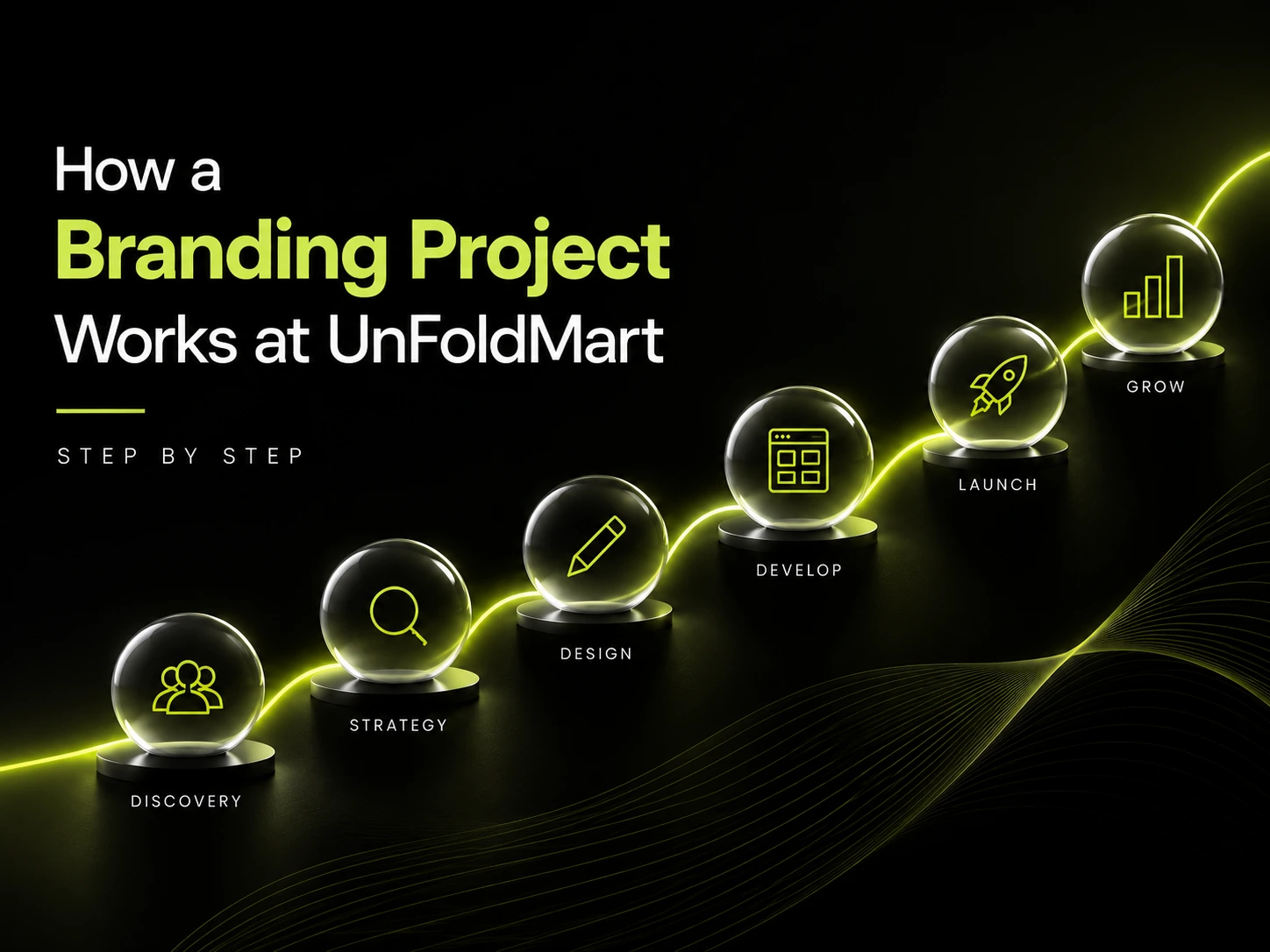
A typical 16-week foundation branding programme runs across five phases: discovery and research, strategy development, identity development, application and guidelines, and rollout planning and handover. Multi-region or bilingual extensions add 4 to 8 weeks; enterprise programmes can run 26 to 52 plus weeks.
Weeks 1 to 3 are discovery and research: client immersion, stakeholder interviews, customer interviews, competitive analysis, audience research. Bilingual programmes include regional audience research in both markets.
Weeks 3 to 6 are strategy development: positioning, brand architecture, target audience definition, brand purpose and values, messaging framework, naming where required.
Weeks 6 to 10 are identity development: logo concepts and refinement, typography system, colour system, photography and illustration style, iconography, motion principles where applicable.
Weeks 10 to 14 are application and guidelines: application across primary touchpoints (website mockups, sales materials, social, advertising templates), comprehensive brand guidelines document, asset library setup. Bilingual programmes produce guidelines in both languages.
Weeks 14 to 16 are rollout planning and handover: rollout roadmap, governance setup, internal team training, asset library handover.
Webflow website integration adds 8 to 16 weeks; total integrated brand plus website programmes typically run 24 to 32 weeks. Multi-region or bilingual extensions add 4 to 8 weeks. Enterprise programmes typically run 26 to 52 plus weeks.
Common timeline blockers include stakeholder review cycles longer than 1 week, scope expansion mid-programme, legal and trademark review for naming, multi-region cultural review for visual identity. Plan for these in baseline timeline.
Choosing the right branding agency depends on the specific brief: scope, scale, timeline, budget, complexity, regional requirements, and what kind of capability matters most. Heritage consultancies, design-led studios, strategy-led consultancies, integrated agencies, boutique studios, and regional agencies each fit different brief profiles.
UnFoldMart positions as a bilingual EN plus DE branding agency operating across DACH and global markets, with brand strategy plus identity plus naming plus digital application integrated under one team. Foundation-tier programmes start at 65,000 USD; bilingual programmes at 75,000 USD; brand plus Webflow programmes at 95,000 USD.
A 30-minute scoping call lets us understand your brand situation, regional requirements, and integration needs, and gives you an honest assessment of whether UnFoldMart is the right fit or whether a heritage consultancy, design-led studio, or another category fits your brief better.
Got Questions? We’ve Got Answers – Clear, Simple, and Straight to the Point
Senior bait-and-switch (where pitches led by senior named principals are followed by junior teams in delivery) is one of the most common branding agency problems and one of the most preventable through deliberate selection process. Why it happens: agencies are commercial businesses that allocate senior time strategically. Senior principals invest in winning new business but often need to move on to the next pitch once the contract is signed. Junior teams deliver day-to-day work with senior review touchpoints. This pattern is structural across many agency models, not unique to one type. How to detect it during selection: ask explicitly who will be working on your account, with names and roles, after contract signing. Ask what percentage of senior principal time is allocated to your account. Ask for examples of how decisions are escalated when senior involvement is needed. Ask references whether the senior people they met during pitch were the same people who delivered the work. How to prevent it in contract: name the specific senior people in the contract, with stipulated time allocation (hours per week, percentage of programme). Include escalation rights if senior allocation drops below stipulated levels. Include termination rights if senior team substantively changes without notice. How to design engagement to encourage senior involvement: structure the engagement around fewer larger decision points where senior review matters more than continuous delivery; build review cadence that requires senior presence; pay for senior time explicitly rather than hoping for it. Where the problem is most severe: large heritage consultancies with many concurrent pitches and deliveries; agencies that compete heavily on senior reputation but have small actual senior teams. Where the problem is least severe: boutique studios led by named principals (the principals are the agency); founder-led integrated agencies where senior principals have direct ownership stake; smaller teams where senior time is naturally distributed across fewer projects. A practical question that surfaces the issue: ask "what is the team that will be working on my account day to day, by name and role, with photos and bios?" Agencies that answer crisply with named individuals typically have stable senior involvement. Agencies that answer vaguely with role descriptions ("a senior strategist and a creative director will guide the work") typically have the bait-and-switch pattern. When senior bait-and-switch is acceptable: when the junior team is genuinely capable and the senior principals add specific value at specific decision points (rather than continuous involvement). The problem is not junior delivery; the problem is when senior involvement was sold and not delivered.
The right answer depends on the brand stage, brief complexity, and integration requirements. Both models work; the trade-offs are different. Separate brand and digital agencies work well when: the brand brief is large enough to justify dedicated heritage brand consultancy work (typically €225,000 plus); the digital brief is large enough to justify dedicated digital agency work; both agencies have track records of working together with downstream agencies; the brand has internal capability to coordinate handoffs; timeline allows for sequential rather than parallel execution. Integrated single-agency delivery works well when: the brand and digital briefs are tightly interrelated; the brand stage is growth or scale-up rather than enterprise rebrand; integration friction across multiple agencies would slow down execution; the budget benefits from integrated team rather than two agency premiums; senior involvement matters more than category specialisation depth. The structural argument for integration: brand strategy informs digital execution; digital execution informs brand evolution. Separating brand from digital across multiple agencies produces friction at every handoff. Brand guidelines designed without digital application input often adapt poorly to digital. Digital execution without brand strategy input often diverges from brand intent. The structural argument for separation: heritage brand consultancies have substantially deeper strategy and architecture capability than integrated agencies. For Fortune 500 multi-region rebrands, the depth of heritage brand work cannot be replicated by integrated agencies. Similarly, specialist digital agencies (Webflow Enterprise Partners, performance marketing specialists, complex product engineering firms) often have depth that integrated agencies lack. Hybrid approach: many brands use heritage brand consultancies for the strategy and identity work, then engage digital agencies (Webflow Enterprise Partners, integrated agencies) for the website and digital execution. This works when the brand consultancy delivers brand guidelines that anticipate digital application and the digital agency works closely with the brand team. Practical decision framework: if the budget for the full programme is under €180,000, integrated single-agency typically wins (the multi-agency premium does not justify itself); if the budget is €180,000 to €890,000, either model can work depending on brief complexity; if the budget is above €890,000 and the brand is multi-region enterprise, separate specialist agencies typically win. Avoid the worst outcome: hiring one heritage brand consultancy and one digital agency that have never worked together, with no internal capability to coordinate handoffs, and expecting the integration to happen organically. This pattern fails predictably; budget for integration management or pick a model where integration is built in.
Bilingual capability ranges from "nice to have" to "structural requirement" depending on which markets the brand operates in. For brands with substantial DACH market exposure or expansion plans, English plus German bilingual delivery is increasingly a structural requirement rather than optional. Why bilingual matters for DACH-exposed brands: the DACH market (Germany, Austria, Switzerland) represents approximately 100 million native German speakers and one of the largest GDP regions globally. Brand work that does not resonate in German markets misses substantial revenue opportunity. Why most agencies underdeliver on bilingual: most global agencies execute in English and translate to German as an afterthought. The result is German content that reads as translated, lacks cultural fluency, and misses regional market expectations (DSGVO, BFSG, German cultural norms, formal address conventions). What good bilingual brand programmes do: develop brand strategy with bilingual audience research from foundation; develop verbal identity in parallel rather than as translation; have native-speaker editors and copywriters in each language; ensure naming linguistic checks across both languages; ensure cultural appropriateness checks for both markets; produce guidelines in both languages. The naming dimension matters substantially. A brand name must work in both English and German with no unintended connotations or pronunciation issues. Linguistic checks for both languages, trademark searches in both jurisdictions, domain availability, and cultural connotation checks are required. The verbal identity dimension matters even more. German brand voice differs from English brand voice in directness, formality, structure, and humour conventions. Direct translation produces brand voice that reads as inauthentic to native speakers. Pricing implication: bilingual brand programmes typically run €67,000 to €310,000 or more depending on scope. The premium over single-language is roughly 20 to 35 percent for well-executed bilingual delivery; the cost of poorly executed bilingual (translation-only) is much higher in lost market resonance. For brands without DACH exposure, English-only delivery is appropriate. The bilingual investment is structural for brands operating in or expanding into German-speaking markets specifically; it is over-investment for brands that operate purely in English-language markets. For brands with multiple language markets beyond English plus German, the same logic applies: parallel development in each language with native-speaker capability, not translation as afterthought. This expands timeline and budget proportionally.
A comprehensive full brand programme includes nine major components: strategy, architecture, naming where required, verbal identity, visual identity, application, guidelines, governance, and measurement. Bilingual or multi-region programmes add regional adaptation across each component. Brand strategy covers positioning (what category you compete in and how you are different), target audience definition, brand purpose and values, brand personality, and competitive frame. Strategy is the foundation; weak strategy produces weak identity work. Brand architecture covers master-brand vs sub-brand vs endorsement vs standalone framework, portfolio rationalisation, naming conventions, and product hierarchy. Architecture matters most for multi-product or multi-segment brands. Naming covers brand name, product names, and service names with linguistic checks across target markets, trademark search, domain availability, and cultural appropriateness checks. Verbal identity covers brand voice and tone, messaging framework, key messages by audience, vocabulary, and copy patterns. Bilingual programmes require parallel verbal identity development in each language. Visual identity covers logo system (primary, secondary, lockups, monograms), typography, colour, photography style, illustration style, iconography, and motion principles where applicable. Application covers website, packaging, environment, advertising, social, sales materials, and internal communications. Application is where most of the rollout effort sits. Guidelines cover the brand guidelines document (digital and PDF), DAM (digital asset management) setup, asset library, and governance documentation. Governance covers brand governance committee, application review process, evolution roadmap, and training for internal teams. Without governance, brands drift within 12 to 24 months. Measurement covers brand health metrics (awareness, consideration, preference, loyalty), brand tracking research cadence, and internal alignment metrics. A 16-week foundation programme typically delivers all nine components for a single language or region. Multi-region or bilingual programmes add 4 to 8 weeks; enterprise programmes can run 26 to 52 plus weeks. Pricing for full brand programmes: foundation €58,000 to €250,000 at integrated agencies; €135,000 to €4,500,000 at heritage consultancies; €71,500 to €890,000 at design-led studios; €180,000 to €7,100,000 plus for multi-region or bilingual programmes.
The right answer depends on which dimension of brand work matters most for your specific brief. Heritage global consultancies (Pentagram, Wolff Olins, Landor and Fitch, Interbrand, Lippincott, Siegel and Gale, Saffron Brand Consultants) excel at end-to-end brand programmes for large multi-region clients. Design-led studios (Collins, And Walsh, DesignStudio, Mother Design, Base Design, Gretel, Pearlfisher, Jones Knowles Ritchie) excel at distinctive visual identity with strong creative reputation. Choose heritage global consultancies when: the brief is multi-region or global rollout with substantial complexity; the brand is undergoing major repositioning, merger, or category redefinition; the budget supports €225,000 to €4,500,000 plus; the timeline supports 6 to 12 plus months; multi-stakeholder enterprise buying processes are part of the brief; senior heritage consultancy reputation is part of credibility. Choose design-led studios when: distinctive visual identity is the primary need; the brand wants a recognisable creative point of view; strategy work is lighter or already done by another team; the budget supports €71,500 to €890,000 plus; timeline allows for creative iteration; the working style fits with creative-director-led delivery rather than process-heavy enterprise consulting. Common decision triggers: when positioning and architecture are the primary challenge, lean toward heritage consultancies or strategy-led firms; when distinctive aesthetic is the primary challenge, lean toward design-led studios; when both matter and you want integrated delivery, consider integrated digital-native agencies that span both. Pricing reality: heritage global consultancy benchmarks are typically 30 to 70 percent above comparable scope at design-led studios or integrated agencies. The premium reflects deeper strategy work, multi-stakeholder enterprise capability, and brand consultancy reputation. Whether the premium is worth it depends entirely on your specific brief. Sector fit matters substantially. Heritage consultancies have stronger track records in financial services, healthcare, and B2B enterprise; design-led studios have stronger track records in consumer brands, scale-ups, cultural institutions, and premium lifestyle. Match agency category to sector for best fit. Avoid the most common mistake: do not pick on portfolio aesthetic alone. A portfolio you love does not predict an agency that will produce work you love for your specific brief. Sector fit, strategic depth, working style fit, and senior involvement matter at least as much as aesthetic.

.webp)