The Top Ecommerce Website Features You Need for 2026
The ecommerce website features that matter for 2026, from AEO/GEO product discovery and AI shopping assistants to frictionless checkout and AR visualisation.
The ecommerce website features that matter for 2026, from AEO/GEO product discovery and AI shopping assistants to frictionless checkout and AR visualisation.
Real projects across branding, packaging, websites and growth.
Straight answers on this topic from the UnFoldMart team.
From branding and packaging to Webflow websites, SEO, AEO and GEO, UnFoldMart brings strategy, design and growth under one team for 250+ brands across 10 markets. Tell us where you want to grow and we'll show you the fastest way there.
Last updated: June 2026
Ecommerce in 2026 is shaped by one big change: a growing share of buying journeys now begins in an AI answer rather than a search box, and shoppers expect a fast, personalised, frictionless experience once they arrive. The features that win are no longer just about a pretty storefront; they are about being found by AI, understood by each visitor, and easy to buy from on any device.
This guide covers the ecommerce website features that actually matter for 2026, what each one is, why it matters now, and how to put it to work, so you can build an online store that gets discovered, builds trust, and converts.
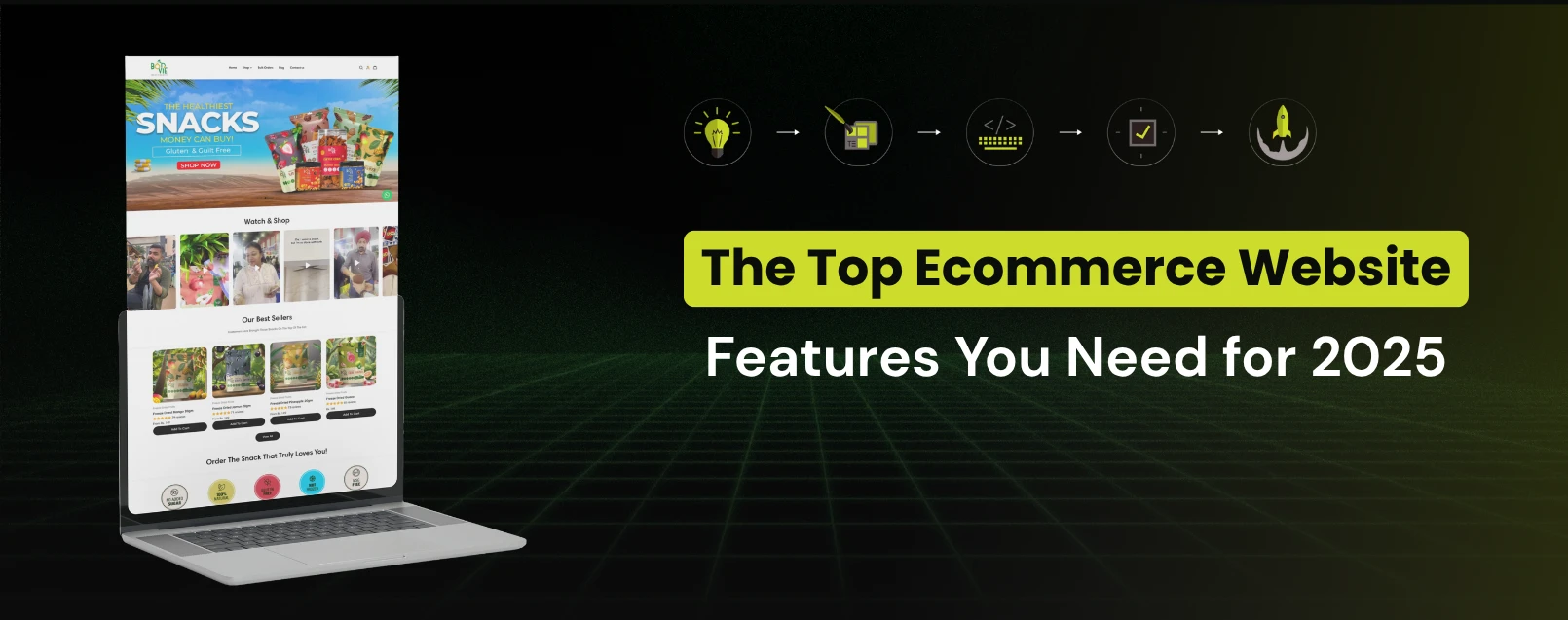
The top ecommerce website features for 2026 are AI-driven personalisation, AEO and GEO for product discovery, AI shopping assistants and conversational commerce, a frictionless mobile-first experience, advanced search and filtering, a seamless one-page checkout, secure and flexible payments, reviews and user-generated content, AR and 3D product visualisation, and subscriptions and loyalty. Together they help your store get found by AI, build trust, and convert.
| # | Feature | What it is | Why it matters in 2026 |
|---|---|---|---|
| 1 | AI personalisation | Tailored content and recommendations | Higher engagement and conversion |
| 2 | AEO & GEO discovery | Products surfaced in AI answers | Journeys now start in AI, not just Google |
| 3 | AI shopping assistants | Conversational, guided buying | Faster path from question to purchase |
| 4 | Frictionless mobile | Fast, responsive mobile experience | Most traffic and sales are mobile |
| 5 | Advanced search & filters | Fast, accurate product finding | Cuts bounce, lifts conversion |
| 6 | Seamless checkout | One-page, guest-friendly checkout | Reduces cart abandonment |
| 7 | Secure, flexible payments | Multiple trusted payment options | Trust and fewer drop-offs |
| 8 | Reviews & UGC | Ratings, photos, social proof | Builds trust, aids AI and SEO |
| 9 | AR & 3D visualisation | See products in context | Confidence up, returns down |
| 10 | Subscriptions & loyalty | Recurring revenue and rewards | Retention as acquisition gets harder |
Personalisation in 2026 goes far beyond a name in an email. Stores use behavioural data and AI to tailor product recommendations, content, and offers to each visitor in real time, surfacing the right product at the right moment. Done well, this lifts engagement, average order value, and conversion; done carelessly, it feels intrusive, so the strongest implementations are transparent and privacy-respecting. The aim is simple: make every shopper feel the store understands what they actually want.
This is the defining new feature for 2026. As shoppers increasingly start with ChatGPT, Perplexity, or Google's AI Overviews, your products need to be discoverable and citable by those engines, not just ranked on a results page. Answer Engine Optimisation (AEO) and Generative Engine Optimisation (GEO) mean clean product data, structured markup, clear specifications, and content that answers real buying questions, so AI can recommend your products by name. A store that is invisible to AI answers is invisible to a fast-growing share of buyers.
The old support chatbot has grown up. In 2026, AI shopping assistants guide customers through discovery and purchase, answering questions, comparing options, recommending products, and handling order and shipping queries, around the clock. The best ones feel like a knowledgeable salesperson rather than a scripted bot, and they shorten the path from question to checkout. For stores with large catalogues, this guided experience can lift conversion meaningfully while reducing support load.
Most ecommerce traffic and an increasing share of sales happen on mobile, so a fast, responsive, touch-friendly experience is non-negotiable. In 2026 that means responsive layouts, genuinely quick load times even on patchy networks, and navigation and checkout designed for thumbs. Speed is also a ranking and conversion factor, so mobile performance work pays back twice. A store that frustrates mobile shoppers loses most of its audience before they ever reach the cart.
As catalogues grow, helping shoppers find the right product fast becomes one of the highest-leverage features. Strong search with autocomplete, plus filters for price, size, colour, brand, and rating, and sensible sorting, guides users straight to what they want and cuts bounce. Increasingly this search is AI-assisted, understanding intent and natural-language queries rather than just matching keywords. Good on-site search is quietly one of the biggest conversion levers a store has.
A clumsy checkout is where carts go to die. In 2026, the best stores keep it to as few steps as possible: a one-page flow that combines address, shipping, and payment, with guest checkout so buyers are not forced to create an account, and auto-fill to speed up returning customers. Every removed field and step lifts completion. The goal is to make paying feel effortless, because friction here directly costs revenue.
Shoppers abandon when they do not see a payment method they trust, and they leave for good if they doubt a site's security. A 2026 store needs a secure, encrypted checkout and a spread of trusted options, cards, digital wallets like Apple Pay and Google Pay, and region-appropriate local methods, plus one-click payment for returning customers. Visible security and the right local payment options together remove two of the most common reasons buyers drop off at the final step.
Social proof remains one of the strongest drivers of ecommerce conversion. Product reviews, star ratings, and customer photos and videos build the trust that turns browsers into buyers, and they help in a second way too: rich review content gives search engines and AI answer engines more to understand and cite about your products. Making it easy for happy customers to leave reviews, and showing that content prominently, compounds over time into a real competitive advantage.
Augmented reality and interactive 3D let shoppers see a product in their own space or from every angle before buying, which is especially powerful in furniture, home decor, fashion, and accessories. The payoff is twofold: higher confidence at the point of purchase and fewer returns, since customers know what they are getting. As the technology becomes easier to implement, AR and 3D are shifting from novelty to a genuine conversion and margin advantage in the right categories.
With acquisition getting more expensive, keeping customers is where the economics improve. Subscription options, for replenishable products or memberships, and well-designed loyalty programmes turn one-off buyers into recurring revenue and repeat visits. The best setups make it easy to manage delivery frequency, offer genuine member benefits like early access and member pricing, and handle billing automatically. For the right business, this recurring layer is what makes the whole store more valuable.
You do not need all ten on day one. Start with the foundations that decide conversion: a fast mobile experience, easy search, frictionless checkout, and trusted payments. Layer in the trust and discovery features next, reviews, plus AEO and GEO so AI engines can find and recommend you. Then add the differentiators that suit your category, personalisation, AI shopping assistants, AR and 3D, and subscriptions. The thread running through all of it is that a 2026 store has to be discoverable by AI, trusted by shoppers, and effortless to buy from, in that order of foundation.
The ecommerce features that matter in 2026 point in one direction: stores that get found by AI, understand each shopper, and make buying effortless. The specific technologies will keep moving, but a fast, trustworthy, AI-discoverable store that converts is a safe foundation to build on.
If you want an ecommerce site built around these 2026 fundamentals, AEO and GEO discovery, performance, frictionless checkout, and a clean, modern build, UnFoldMart can help. To map out your store, book a free website strategy call and we will help you plan a store built to convert. For related reading, see our guide to strategic branding and how it strengthens an online store.
About the author: Abhishek Garg is the founder of UnFoldMart, a website and growth agency building ecommerce and high-performance sites for consumer and B2B brands across India and international markets.
Got Questions? We’ve Got Answers – Clear, Simple, and Straight to the Point
The choice matters less than most technical debates suggest — both traditional platforms (Shopify, WooCommerce, BigCommerce) and headless setups (Shopify Hydrogen, Commerce Layer, Saleor, Medusa, or headless WordPress + custom frontend) can deliver excellent ecommerce experiences. Traditional platforms are faster to launch, cheaper to maintain, and adequate for most mid-market merchants — Shopify in particular has closed most of the customisation gap that used to justify headless. Headless makes sense when the business needs deep custom UX, unusual integrations, multi-channel commerce (web + mobile app + kiosk + in-store), or content-heavy commerce (editorial commerce, magazine-style product storytelling) that traditional platforms struggle with. UnFoldMart's ecommerce recommendations start from business requirements, not platform preference — the wrong-fit platform costs more in workarounds than the right-fit platform costs in licensing.
Directly and heavily. Google's Core Web Vitals (Largest Contentful Paint under 2.5 seconds, Interaction to Next Paint under 200ms, Cumulative Layout Shift under 0.1) are confirmed ranking signals for ecommerce sites, and their conversion impact usually exceeds their ranking impact — studies consistently show 1-second improvements in LCP producing 5–10% conversion lift on ecommerce. Mobile speed matters more than desktop: over 70% of ecommerce sessions in most markets are mobile, and mobile Core Web Vitals are typically weaker than desktop equivalents. Practical priorities: server-side render or statically generate product pages, optimise product images (WebP or AVIF with responsive sizing), lazy-load below-the-fold content, and audit third-party scripts (chat widgets, analytics, tag managers) which often dominate the slow-loading footprint.
Payment methods are region-specific and getting them wrong costs meaningful conversion. Essential regional coverage: iDEAL and Bancontact for Netherlands and Belgium (iDEAL alone accounts for the majority of Dutch e-commerce checkouts); SEPA instant and Klarna for DACH; Sofort still relevant in Germany; Twint for Switzerland; Trustly and Swish for Nordics. Global essentials: Apple Pay, Google Pay, PayPal, and major credit cards. Buy-now-pay-later options (Klarna, Afterpay, Affirm, Alma) increasingly expected across most Western markets, especially for orders above €100. Merchants using only US-payment defaults for European checkout regularly see 15–35% cart abandonment increases compared with locally-appropriate payment coverage. Regional payment selection isn't a nice-to-have — it's directly ranked by conversion impact.
Substantially. AI answer engines increasingly compose product shortlists for buyers before those buyers ever visit a merchant site. To be cited inside those shortlists, product pages need six things: complete Product schema with variant, availability, and price data; visible reviews with structured markup; transparent pricing (AI engines skip pages that hide prices behind logins or configurators); clear differentiation content (what makes this product different from category competitors); category-appropriate certifications on-page (organic, fair-trade, vegan, halal, kosher where relevant); and a defensible entity signal via Organization schema for the parent brand. Merchants relying only on classical ecommerce SEO tactics without these AI-readiness features get replaced in AI-generated product recommendations by competitors that have adapted.
Eight features have moved from optional to essential in 2026. AI-driven personalisation (product recommendations, dynamic pricing zones, adaptive category pages based on browse behaviour). One-page or accelerated checkout with wallet-native payment (Apple Pay, Google Pay, Shop Pay, Klarna, iDEAL for NL, SEPA instant for EU). Mobile-first design that treats desktop as the secondary experience, not the reference. Sub-2-second Largest Contentful Paint on 3G/4G devices, since Google's Core Web Vitals thresholds directly affect ranking and conversion. Complete Product schema with Offer, AggregateRating, and Availability so AI answer engines can cite the product. Post-purchase transparency (real-time order tracking, easy returns portal, subscription management). Localised trust signals per market (regional payment methods, native-language reviews, local phone/support). And explicit AI-search readiness (FAQ blocks, comparison content, structured product data) since a growing share of product discovery starts in ChatGPT or Perplexity.


.webp)