Technical SEO for AI-Readable Content
Learn how to optimize your website for AI-readable content. Discover technical SEO strategies that improve machine understanding, visibility, and search performance.
Learn how to optimize your website for AI-readable content. Discover technical SEO strategies that improve machine understanding, visibility, and search performance.
Real projects across branding, packaging, websites and growth.
Straight answers on this topic from the UnFoldMart team.





From branding and packaging to Webflow websites, SEO, AEO and GEO, UnFoldMart brings strategy, design and growth under one team for 250+ brands across 10 markets. Tell us where you want to grow and we'll show you the fastest way there.
For years, technical SEO focused on helping search engines crawl and index websites efficiently.
That goal has not disappeared, but the stakes have changed.
Modern AI-powered search systems do not just index pages. They interpret them. They extract meaning, relationships, context, and intent. They synthesize information across sources to generate answers.
In this environment, being crawlable is not enough. Your content must be understandable to machines at a deeper level.
If AI systems cannot accurately interpret your website, they cannot confidently reference it, summarize it, or recommend it.
Technical SEO is evolving from infrastructure optimization to knowledge clarity.
Human readers rely on context, visuals, and intuition. Machines rely on structure.
A well-written article that lacks clear formatting, semantic signals, or logical organization may be easy for people to understand but difficult for algorithms to parse accurately.
AI-readable content bridges this gap.
It ensures that meaning is conveyed explicitly through technical signals, not just implied through prose.
Organizations that optimize for machine interpretation increase their chances of appearing in AI-generated responses.
AI-readable content is structured in a way that allows automated systems to extract meaning reliably.
Key characteristics include:
AI readability goes beyond crawlability.
A page may be fully indexed yet poorly understood if relationships between concepts are unclear.
For example, a service page that never explicitly states what the service is, who it is for, and how it works forces AI systems to infer meaning.
Explicit explanations reduce uncertainty.
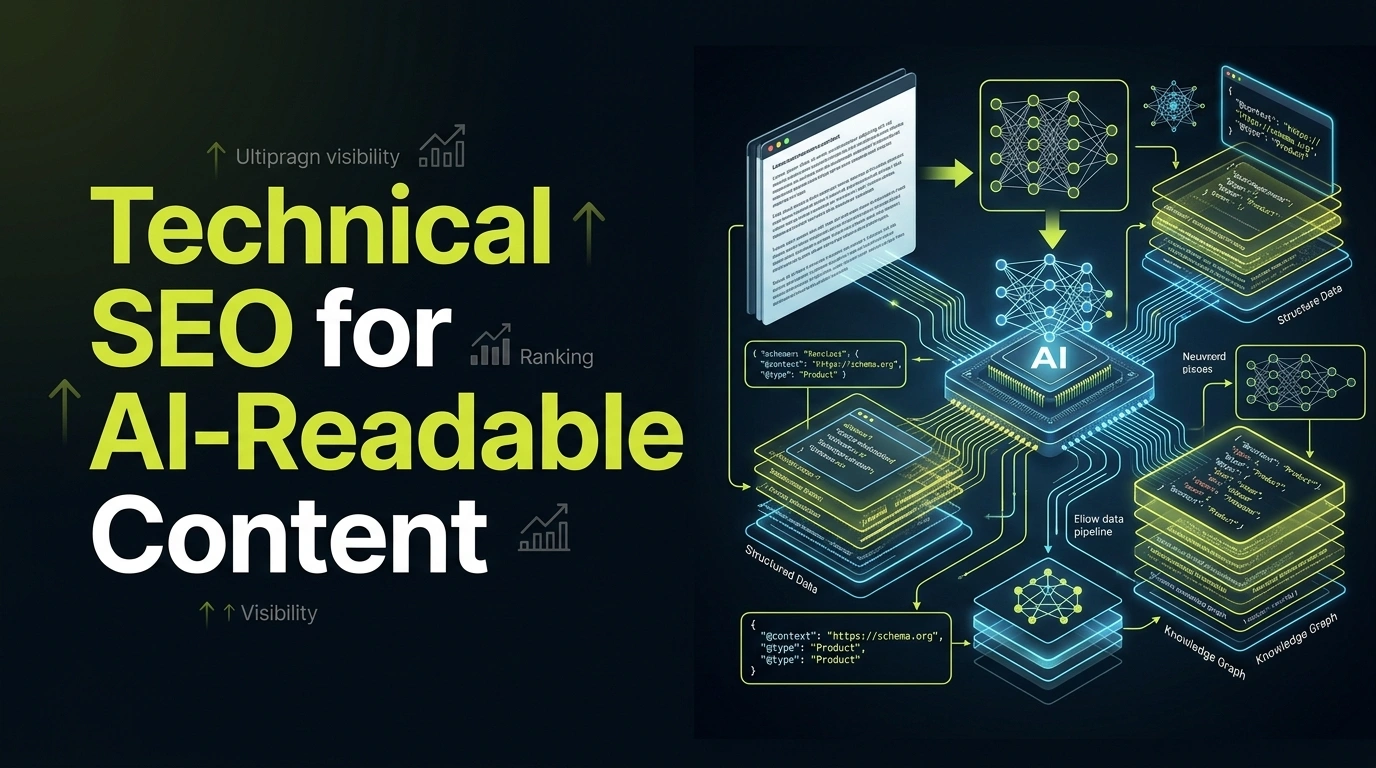
Understanding the processing pipeline helps clarify why technical factors matter.
Automated systems discover pages through links, sitemaps, and references.
HTML is analyzed to identify structure, headings, and content blocks.
Key concepts such as organizations, products, people, and locations are identified.
Relationships between entities are evaluated.
Information is compared with existing data sources and knowledge graphs.
Breakdowns at any stage reduce the likelihood of inclusion in AI-generated outputs.
If AI systems cannot access your content, nothing else matters.
Search engines must be able to include pages in their databases.
Common issues include:
Slow websites hinder both user experience and automated processing.
Improve performance through:
Most interactions occur on mobile devices. Responsive design ensures accessibility across screen sizes.
Secure connections signal credibility and protect data integrity.
Semantic tags clarify structure.
Readable URLs provide contextual clues.
Example:
/performance-marketing-lead-generation
instead of
/page?id=4821
Lists clarify relationships while tables present comparative data clearly.
Schema markup provides machine-readable descriptions of content.
Benefits include:
Common schema types:
AI systems analyze relationships across pages.
Strengthen entity clarity through:
Modern AI systems process more than text.
Optimize by including:
Regular audits help identify these issues.
The goal is coherence, not perfection.
AI search will continue evolving.
Future trends may include:
Technical SEO is no longer just about enabling search engines to find your pages.
It is about enabling AI systems to understand them.
Clear structure, semantic signals, and reliable technical performance increase confidence in your content.
When machines understand your information accurately, they are more likely to reference it.
Technical clarity ultimately supports human credibility.
If your website produces valuable content but struggles to generate consistent leads, technical barriers may be limiting visibility.
Book a strategy consultation with UnFoldMart to turn your website into a scalable lead-generation engine.
Got Questions? We’ve Got Answers – Clear, Simple, and Straight to the Point
Yes. Performance influences accessibility and user experience.
Even basic optimization can significantly improve visibility.
It may perform moderately well but will not reach full potential.
Yes. Machine interpretation depends heavily on technical clarity.

.webp)