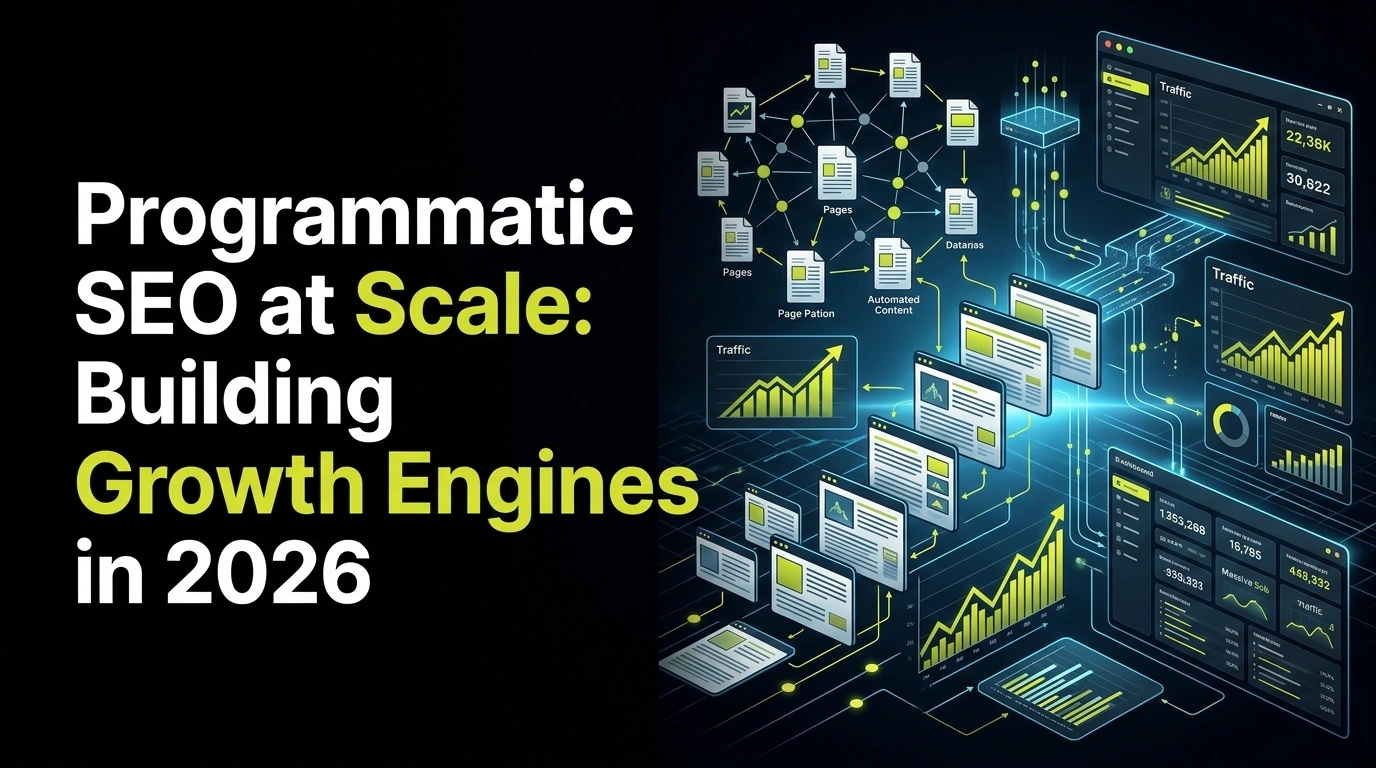
Programmatic SEO at Scale in 2026: How to Build Data-Driven Growth Engines
Learn how to execute programmatic SEO at scale in 2026 using data-driven pages, automation frameworks, and quality controls to capture long-tail traffic and generate leads.
Learn how to execute programmatic SEO at scale in 2026 using data-driven pages, automation frameworks, and quality controls to capture long-tail traffic and generate leads.
Real projects across branding, packaging, websites and growth.
Straight answers on this topic from the UnFoldMart team.





From branding and packaging to Webflow websites, SEO, AEO and GEO, UnFoldMart brings strategy, design and growth under one team for 250+ brands across 10 markets. Tell us where you want to grow and we'll show you the fastest way there.
Programmatic SEO has become one of the most powerful growth levers in digital marketing. By using structured data and automation, organizations can publish thousands or even millions of pages targeting highly specific search queries.
Yet scale alone does not guarantee success.
Many companies deploy programmatic strategies expecting exponential traffic growth, only to see minimal impact or even performance declines. The reason is simple. Search engines no longer reward volume for its own sake. They evaluate usefulness, uniqueness, intent alignment, and overall site quality.
In 2026, AI-driven search systems further intensify these standards. Low-value, repetitive, or thin pages generated at scale are increasingly filtered out of both traditional rankings and AI summaries.
Scale amplifies outcomes. A strong strategy becomes dominant. A weak one becomes noise.
Successful programmatic SEO is not about flooding the index with pages. It is about building a structured, data-driven content system that delivers genuine value across thousands of long-tail queries.
When executed correctly, programmatic SEO can become a predictable acquisition engine. When executed poorly, it can dilute authority and waste resources.
Programmatic SEO refers to the automated creation of large numbers of web pages using structured data and templates.
Instead of writing each page manually, organizations design scalable frameworks that generate content dynamically from databases.
Typical examples include:
Each page targets a unique combination of variables such as city plus service, product plus feature, or category plus attribute.
Unlike traditional content marketing, which prioritizes depth in individual articles, programmatic SEO focuses on breadth across long-tail search demand.
Automation does not eliminate strategy. Human planning determines which queries to target, what data to use, how templates generate value, and which pages should or should not be indexed.
Search behavior is becoming increasingly specific.
Users ask detailed queries influenced by voice assistants, conversational interfaces, and AI tools. Instead of searching for “hotels,” they search for “pet-friendly hotels near airport with free shuttle.”
This growth in long-tail queries creates massive opportunities for scalable content systems.
Key advantages include:
However, search engines now detect low-quality automation easily. Thin or repetitive pages may be ignored entirely.
Programmatic SEO works best when every page delivers distinct value rather than simple keyword variation.
Each page must answer a real user need. If pages contain nearly identical information with minor variations, search engines may consolidate or suppress them.
Programmatic pages depend entirely on the quality of underlying data. Accurate and structured datasets produce valuable content.
Templates should produce natural and informative content rather than mechanical output.
Effective templates often include:
Different search queries require different page structures.
Not every generated page should be indexed. Low-value pages should be excluded to preserve domain quality signals.
Combining geographic variables with services or products captures strong local demand.
Pages comparing tools, services, or features address evaluation queries effectively.
Aggregated directories organize options and help users compare multiple providers or products.
Interactive tools such as pricing calculators or performance estimators provide personalized results and strong engagement.
Statistics, benchmarks, or rankings based on proprietary datasets can attract links and authority.
Templates form the backbone of programmatic SEO systems.
A strong template ensures consistency while allowing dynamic variation across pages.
Important considerations include:
Templates should prioritize readability first and automation second.
Large programmatic SEO systems require strong technical infrastructure.
Centralized structured datasets enable efficient generation and updates.
Pages can be generated through static builds, dynamic rendering systems, or custom frameworks.
Consistent URL structures clarify page relationships.
Automated linking distributes authority across large page networks.
Large sites require segmented sitemaps to support efficient crawling.
CDN usage, caching strategies, and optimized code ensure fast delivery across thousands of pages.
Publishing every generated page may damage site quality signals.
Effective strategies include:
Search engines evaluate overall domain quality, not just individual pages.
Programmatic SEO requires continuous optimization rather than one-time deployment.
AI-driven search platforms prioritize trustworthy and information-rich sources.
Low-value automated pages are increasingly filtered out, while well-structured datasets can become preferred citation sources.
Successful programmatic pages typically include:
Long-term success requires continuous improvement.
Well-maintained programmatic systems compound growth over time.
Programmatic SEO is one of the most powerful tools for capturing long-tail demand.
However, scale alone does not guarantee success. Data quality, strategic planning, and commitment to usefulness determine outcomes.
Strong systems dominate search landscapes and generate predictable traffic. Weak systems produce clutter that search engines increasingly ignore.
In 2026, strategic scale guided by insight is what builds lasting visibility.
If your organization has valuable data but struggles to convert it into predictable organic traffic and qualified leads, programmatic SEO may be the missing growth engine.
Book a strategy consultation with UnFoldMart to transform your data into a sustainable lead generation machine.
Got Questions? We’ve Got Answers – Clear, Simple, and Straight to the Point
By ensuring each page provides distinct value and by managing canonicalization carefully.
AI can assist, but programmatic SEO typically relies on database-driven generation.
Yes, particularly in niche markets with structured data.
There is no fixed number. Success depends on demand, quality, and competition.
Yes. It remains highly effective when focused on genuine value rather than mass production.

.webp)