Neighborhood Keyword Targeting: How to Rank in Hyperlocal Search Results (2026 Guide)
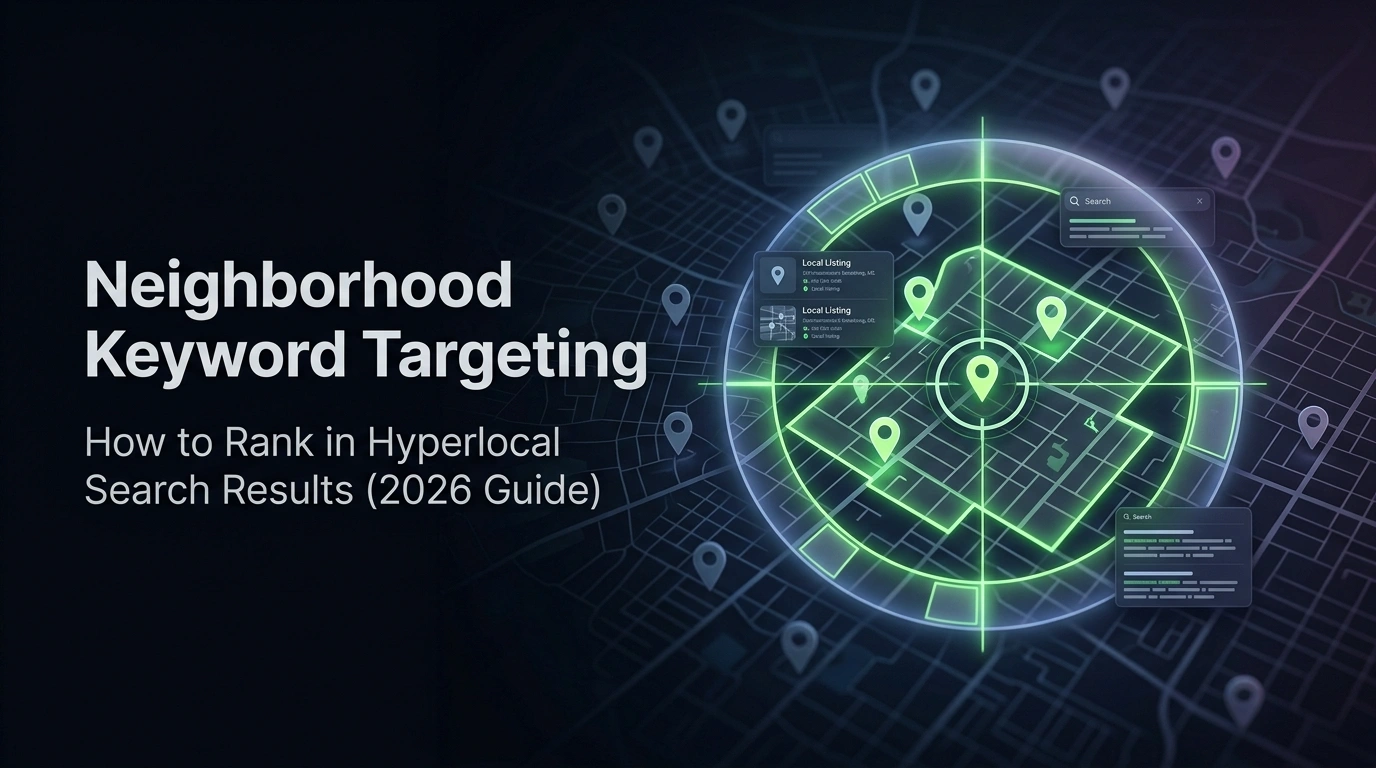
Local search is becoming more precise. Instead of searching at the city level, users are increasingly looking for services within specific neighborhoods. Queries are no longer limited to “restaurant in Berlin” but have evolved into “restaurant in Kreuzberg” or “café near Shoreditch.”
This shift makes neighborhood keyword targeting a critical part of modern local SEO. Businesses that optimize for hyperlocal queries can capture high-intent users who are ready to take action.
For companies operating in competitive cities, focusing on neighborhood-level keywords can significantly improve visibility, reduce competition, and drive more relevant traffic.
What is Neighborhood Keyword Targeting?
Neighborhood keyword targeting is the process of optimizing content and business listings for specific areas within a city. It focuses on smaller geographic regions, such as neighborhoods, districts, or local zones.
Unlike city-level SEO, which targets broader audiences, neighborhood targeting aims to reach users searching within a more defined area. This makes it more precise and often more effective for conversion.
Why is Neighborhood Keyword Targeting Important?
Hyperlocal searches usually come from users with clear intent. They are often looking for something nearby and are more likely to make a decision quickly.
Targeting neighborhoods allows businesses to appear in highly relevant searches while facing less competition than broader city-level keywords. It also strengthens local relevance, which is a key ranking factor.
Key benefits include:
- Higher conversion potential
- Stronger local relevance
- Improved visibility in specific areas
How Do Neighborhood-Based Searches Work?
Search engines use location signals, user intent, and context to deliver results for neighborhood-based queries. When a user searches for a service in a specific area, search engines prioritize businesses that clearly indicate their presence in that location.
These searches can be explicit, where the user mentions a neighborhood, or implicit, where the search engine uses the user’s location to determine relevant results.
For example, a user searching for “best bakery near me” may see results based on their exact neighborhood, even if they do not mention it directly.
What Types of Neighborhood Keywords Exist?
Service Plus Neighborhood Keywords
These keywords combine a service with a specific neighborhood, such as “salon in Soho” or “plumber in Mitte.” They are highly targeted and match clear user intent.
Near Me Variations
“Near me” searches rely on location data rather than explicit keywords. Businesses must optimize their listings and content to appear in these results.
Long-Tail Local Queries
These are more detailed queries that often include multiple elements, such as service, location, and intent. They reflect how users naturally search, especially through voice.
Landmark-Based Keywords
Users often search using well-known landmarks or areas. For example, “restaurant near Central Park” or “store near Oxford Street.”
These keywords help capture traffic from users who may not know exact neighborhood names.
How to Find Neighborhood Keywords?
Identifying the right keywords requires a combination of tools and local understanding. Keyword research tools can provide data on search volume and variations, but they should be combined with real-world insights.
Search suggestions and autocomplete features reveal how users phrase their queries. Analyzing competitors can also help identify gaps and opportunities.
Local knowledge plays a crucial role. Understanding how people refer to specific areas can help create more accurate and relevant content.
How to Optimize Content for Neighborhood Keywords?
Optimizing for neighborhood keywords requires a balance between relevance and natural language. Content should include location-specific references without appearing forced.
Creating dedicated pages for specific neighborhoods is one of the most effective strategies. These pages should provide unique and useful information rather than repeating generic content.
On-page elements such as titles, headings, and descriptions should include neighborhood keywords in a natural way. This helps search engines understand the focus of the content.
Google Business Profile optimization also plays an important role. Clearly defining service areas and maintaining accurate information improves visibility in local results.
In addition, creating blog content that addresses local topics can help strengthen relevance and attract traffic.
What Are Real Examples of Neighborhood Keyword Targeting?
A café located in a busy district can attract more customers by optimizing for searches related to that specific neighborhood. This helps it appear in results for users nearby.
A repair service can target multiple neighborhoods within a city, ensuring that it reaches users in different areas without competing for broad city-level keywords.
A retail store can focus on local foot traffic by optimizing for searches that include nearby landmarks or well-known areas.
These examples show how hyperlocal targeting improves both visibility and conversions.
What Are Common Neighborhood SEO Mistakes?
One common mistake is overusing keywords in an unnatural way, which can reduce content quality and readability. Search engines prioritize content that is useful and easy to understand.
Another issue is creating duplicate content across multiple neighborhood pages. Each page should be unique and tailored to its specific location.
Ignoring local intent can also limit effectiveness. Content should reflect what users are actually searching for in that area.
How to Scale Neighborhood Keyword Targeting?
Scaling requires a structured approach. Businesses should start by targeting key neighborhoods where demand is highest and gradually expand to additional areas.
Creating a consistent framework for location pages helps maintain efficiency while ensuring that each page remains unique. Internal linking between pages can further strengthen authority.
As the number of targeted areas grows, maintaining quality and consistency becomes increasingly important.
What Is the Future of Hyperlocal SEO?
Hyperlocal SEO is expected to grow as search engines become more focused on personalization and intent. AI-driven search results are improving the ability to deliver highly relevant local information.
Voice search is also contributing to the rise of conversational and location-specific queries. Users are increasingly expecting immediate and accurate answers based on their exact location.
Businesses that invest in hyperlocal strategies will be better positioned to capture this evolving demand.
Conclusion
Neighborhood keyword targeting is a powerful way to improve local visibility and attract high-intent customers. By focusing on specific areas within a city, businesses can create more relevant content and compete more effectively in local search.
As search behavior continues to evolve, hyperlocal optimization will become an essential part of any successful SEO strategy.


FAQs
Got Questions? We’ve Got Answers – Clear, Simple, and Straight to the Point
Realistic timelines: neighbourhood keyword rankings move faster than city-level because competition is thinner — measurable ranking movement often shows in 4–8 weeks for well-structured pages. Grid-based rank tracking around the location catches the movement before city-average dashboards do. Conversion attribution to specific neighbourhood pages usually stabilises around the 90-day mark. Full district-level dominance across a competitive urban zone (Berlin, Amsterdam, Zurich) typically takes 6–12 months. Neighbourhood SEO also holds ranking more durably than city-level once earned — the specific local signals (localized content, area-served schema, hyperlocal citations) don't erode quickly through algorithm shifts. UnFoldMart's hyperlocal engagements typically prioritise neighbourhood targeting after city-level ranking is stable rather than running both simultaneously.
Five mistakes appear most often. Publishing 30 templated neighbourhood pages with only the name changed — triggers thin-content flags across the whole cluster. Using neighbourhood names inconsistently (Amsterdam Zuid vs Amsterdam-Zuid vs Zuid) so the same neighbourhood competes with itself across variants. Optimising only for the neighbourhood name without adding qualifying service intent (a page targeting just "Kreuzberg" without service context rarely converts). Skipping local schema (LocalBusiness with correct areaServed data) which weakens the neighbourhood signal for both Google and AI engines. And relying entirely on tool-reported search volume when real neighbourhood queries often don't appear in tool data — leading to under-targeting of neighbourhoods that actually drive pipeline. Fixing any two of these usually opens meaningful ranking headroom within a quarter.
Neighbourhood pages need genuine local content, not templated copy with the neighbourhood name swapped. Effective patterns: local intro paragraph describing the neighbourhood and how it affects service delivery (parking, access, permit rules, common local issues); named local team member or contact if applicable; area-specific FAQs mirroring how residents actually voice questions; local landmarks or reference points mentioned naturally; genuine local photos rather than stock imagery; testimonials from named customers in that neighbourhood where available; and clear service delivery details for the area. Pages built this way earn ranking and AI citations. Templated "[Service] in [Neighbourhood]" pages with only the neighbourhood name changed trigger Google's helpful-content demotion and rarely earn either.
Low volume doesn't mean low value. Neighbourhood queries convert at meaningfully higher rates than city-level queries because intent is sharper — someone typing "family dentist Amsterdam-Zuid open Saturday" has already narrowed by location, service, and availability. A neighbourhood keyword getting 20 searches per month with 15% conversion often outperforms a city-level keyword getting 500 searches per month at 1% conversion. Rank tracking should include neighbourhood terms even when volume looks negligible in tools — the conversion economics justify the effort. Businesses that skip low-volume neighbourhood targeting typically over-invest in high-volume city queries where competition and cost per lead are much higher.
Neighbourhood keywords rarely surface in standard keyword tools because search volumes at that level are small enough (often under 30 searches per month per neighbourhood) that tools like Semrush and Ahrefs don't report reliable numbers. Effective research combines four sources: (1) Google autocomplete typed into a browser set to the target city's location; (2) People Also Ask boxes on service-plus-city queries; (3) direct sampling in Google Search from an IP address in the target neighbourhood (or via VPN + location spoof); and (4) social listening — how neighbourhood residents actually describe their area in local Reddit threads and community Facebook groups. Neighbourhood variants that show up in real user discussions almost always outperform the neighbourhood keywords tools suggest.

Want to Turn Your Brand Into a Scalable Growth Engine?
We help modern businesses unify branding, websites, SEO, and paid media into one performance-driven system designed to scale.