Multi-Location SEO Strategy: How to Rank Your Business in Multiple Cities (2026 Guide)
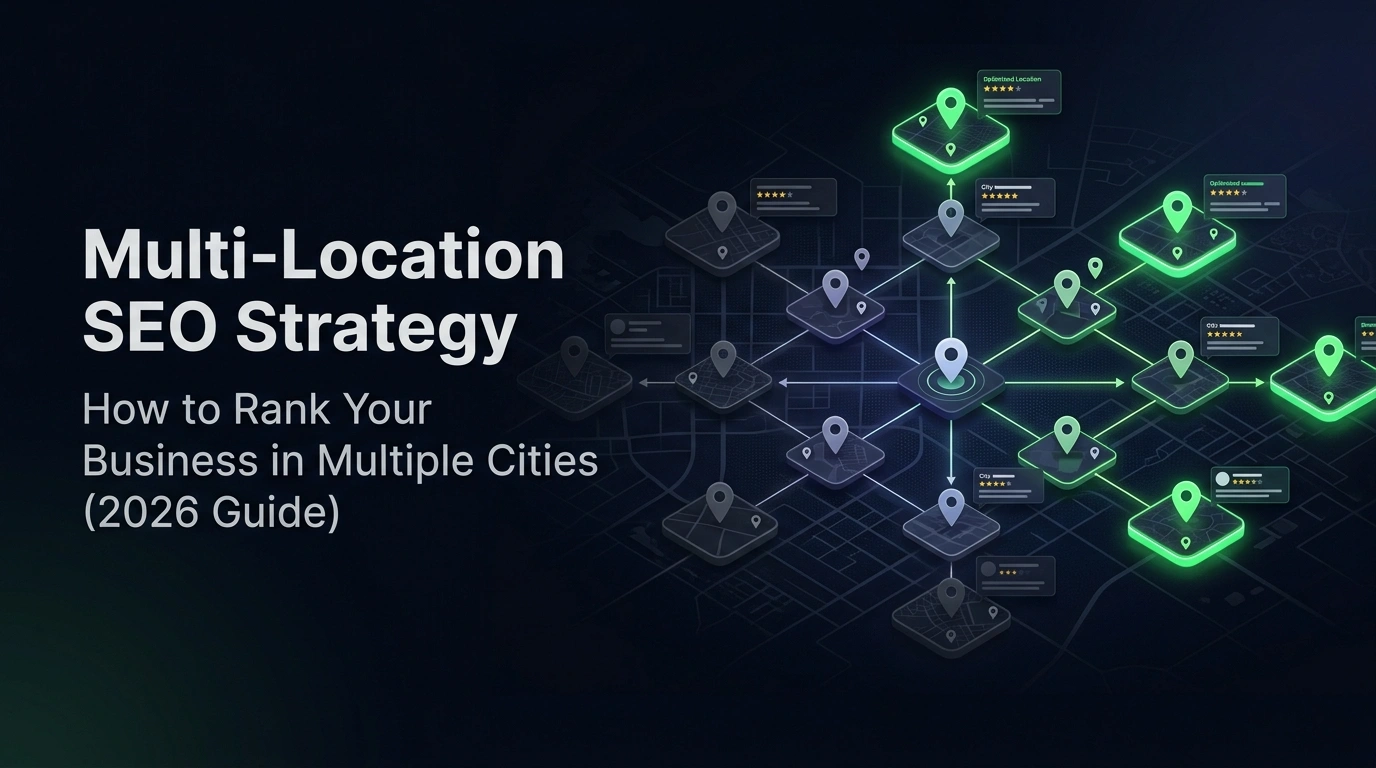
As businesses expand into new cities, their online visibility must scale along with them. Ranking in one location is no longer enough. To attract customers across multiple regions, businesses need a structured approach that ensures each location performs well in local search.
A multi-location SEO strategy focuses on optimizing each business location individually while maintaining overall consistency. This approach allows businesses to appear in local search results across different cities, increasing visibility and customer reach.
For companies operating in competitive urban markets, a well-executed strategy can make the difference between limited visibility and scalable growth.
What is Multi-Location SEO?
Multi-location SEO is the process of optimizing a business to rank in local search results across multiple cities or regions. Instead of focusing on a single location, it involves creating tailored strategies for each area.
Unlike standard local SEO, which targets one location, multi-location SEO requires managing multiple listings, pages, and signals while maintaining consistency across all platforms.
Why is Multi-Location SEO Important?
Expanding into multiple locations increases both opportunity and complexity. Without proper optimization, businesses may struggle to appear in local search results outside their primary location.
A strong multi-location SEO strategy helps businesses improve visibility across cities, attract a wider audience, and build a consistent brand presence. It also allows businesses to compete more effectively in each local market.
This approach supports long-term growth by creating multiple entry points for customers.
What Challenges Do Multi-Location Businesses Face?
Managing SEO for multiple locations comes with several challenges. One of the most common issues is maintaining consistent business information across different platforms. Even small inconsistencies can reduce trust and affect rankings.
Another challenge is avoiding duplicate content across location pages. Search engines prefer unique and relevant content for each location, which requires additional effort.
Businesses also need to compete in different markets, each with its own level of competition, search behavior, and customer expectations. Balancing these factors while maintaining efficiency can be complex.
How Does Multi-Location SEO Work?
Multi-location SEO works by creating strong, location-specific signals for each business branch. This includes optimizing listings, building local content, and ensuring that each location is clearly defined.
Search engines evaluate each location separately based on relevance, proximity, and authority. This means every location must have its own optimized presence while still being connected to the main brand.
What Are the Key Elements of a Multi-Location SEO Strategy?
Google Business Profile for Each Location
Each location should have its own Google Business Profile with accurate and complete information. This helps search engines understand where each branch operates and improves visibility in local search results.
Location-Specific Landing Pages
Dedicated pages for each city are essential for building relevance. These pages should include unique content that reflects the specific location, rather than repeating the same information across multiple pages.
Local Keyword Targeting
Keywords should be tailored to each location. Including city names and relevant local terms helps match user queries and improve rankings.
Consistent Business Information
Maintaining the same business name, address, and phone number across all platforms is critical. Consistency strengthens trust and supports better rankings.
Local Citations
Each location should be listed on relevant directories and platforms. These citations help verify the business and improve local authority.
Reviews and Reputation Management
Customer reviews should be collected for each location individually. This ensures that every branch builds its own credibility and trust.
Local Content Strategy
Creating content that reflects local interests and needs helps strengthen relevance. This can include city-specific pages or blog content.
Backlinks for Each Location
Links from local websites signal trust and authority. Building relationships within each city helps improve visibility and credibility.
Website Structure Optimization
A clear website structure makes it easier for users and search engines to navigate location pages. Internal linking between pages also helps distribute authority.
How to Build a Multi-Location SEO Strategy Step by Step?
The process begins by setting up and optimizing a Google Business Profile for each location. Once listings are in place, businesses should create dedicated location pages with unique content.
The next step is to optimize keywords for each city and ensure that all business information is consistent across platforms. Building citations and collecting reviews further strengthens local signals.
Finally, businesses should track performance and continuously improve their strategy based on results.
What Are Real Examples of Multi-Location SEO?
A retail brand operating in multiple cities can create location-specific pages and listings to attract customers in each area. This helps the brand appear in local search results across all locations.
A restaurant chain can optimize each branch individually, ensuring that each location has its own reviews, content, and visibility.
A service-based business can expand into new regions by building local authority and tailoring its strategy for each market.
These examples show how a structured approach leads to scalable growth.
What Are Common Multi-Location SEO Mistakes?
One of the most common mistakes is using duplicate content across location pages. This reduces relevance and limits ranking potential.
Inconsistent business information across listings can also harm credibility. Ignoring reviews or failing to manage them properly weakens trust signals.
Poor internal linking between location pages is another issue that can limit visibility and authority distribution.
How to Scale Multi-Location SEO Successfully?
Scaling requires a balance between consistency and localization. Businesses should start by focusing on key cities and building strong local presence before expanding further.
As new locations are added, maintaining consistent processes becomes essential. Using tools and structured workflows can help manage multiple listings efficiently.
Gradual expansion allows businesses to maintain quality while increasing reach.
What Is the Future of Multi-Location SEO?
Multi-location SEO will continue to evolve as search engines become more advanced. AI-driven search is increasing the importance of context and personalization.
Search results are becoming more tailored to individual users, which means businesses must provide accurate and relevant information for each location.
As competition grows, businesses that focus on strong local signals and consistent optimization will have a clear advantage.
Conclusion
A multi-location SEO strategy allows businesses to expand their visibility and attract customers across multiple cities. By optimizing each location individually while maintaining consistency, businesses can build a scalable and effective local presence.
Success in multi-location SEO requires ongoing effort, but the results can significantly impact growth and reach.


FAQs
Got Questions? We’ve Got Answers – Clear, Simple, and Straight to the Point
Franchise multi-location adds coordination complexity that corporate multi-location doesn't. Franchisees usually have partial control over their local GBP and marketing, so central corporate teams need clear brand guidelines, standardised location page templates that franchisees can populate, an approved directory list with automated citation deployment, franchisee training on GBP best practices, and centralised review monitoring even when responses happen locally. Left entirely to franchisees, quality varies wildly across the network; too centralised, and local nuance disappears. The winning franchise model usually gives franchisees ownership of local content and review responses within a strong central framework of brand standards, technical setup, and shared tooling. Reporting rolled up centrally lets corporate spot underperforming locations before ranking damage becomes structural.
Beyond the single-location stack, multi-location adds three categories. Listing management platforms (Yext, Uberall, Moz Local) submit and maintain NAP data across dozens of directories at scale — essential past five locations. Grid-based rank tracking (Local Falcon, GeoRanker) run per location, not per city average — the district-level variance matters most for enterprise multi-location work. Review management platforms (Birdeye, Podium, GatherUp) coordinate review generation and response across locations while giving central visibility. Reporting tools that aggregate per-location performance into a single view (Semrush Listing Management, BrightLocal Multi-Location dashboards) prevent central teams from losing sight of which locations are drifting. UnFoldMart's multi-location engagements typically use Uberall or Yext plus Local Falcon plus a review platform as the core stack.
It happens more often than most multi-location businesses realise. Two forms are common: same-service pages competing across cities for city-agnostic queries (Google can't decide which to rank), and location pages competing with a national services page for the same intent. Prevention: distinct on-page targeting for each location (city name in title, H1, meta, structured data), internal linking that clearly signals hierarchy, and either separating national brand queries from location-specific commercial queries or consolidating a national services page as the authority and using location pages purely for city-specific intent. Businesses that publish 50 near-identical location pages usually see thin-content flags across the whole cluster.
Location pages should live at a consistent URL pattern that scales: /locations/[city-slug]/ works well for most, with a parent /locations/ hub page linking to each. Avoid deep nesting (/services/[service]/[city]/[neighbourhood]/) which fragments crawl and dilutes authority. Each location URL needs genuinely distinct content — unique intro paragraphs, location-specific author bylines, real local photos, area-specific FAQs, local team information, and evidence of local presence. Templated "[Service] in [City]" pages with only the city name swapped trigger Google's helpful-content demotion and rarely earn AI citations. Distinct URLs plus distinct content is one of the single largest levers for multi-location ranking.
Multi-location SEO isn't single-location SEO copied multiple times — the compounding challenges appear beyond three locations. Each location needs its own optimised Google Business Profile with location-specific categories and photos, its own dedicated URL on the website (not a shared page), its own citation set with consistent NAP across all directories, its own review-generation pipeline with local response owners, and its own local backlink profile. Central template plus local execution usually beats either extreme — fully centralised production loses local nuance and fully decentralised loses consistency. Formal change control (documented process for GBP edits, address updates, category changes) becomes non-negotiable past three locations to prevent the ranking damage uncoordinated updates cause.

Want to Turn Your Brand Into a Scalable Growth Engine?
We help modern businesses unify branding, websites, SEO, and paid media into one performance-driven system designed to scale.