Local SEO vs Hyperlocal SEO: Understanding the Key Differences (2026 Guide)
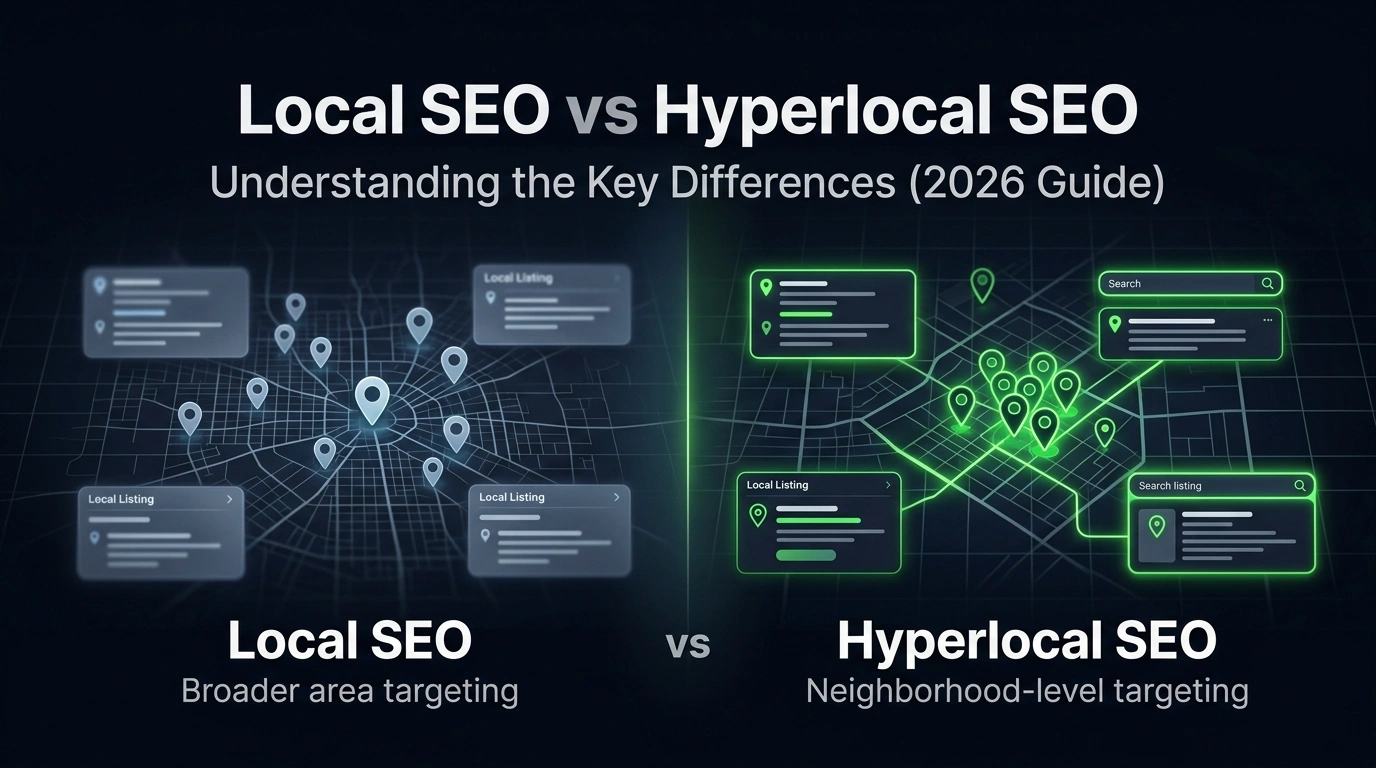
Local search has become more refined over time. Businesses are no longer competing only at the city level, as users now expect results tailored to their exact location. This shift has introduced a more advanced layer of optimization known as hyperlocal SEO.
While both strategies aim to improve visibility in local search, they operate at different levels of precision. Many businesses struggle to understand which approach to prioritize or how to combine them effectively.
This guide breaks down local SEO vs hyperlocal SEO, helping you understand their differences, use cases, and how they can work together to drive better results.
What is Local SEO?
Local SEO is the process of optimizing a business to appear in search results for a specific city or region. It focuses on improving visibility for location-based queries that include broader geographic areas.
This approach typically involves optimizing business listings, targeting city-level keywords, and creating content that reflects the overall market. It is widely used by businesses that want to reach customers across an entire city.
What is Hyperlocal SEO?
Hyperlocal SEO focuses on targeting much smaller geographic areas, such as neighborhoods, streets, or specific zones within a city. It is designed to capture highly specific search queries with strong intent.
Instead of targeting broad city-level keywords, hyperlocal SEO aims to rank for searches that reflect precise locations. This makes it especially effective for businesses that rely on nearby customers or foot traffic.
What Is the Difference Between Local SEO and Hyperlocal SEO?
The main difference lies in the level of targeting. Local SEO focuses on broader areas, while hyperlocal SEO narrows down to very specific locations.
Local SEO typically targets city-level keywords and aims to attract a wider audience. In contrast, hyperlocal SEO focuses on neighborhood-level queries, where competition is often lower but intent is higher.
The content strategy also differs. Local SEO relies on general location-based content, while hyperlocal SEO requires more detailed and specific information tailored to smaller areas.
In terms of competition, local SEO is usually more competitive because it targets larger markets. Hyperlocal SEO, on the other hand, allows businesses to compete in smaller, more focused segments.
How Does Local SEO Work?
Local SEO works by building strong signals that connect a business to a specific city or region. This includes optimizing business listings, using location-based keywords, and creating relevant content.
Search engines evaluate factors such as relevance, proximity, and authority to determine rankings. Businesses that provide accurate information and maintain consistent signals are more likely to perform well.
This approach is suitable for most businesses, especially those that serve customers across a wide area.
How Does Hyperlocal SEO Work?
Hyperlocal SEO works by creating highly specific signals for smaller geographic areas. It focuses on matching user intent at a more granular level.
This involves targeting neighborhood-based keywords, creating location-specific content, and optimizing for proximity. Search engines prioritize businesses that clearly indicate their presence in a particular area.
Because of its precision, hyperlocal SEO often leads to higher engagement and conversions.
When Should Businesses Use Local SEO?
Local SEO is ideal for businesses that want to reach customers across an entire city or region. It works well for companies that offer services in multiple areas or do not rely on foot traffic from a specific neighborhood.
Businesses that are expanding into new cities or building a broader presence can benefit from this approach. It provides a strong foundation for visibility and growth.
When Should Businesses Use Hyperlocal SEO?
Hyperlocal SEO is most effective for businesses operating in competitive urban environments where precision matters. It is particularly useful for physical stores, restaurants, and service providers that depend on nearby customers.
Businesses targeting specific neighborhoods or areas with high foot traffic can use hyperlocal SEO to attract highly relevant users.
What Are the Benefits of Local SEO vs Hyperlocal SEO?
Local SEO provides broader visibility and allows businesses to reach a larger audience within a city. It is effective for building brand presence and attracting diverse customers.
Hyperlocal SEO offers more precise targeting, which often leads to higher conversion rates. By focusing on smaller areas, businesses can connect with users who are closer and more likely to take action.
Both strategies have unique advantages and can complement each other when used together.
Can Local SEO and Hyperlocal SEO Work Together?
Local SEO and hyperlocal SEO are not mutually exclusive. In fact, combining both strategies can create a more comprehensive approach to local search.
Businesses can use local SEO to build visibility at the city level while using hyperlocal SEO to target specific neighborhoods. This layered strategy helps cover both broad and precise search queries.
By integrating both approaches, businesses can maximize their reach and improve overall performance.
What Are Real Examples of Local SEO vs Hyperlocal SEO?
A business targeting “plumber in Berlin” is using local SEO to reach customers across the city. This approach focuses on broader visibility and higher search volume.
In contrast, a business targeting “plumber in Kreuzberg” is using hyperlocal SEO to reach users in a specific neighborhood. This results in more precise targeting and often higher conversion rates.
These examples show how the two strategies differ in scope and effectiveness depending on the goal.
What Are Common Mistakes When Choosing Between Them?
One common mistake is relying only on broad city-level keywords and ignoring hyperlocal opportunities. This can limit visibility in highly targeted searches.
Another issue is over-targeting without a clear strategy, which can lead to scattered efforts and weak results. Businesses should focus on balancing both approaches rather than choosing one exclusively.
Understanding the strengths of each strategy helps avoid these mistakes.
What Is the Future of Local and Hyperlocal SEO?
Local and hyperlocal SEO will continue to evolve as search engines become more focused on user intent and personalization. AI-driven search is making it easier to deliver highly relevant results based on context and location.
Voice search and mobile usage are also increasing the importance of precise targeting. Users expect quick and accurate answers that reflect their exact location.
Businesses that adapt to these trends and invest in both local and hyperlocal strategies will be better positioned for long-term success.
Conclusion
Local SEO and hyperlocal SEO serve different but complementary purposes. While local SEO helps businesses build visibility across a city, hyperlocal SEO allows them to connect with users at a more precise level.
By understanding the differences and combining both strategies, businesses can create a stronger and more effective local SEO approach.


FAQs
Got Questions? We’ve Got Answers – Clear, Simple, and Straight to the Point
Most single-location and small multi-location businesses can pursue both simultaneously by treating hyperlocal as an extension of local, not a separate channel. Same GBP, same citations, same review process — layered with district-level content, neighbourhood-focused blog posts, and hyperlocal keyword targeting on service pages. Businesses with five or more locations across multiple cities usually need a formal split: a central local SEO programme covering all locations at city level, plus district-specific hyperlocal work led by local teams or content owners familiar with each neighbourhood. Trying to run centralised hyperlocal at scale rarely produces genuinely local-feeling content — the district-level signal Google and AI engines look for gets diluted.
Larger cities with genuinely distinct districts benefit most. In Europe: Berlin, Munich, Hamburg, Vienna, Zurich, Amsterdam, Rotterdam, Utrecht, Brussels, Paris, London, Madrid. In North America: New York, Los Angeles, San Francisco, Chicago, Toronto. In these cities, buyers explicitly search at neighbourhood level and competitive intensity at city level is high enough to make district-level differentiation worthwhile. Smaller cities (populations under roughly 300,000) usually don't have enough district-level search volume to justify hyperlocal effort — city-level local SEO covers most opportunity. Distinct district identity matters as much as raw population: cities with strong neighbourhood cultures (Berlin, Amsterdam) reward hyperlocal more than cities with less distinct districts of similar size.
Yes — the two approaches use different sub-metrics even when they draw from the same tools. City-level local SEO watches average local pack ranking, GBP impressions and clicks for city queries, and citation coverage across city-level directories. Hyperlocal SEO tracks grid-based rank at multiple points around the location (not just city centre), impressions on district and postcode-level queries, and district-specific competitor benchmarks. Grid-based rank trackers (Local Falcon, GeoRanker) become non-optional for hyperlocal because average city positions hide the district-level variance where hyperlocal wins or loses. Businesses measuring only city-average ranking usually miss whether their hyperlocal effort is actually working.
Hyperlocal SEO earns its investment when three conditions hold: your city is competitive enough that ranking at city level requires more resources than you have; buyers in your category actually search at district or neighbourhood level (dentists, plumbers, restaurants, gyms, real estate almost always yes; specialised B2B services often no); and you can produce genuinely local content per district, not just templated pages. Businesses in smaller cities or less competitive categories usually get better returns from strong city-level local SEO alone. UnFoldMart's client engagements typically start with city-level SEO and add hyperlocal targeting only after city-level ranking is stable — doing both simultaneously usually spreads effort too thin.
Local SEO targets city or metropolitan-area queries — "orthodontist Amsterdam," "tax accountant Berlin." Hyperlocal SEO targets smaller geographic units: neighbourhoods, districts, postcodes, or even street-level queries — "orthodontist Amsterdam-Zuid," "tax accountant Berlin-Kreuzberg," "restaurant near Museumsquartier." The two share the same foundational infrastructure (Google Business Profile, citations, reviews, LocalBusiness schema) but hyperlocal adds a layer of neighbourhood-specific content, district-level keyword targeting, and community signals that city-level local SEO doesn't require. Hyperlocal is a subset of local, not a replacement — you can't do hyperlocal well without solid local foundations.

Want to Turn Your Brand Into a Scalable Growth Engine?
We help modern businesses unify branding, websites, SEO, and paid media into one performance-driven system designed to scale.