Google Maps Ranking Factors: How to Rank Higher in Local Search (2026 Guide)
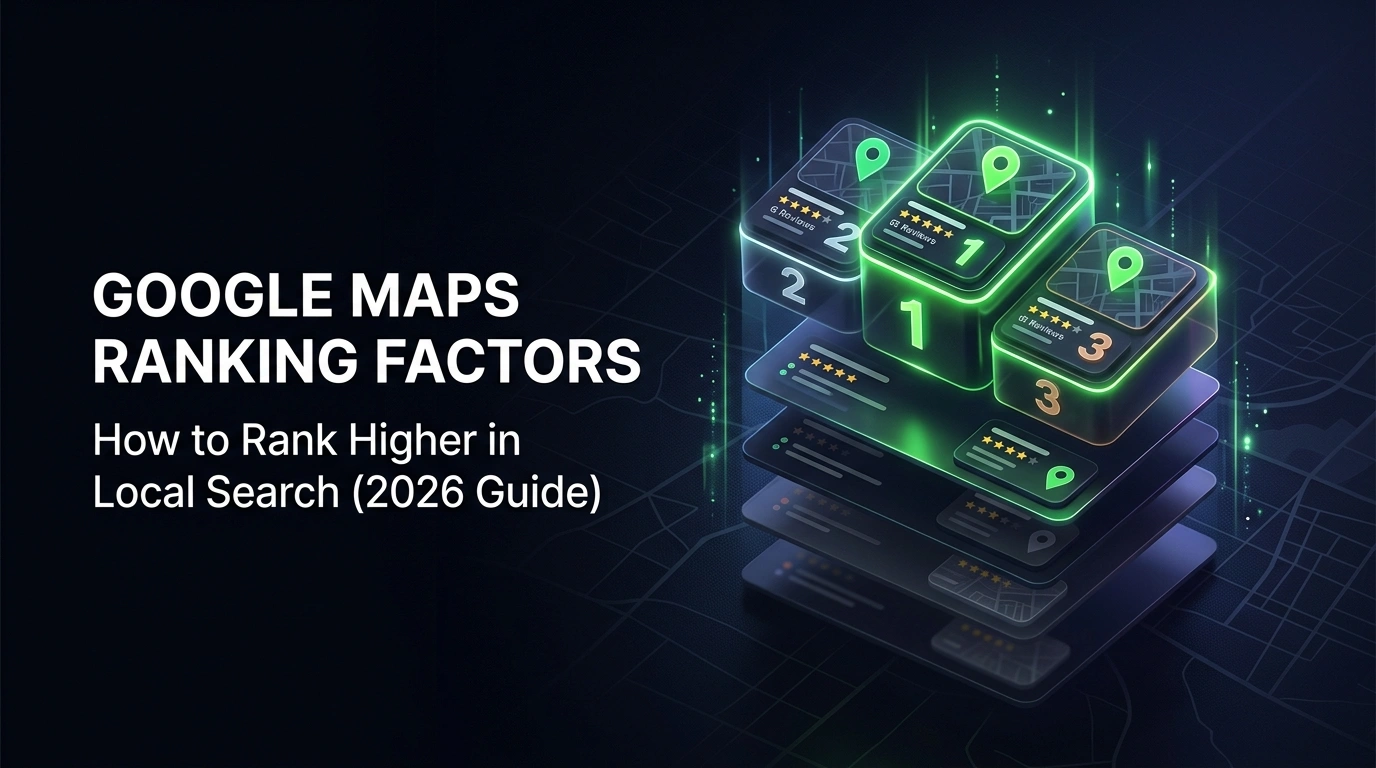
Google Maps has become one of the most important platforms for local search. Whether users are looking for a restaurant, a repair service, or a retail store, they often rely on map results to find nearby options quickly.
With the growth of mobile usage and location-based searches, appearing in Google Maps results can directly impact foot traffic, calls, and sales. Businesses that rank higher on Google Maps are more likely to attract customers who are ready to take action.
Understanding Google Maps ranking factors is essential for any business that wants to improve visibility and compete effectively in local search.
What Are Google Maps Ranking Factors?
Google Maps ranking factors are the criteria used by search engines to determine which businesses appear in local map results and in what order.
These factors help search engines evaluate which businesses are most relevant, trustworthy, and useful for a user’s query.
They are closely tied to your Google Business Profile and your overall local SEO strategy.
How Does Google Maps Ranking Work?
Google Maps rankings are primarily based on three core factors:
- Proximity
- Relevance
- Authority
Proximity refers to how close your business is to the user’s location. Relevance measures how well your business matches the search query. Authority reflects how trusted and credible your business appears online.
These factors work together to determine which businesses appear at the top of local results.
What Are the Most Important Google Maps Ranking Factors?
Google Business Profile Optimization
A complete and accurate Google Business Profile is the foundation of ranking.
Key elements:
- Correct name, address, and phone number
- Proper business categories
- Detailed description with relevant keywords
- Updated business hours
Business Location and Proximity
Your physical location plays a major role in ranking.
Important points:
- Businesses closer to the user are more likely to appear
- Exact location cannot be controlled, but relevance can be improved
Relevance to Search Query
Search engines match your business information with user queries.
Ways to improve relevance:
- Use relevant keywords in your profile
- Clearly define your services
- Align content with user intent
Reviews and Ratings
Reviews are one of the most influential ranking factors.
Focus on:
- Number of reviews
- Average rating
- Recency of reviews
- Keywords mentioned in reviews
Example:
A restaurant with consistent positive reviews mentioning its location is more likely to rank higher.
Citations and Listings
Citations are mentions of your business on directories and platforms.
Key factors:
- Consistent business information
- Listings on trusted platforms
- Presence across multiple directories
Backlinks and Authority
Links from other websites signal trust and credibility.
Best practices:
- Get links from local websites
- Focus on quality over quantity
- Build relationships with local platforms
User Engagement Signals
User interactions influence rankings.
Examples:
- Clicks on your listing
- Calls from your profile
- Requests for directions
Higher engagement indicates that your listing is useful.
Photos and Content Updates
Regular updates improve visibility and trust.
Important actions:
- Upload high-quality images
- Update content regularly
- Showcase real products or services
Website Optimization
Your website supports your local ranking.
Key elements:
- Use local keywords
- Ensure mobile optimization
- Improve page speed
Behavioral Signals
Search engines analyze how users interact with your listing over time.
Examples:
- Time spent on listing
- Repeat visits
- Interaction patterns
How Can Businesses Improve Their Google Maps Ranking?
- Fully optimize your Google Business Profile
- Use accurate and consistent business details
- Encourage and respond to customer reviews
- Upload high-quality images regularly
- Build local citations and backlinks
- Optimize your website for local SEO
- Use location-based keywords
- Keep your business information updated
- Improve user engagement through better listings
- Monitor performance and adjust strategies
These actions help improve both visibility and credibility in local search.
What Are Common Google Maps Ranking Mistakes to Avoid?
- Incomplete or outdated business profile
- Incorrect or inconsistent business information
- Ignoring customer reviews
- Overusing keywords unnaturally
- Lack of local backlinks
- Poor-quality or missing images
Avoiding these mistakes helps maintain strong rankings and user trust.
How Do Google Maps Rankings Vary by Location?
Google Maps rankings can differ depending on the city and level of competition.
For example:
- In Amsterdam, competition may be higher due to dense urban activity
- In Zurich, trust and reviews may play a stronger role
- In Berlin, search behavior may vary by neighborhood
This means businesses must adapt their strategy based on location and audience.
What Is the Future of Google Maps Ranking?
Google Maps ranking will continue to evolve with advancements in technology.
Key trends:
- AI-driven local search results
- Increased personalization based on user behavior
- Growth of voice and mobile searches
- Greater importance of engagement signals
Businesses that stay updated and adapt to these changes will maintain a competitive edge.
Conclusion
Google Maps ranking factors play a crucial role in local SEO success. By optimizing your business profile, improving relevance, and building trust, businesses can increase their visibility and attract more customers.
A strong presence on Google Maps is no longer optional. It is a key driver of growth in local search.


FAQs
Got Questions? We’ve Got Answers – Clear, Simple, and Straight to the Point
The 3-pack is what appears in standard Google search results and Maps AI Overviews — three businesses selected as the strongest overall match. Getting into it requires performing well on all three ranking factors, not just being nearby. The expanded Maps view shows dozens of results and gives lower-ranking businesses far more visibility, but conversion from expanded Maps is lower than from the 3-pack. The practical implication: rank tracking for local businesses should measure both, but the 3-pack drives most of the actual leads. Businesses hovering at positions 4–10 usually see the biggest lead gains from breaking into the pack.
Meaningfully. Google's local algorithm treats direction requests, phone calls, website clicks, and photo views from Maps as engagement signals that reinforce ranking. A business that consistently earns direction requests and calls from Maps sees compounding ranking gains over time; a business with high impressions but low engagement gradually loses position. This is one reason optimising the profile itself — photos, categories, description, offer posts — matters more than most owners realise. The profile isn't just a listing; it's actively judged on whether it converts the impressions it earns.
Prominence is built from a mix of offline and online signals: review volume and quality, review recency, backlinks to the business website, unlinked brand mentions across trusted sources, citations in local directories, media coverage, and behavioural signals like click-through and direction-request rate. Older well-known businesses get a natural prominence boost that newer businesses can't match immediately. The fastest way for newer businesses to build prominence is a combined push on reviews (steady flow with owner responses), local press and community mentions, and consistent citations — not one of those in isolation.
Proximity is the hardest factor to influence because you can't move your business, but it's less absolute than most people think. Google doesn't just use straight-line distance — it also considers relevance and prominence when deciding which businesses to include in the results for a given searcher location. A highly relevant, prominent business three kilometres away often outranks a weaker business one kilometre away for the same query. That's why businesses outside a dense city core aren't automatically shut out; they just have to compensate with stronger relevance and prominence signals.
Google uses three primary ranking factors for Maps and the local pack: proximity (how close the business is to the searcher's location or the query's implied location), relevance (how well the business matches the intent of the search — categories, description, services, review keywords), and prominence (how well-known and trusted the business is online — review volume, backlinks, mentions across the web). All three matter, but weightings shift by query type. Generic queries lean heavier on prominence and relevance; "near me" queries lean heavier on proximity. Understanding which factor dominates each of your target queries is the starting point for any real ranking plan.

Want to Turn Your Brand Into a Scalable Growth Engine?
We help modern businesses unify branding, websites, SEO, and paid media into one performance-driven system designed to scale.