Google Business Profile Optimization: A Complete Guide for 2026
Learn how to optimize your Google Business Profile to rank higher in local search and Google Maps. Boost visibility, reviews, and customer engagement in 2026.
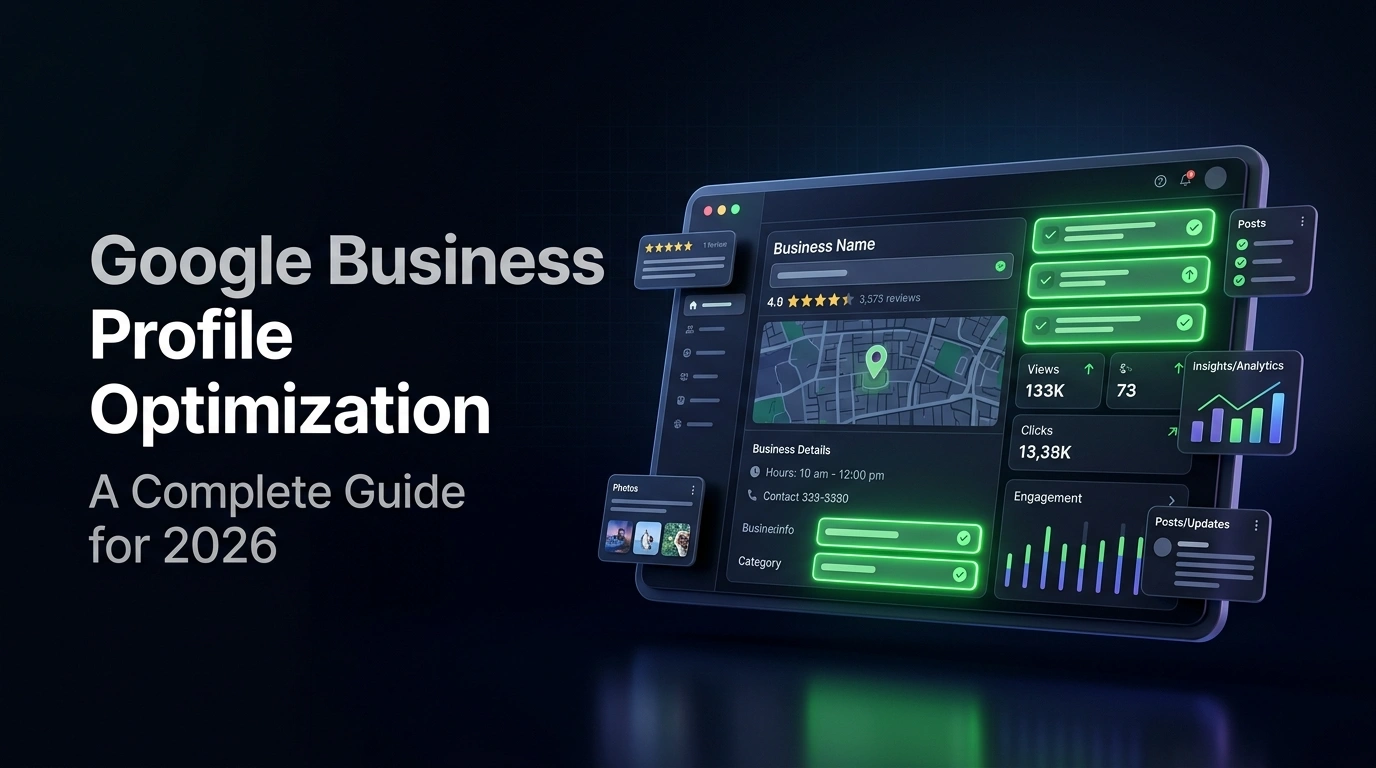
Learn how to optimize your Google Business Profile to rank higher in local search and Google Maps. Boost visibility, reviews, and customer engagement in 2026.
Real projects across branding, packaging, websites and growth.
Straight answers on this topic from the UnFoldMart team.
From branding and packaging to Webflow websites, SEO, AEO and GEO, UnFoldMart brings strategy, design and growth under one team for 250+ brands across 10 markets. Tell us where you want to grow and we'll show you the fastest way there.
Google Business Profile plays a central role in how customers discover businesses in local search. When users search for nearby services, results from Google Maps and local listings often appear before traditional websites.
With the rise of mobile and location-based searches, businesses that optimize their Google Business Profile are more likely to attract customers who are ready to take action. Whether someone is looking for a restaurant, a salon, or a repair service, they typically choose from the top listings they see.
Google Business Profile optimization helps businesses improve visibility, build trust, and increase engagement in local search results.
Google Business Profile optimization is the process of improving your business listing to increase visibility in local search and Google Maps results.
It involves updating business information, adding relevant content, and improving engagement signals so that search engines can better understand and rank your business.
This process is essential for improving local SEO performance.
Google Business Profile has a direct impact on how businesses appear in local search results.
Key reasons it is important:
A well-optimized profile makes it easier for customers to choose your business over competitors.
Google Business Profile influences rankings through three main factors:
Proximity determines how close your business is to the user. Relevance measures how well your listing matches the search query. Authority reflects trust signals such as reviews and engagement.
Optimizing your profile improves all three factors, increasing your chances of ranking higher.
Accurate business information is the foundation of optimization.
Key actions:
Selecting the right categories helps search engines understand your business.
Best practices:
Your description should clearly explain what your business offers.
Tips:
Images improve engagement and trust.
Key actions:
Reviews are one of the most important ranking factors.
Focus on:
Regular updates keep your profile active.
Examples:
Consistency helps improve visibility.
Listing your offerings helps users understand your business.
Best practices:
These strategies help improve both rankings and customer interactions.
A restaurant can increase visibility by uploading updated menu images, maintaining accurate opening hours, and collecting reviews that mention location and service quality.
A salon can attract more bookings by posting regular updates, sharing service photos, and responding to customer feedback.
A repair service can improve calls and inquiries by keeping contact details accurate and adding clear service descriptions.
These examples show how optimization leads to better engagement and higher visibility.
Avoiding these mistakes helps maintain strong rankings and trust.
Google provides insights to help businesses understand performance.
Key metrics to track:
Regular analysis helps improve strategy and results.
Google Business Profile will continue to evolve with changes in search behavior.
Key trends:
Businesses that stay updated will have a competitive advantage.
Google Business Profile optimization is essential for businesses that want to improve visibility and attract local customers. By maintaining accurate information, engaging with users, and regularly updating content, businesses can strengthen their presence in local search.
A well-optimized profile not only improves rankings but also builds trust and drives meaningful results.
Straight answers on this topic from the UnFoldMart team.
Yes — changes to GBP fields are among the most common causes of ranking movement and, when done wrong, suspension. Category changes, name edits that add keywords not in your legal business name, address changes without matching updates elsewhere, and rapid photo bulk uploads can all trigger reviews or temporary suspension. Best practice: change one significant field at a time, wait 2–4 weeks between major edits, verify NAP consistency across every listing before any change, and document a rollback plan. Businesses managing multi-location GBPs benefit from formal change control — UnFoldMart's local SEO audits include this process for clients with more than three locations.
GBP feeds directly into AI answer surfaces for local queries. When someone asks Google's AI Overview, ChatGPT, or Perplexity "best [service] near me" or "[service] in [city]," the AI often pulls category, review, hours, and description data straight from Google Business Profiles rather than the website. Businesses with thin or outdated GBPs get skipped in these AI answers even if their website ranks well. Practical fix: treat the GBP description, categories, and services list as AI-search content, not just Google Maps content — write them as extractable, entity-rich answers to the actual queries customers use.
Substantially — review recency, volume, response rate, and diversity of review keywords are among the strongest signals for local pack ranking in 2026. A steady flow of recent reviews (a handful per month) consistently outperforms a large stockpile of older ones. Owner responses matter almost as much as the reviews themselves; Google reads them as engagement and trust signals, and prospective customers read them as service quality. Buying or gating reviews violates Google's guidelines and increasingly gets flagged — the safer growth path is a documented internal process for asking every customer post-service.
Seven fundamentals compound most reliably: (1) a fully completed primary and secondary category selection matching how customers actually describe your business; (2) NAP (name, address, phone) consistency across every online listing; (3) a steady flow of recent reviews with responses to every one; (4) regular Google Posts (weekly minimum) covering offers, events, and updates; (5) high-quality photos refreshed monthly, including exterior, interior, product, and team shots; (6) accurate service-area or hours data including special holiday hours; and (7) the Q&A section actively managed — both customer questions and owner-seeded questions.
Google Business Profile (GBP) has moved from a nice-to-have local listing to a core ranking asset in 2026. It drives visibility in Google Maps, the local pack on standard search, and increasingly inside Google AI Overviews for local queries — all three surfaces pull heavily from GBP data. For any business with a physical location or defined service area, a poorly maintained GBP silently caps how much organic traffic and enquiries the business can earn, regardless of how well the website itself is optimised. In many local categories, GBP outperforms the main website as a lead source.