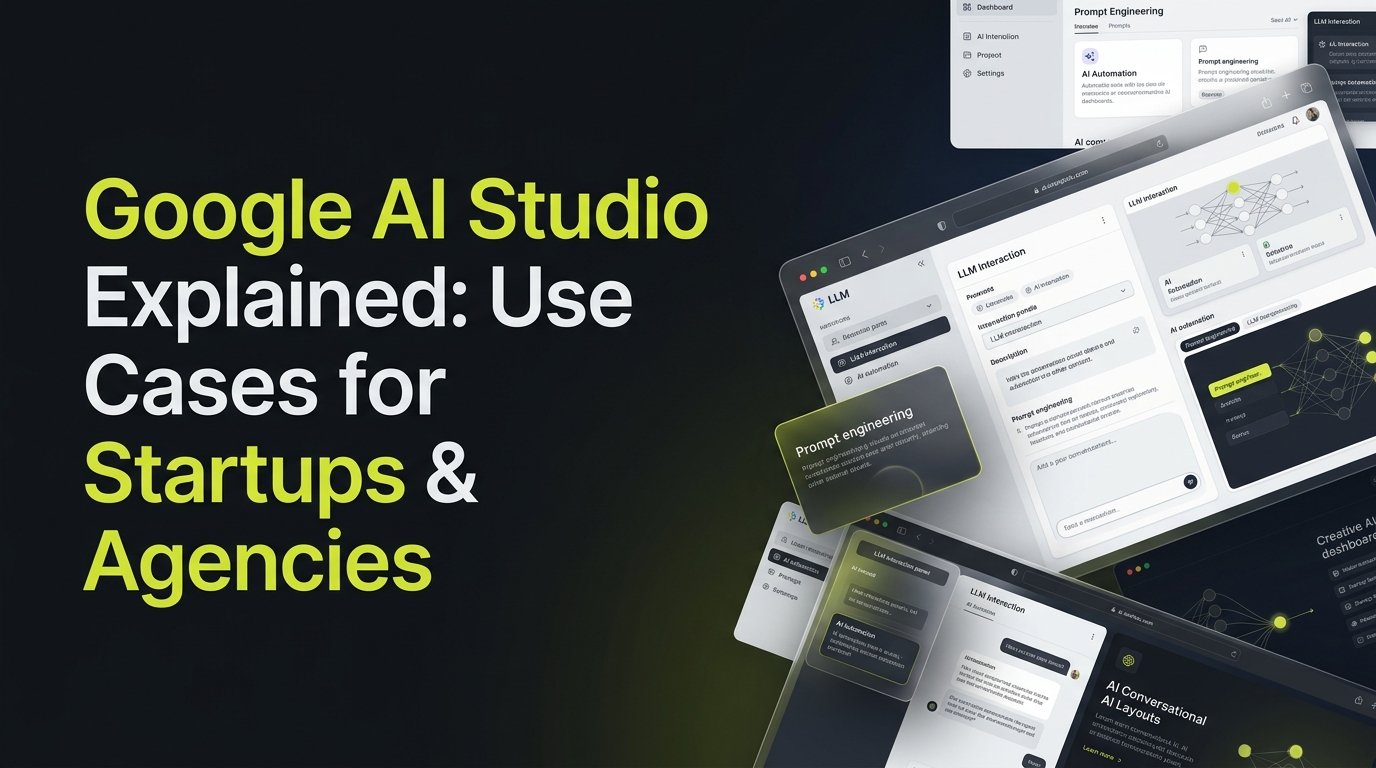
Google AI Studio Explained: Use Cases for Startups & Agencies
Learn what Google AI Studio is, how it works, and real use cases for startups and agencies building AI-powered workflows.
Learn what Google AI Studio is, how it works, and real use cases for startups and agencies building AI-powered workflows.
Real projects across branding, packaging, websites and growth.
Straight answers on this topic from the UnFoldMart team.

From branding and packaging to Webflow websites, SEO, AEO and GEO, UnFoldMart brings strategy, design and growth under one team for 250+ brands across 10 markets. Tell us where you want to grow and we'll show you the fastest way there.
Startups are using AI to move faster with fewer resources. Agencies are using AI to scale output without scaling headcount. In this shift, one tool is quietly gaining attention among technical and growth-focused teams.
Google AI Studio
Unlike consumer AI tools designed mainly for chatting or content drafts, Google AI Studio is built for building, testing, and deploying AI-powered workflows.
This article explains what Google AI Studio actually is, how it works, and where it makes sense for startups and agencies in the real world.
Most businesses already rely on Google for search, ads, analytics, cloud, and productivity. Google AI Studio extends that ecosystem into custom AI workflows.
At the same time:
Google AI Studio sits between no-code AI tools and full custom AI development. That makes it especially attractive for teams that want power without extreme complexity.
Google AI Studio is a development environment for working with Google’s generative AI models.
It allows users to:
Unlike consumer tools, Google AI Studio is not just about getting answers. It is about building AI behavior that can be reused, scaled, and integrated into products or workflows.
Think of it as a workspace for designing how AI should behave inside your business systems.
Google AI Studio provides an interface where users interact directly with AI models.
Key elements include:
You can experiment in the interface, then deploy the same logic into apps, dashboards, or internal tools.
This makes it suitable for teams that want consistent AI behavior instead of one-off responses.
ChatGPT is excellent for conversation, brainstorming, and drafting. Google AI Studio serves a different purpose.
ChatGPT focuses on interaction. Google AI Studio focuses on implementation.
Key differences:
For businesses, the choice is not either or. Many teams use ChatGPT for thinking and Google AI Studio for building.
Startups use Google AI Studio to analyze market data, summarize research, and explore feature ideas systematically.
Instead of ad hoc brainstorming, teams can create structured prompts that generate consistent insights across topics.
Google AI Studio enables startups to embed AI features into early products.
Examples include:
This reduces development time while allowing teams to test real user behavior.
Startups can build AI systems trained on documentation, FAQs, and policies to handle first-line support queries.
Because outputs can be structured and controlled, responses stay aligned with brand tone and accuracy requirements.
Growth teams use Google AI Studio to test content variations, generate structured landing page copy, and analyze messaging performance.
This supports faster experimentation without relying entirely on manual effort.
Agencies use Google AI Studio to standardize content generation across clients.
Instead of prompting manually each time, they build reusable prompt frameworks for:
This improves consistency and efficiency.
AI Studio can assist in clustering keywords, analyzing SERP intent, and generating content structures aligned with search behavior.
Because outputs can be formatted cleanly, they integrate easily into SEO tools and dashboards.
Agencies use AI to summarize campaign data, identify trends, and generate insights from large datasets.
This reduces reporting time and allows teams to focus on strategy instead of spreadsheets.
Google AI Studio helps agencies automate repetitive internal tasks like proposal drafts, research summaries, and onboarding documentation.
This frees senior team members to focus on higher-value work.
Google AI Studio offers several advantages for startups and agencies.
It provides:
For teams already invested in Google Cloud or Workspace, adoption feels natural.
Google AI Studio is powerful, but it is not for everyone.
Limitations include:
It is best suited for teams willing to invest time in setup and optimization.
Google AI Studio makes sense when:
It may not be ideal when:
Choosing the right tool depends on the job, not the hype.
For startups and agencies new to the platform:
Small, focused implementations work better than broad automation attempts.
To get real value from Google AI Studio:
AI works best as a support system, not a replacement for thinking.
Using tools like Google AI Studio allows businesses to:
This is especially important for agencies that want to differentiate beyond deliverables.
Google AI Studio is not magic.
It does not replace strategy, creativity, or expertise. But it gives startups and agencies the ability to build AI into how they work, not just use it occasionally.
Teams that treat it as infrastructure rather than a novelty will gain a lasting advantage.
The question is not whether to use AI, but how intentionally you use it.
AI tools are only valuable when aligned with real business goals.
At UnFoldMart, we help startups and agencies integrate AI into SEO, content, and growth systems that actually scale.
👉 Talk to our team and build AI workflows that deliver real impact.
Straight answers on this topic from the UnFoldMart team.
When configured properly with governance and security practices, it can be used safely for business workflows.
Yes. It integrates well with Google Cloud, APIs, and related services.
They serve different purposes. ChatGPT is better for conversation and ideation. Google AI Studio is better for building AI workflows.
It typically includes free usage tiers, with costs increasing based on usage and API calls.