GEO vs SEO vs AEO: What’s the Difference and Which Strategy Wins in 2026?
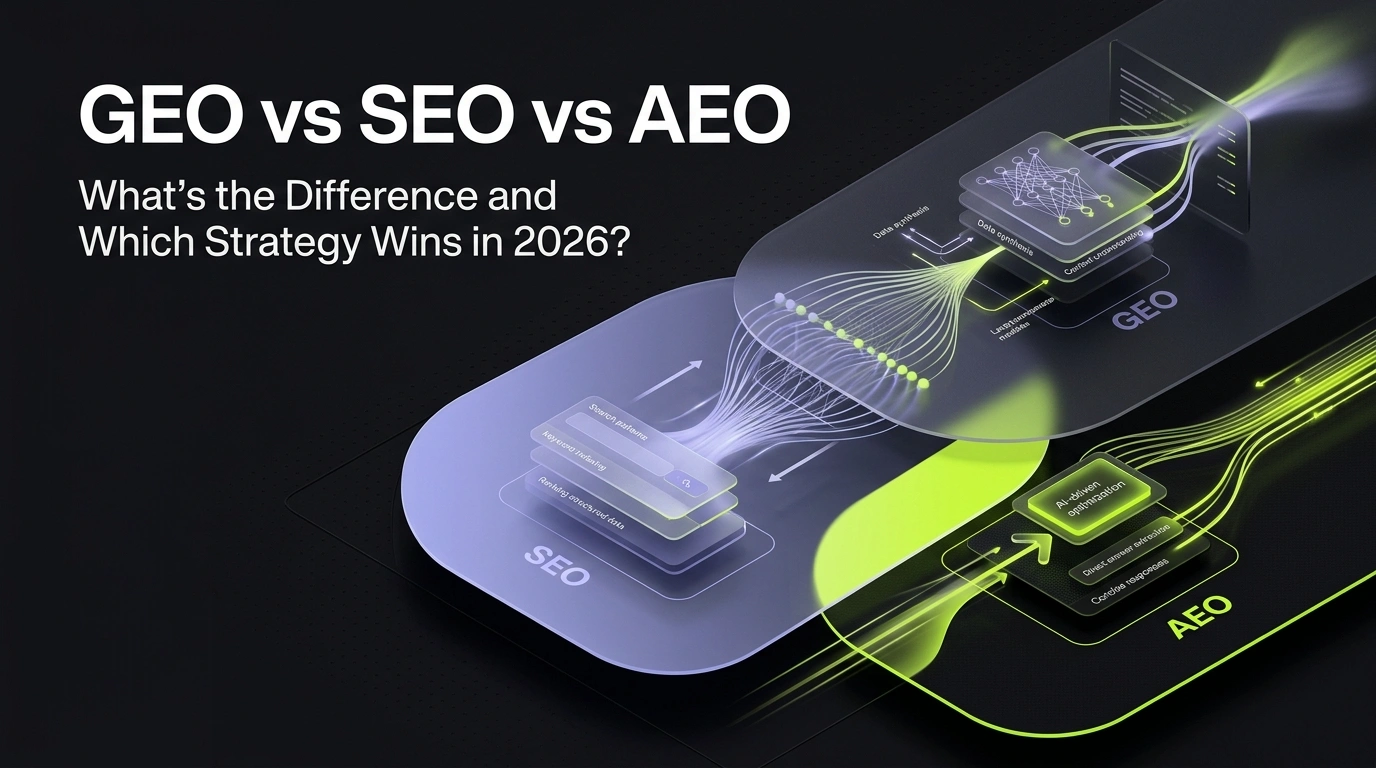
If you have been exploring digital marketing trends recently, you have likely come across multiple terms such as SEO, AEO, and GEO. For many businesses, this creates confusion. Are these different strategies? Are they competing approaches? Or are they simply different stages of how search is evolving?
The reality is that search itself is changing. What started as keyword-based optimization has now moved toward answer-driven and AI-powered experiences. Users are no longer just searching. They are asking, expecting instant responses, and increasingly relying on AI-generated outputs.
For businesses, especially those operating or expanding across Europe, this shift is significant. It affects how content is created, how visibility is achieved, and ultimately how customers are acquired.
In this guide, we will break down what SEO, AEO, and GEO mean, how they differ, and how businesses can use them together to build a future-ready search strategy in 2026.
What Is SEO?
Search Engine Optimization, commonly known as SEO, is the traditional approach to improving a website’s visibility on search engines like Google. The primary goal of SEO has always been to rank higher in search results and drive organic traffic to a website.
SEO focuses on several core elements, including keyword research, content optimization, technical performance, and link building. Over the years, it has evolved from simple keyword placement to a more sophisticated practice centered around user intent and content quality.
Even in 2026, SEO remains the foundation of any digital growth strategy. Businesses still need optimized websites, strong content, and technical performance to remain visible in search engines.
However, SEO alone is no longer sufficient. It is now part of a broader ecosystem that includes answer engines and AI-driven platforms.
What Is AEO (Answer Engine Optimization)?
Answer Engine Optimization, or AEO, focuses on optimizing content to appear as direct answers within search results. Instead of prioritizing clicks, AEO is about providing immediate value to users.
This approach gained importance with the rise of featured snippets, voice assistants, and conversational search. When users ask questions such as “What is AI SEO?” or “How does digital marketing work?”, search engines aim to deliver a clear and concise answer instantly.
AEO requires content to be structured in a way that makes it easy for search engines to extract and present information. This often includes well-defined headings, direct answers, and clear formatting.
While SEO aims to bring users to your website, AEO ensures your content is visible even if users do not click. It is particularly valuable for building brand authority and visibility in high-intent queries.
What Is GEO (Generative Engine Optimization)?
Generative Engine Optimization, or GEO, represents the next stage in the evolution of search. It focuses on optimizing content for AI-driven platforms that generate responses instead of simply displaying results.
These platforms include AI-powered search experiences, conversational engines, and generative tools that synthesize information from multiple sources to provide answers.
In this environment, visibility is no longer about ranking or even appearing in a snippet. It is about being included in the data that AI systems use to generate responses.
GEO emphasizes:
- Content authority and credibility
- Context-rich, comprehensive information
- Clear and structured communication
- Consistent brand presence across digital platforms
For businesses, GEO is becoming increasingly important as AI continues to reshape how users access information. It is not a replacement for SEO or AEO, but rather an extension that prepares brands for the future of search.
SEO vs AEO vs GEO: Key Differences
Understanding the differences between these three approaches helps clarify how they fit into a modern strategy.
Verdict:
SEO builds the foundation, AEO improves visibility within search results, and GEO prepares your content for AI-driven discovery. Together, they form a complete search strategy.
How Search Is Evolving
To understand why these approaches matter, it is important to look at how search behavior has changed over time.
Initially, search was keyword-driven. Users entered short phrases, and search engines returned a list of links. Over time, this evolved into more sophisticated queries, where intent and context became important.
Today, search is increasingly conversational. Users ask full questions, expect immediate answers, and interact with AI systems that can understand nuance and provide detailed responses.
This shift has led to the rise of zero-click searches, where users find what they need without visiting a website. It has also introduced AI as a primary interface for information discovery.
As a result, businesses must optimize not only for search engines but also for answer engines and generative platforms.
When to Use SEO, AEO, and GEO
Each approach serves a different purpose, and the right strategy depends on business goals.
SEO is essential for long-term growth. It helps build a strong online presence, drive consistent traffic, and establish authority over time. Businesses focused on website performance and lead generation cannot ignore SEO.
AEO becomes important when visibility within search results matters. It is particularly useful for capturing high-intent queries, appearing in featured snippets, and optimizing for voice search.
GEO is most relevant for businesses looking to stay ahead of the curve. It is ideal for companies that want to ensure their content is included in AI-generated responses and remain visible as search continues to evolve.
In practice, most businesses will benefit from using all three approaches together rather than choosing one over the others.
Benefits of Each Approach
Each strategy offers distinct advantages that contribute to overall growth.
SEO provides stability and long-term traffic. It builds a strong foundation that supports all other marketing efforts.
AEO enhances visibility by positioning content as a direct answer. This can improve brand recognition and credibility, even in zero-click environments.
GEO offers future positioning. As AI becomes more dominant, businesses that invest in GEO will be better prepared to maintain visibility and relevance.
Together, these approaches create a balanced and resilient search strategy.
Challenges and Limitations
Despite their advantages, each approach comes with its own set of challenges.
SEO can be slow and highly competitive. Achieving and maintaining rankings requires consistent effort and ongoing optimization.
AEO offers limited control. Even if your content is selected as an answer, it may be summarized in a way that does not fully represent your brand.
GEO is still evolving. Best practices are not fully defined, and measuring performance can be difficult.
Understanding these limitations is important for setting realistic expectations and building effective strategies.
GEO, SEO, and AEO in Europe
The complexity of applying these strategies increases in the European market.
Businesses must deal with multiple languages, diverse cultural contexts, and varying search behaviors across countries. A strategy that works in Germany may not be effective in the Netherlands or Switzerland.
In addition, data privacy regulations influence how search engines personalize results, which can impact both AEO and GEO strategies.
For companies expanding across Europe, success depends on combining localization with scalability. Content must be adapted to each market while maintaining consistency in quality and messaging.
This is where a well-integrated approach to SEO, AEO, and GEO becomes particularly valuable.
The Hybrid Strategy: Why Businesses Need All Three
Rather than viewing SEO, AEO, and GEO as separate strategies, businesses should see them as complementary components of a unified approach.
SEO provides the foundation by ensuring your website is visible and technically optimized. AEO builds on this by increasing your chances of appearing in direct answers and featured results. GEO extends your reach into AI-driven platforms, ensuring your content remains relevant as search evolves.
This hybrid model allows businesses to:
- Maintain consistent traffic
- Increase visibility across multiple search formats
- Future-proof their digital strategy
In 2026, the most successful companies will not choose between these approaches. They will integrate them.
Ready to Build a Future-Ready Search Strategy?
Search is no longer limited to rankings and clicks. It now includes answers, conversations, and AI-generated insights.
At UnFoldMart, we help businesses design integrated SEO, AEO, and GEO strategies that drive visibility, traffic, and growth across European markets.
Whether you are looking to strengthen your current SEO efforts or prepare for the future of AI-driven search, our team can help you build a strategy that delivers measurable results.
👉 Book a strategy call with UnFoldMart to explore your growth opportunities.



FAQs
Got Questions? We’ve Got Answers – Clear, Simple, and Straight to the Point
There's real risk of duplication and confused reporting if the three are treated as separate service lines. In practice, the same team should own all three, with skill additions rather than function separations: SEO practitioners add prompt-level research, deeper schema and entity work, and AI-citation analysis. Agencies that split GEO or AEO into standalone products usually deliver disjointed strategy and force clients to reconcile three sets of reporting. UnFoldMart operates GEO and AEO as integrated layers inside a modern SEO engagement rather than separate deliverables.
The right split depends on where your buyers actually search. A rough 2026 starting point: pipeline-heavy B2B, SaaS, and considered-purchase brands (buyers using ChatGPT/Perplexity for research) benefit from roughly 40% SEO, 30% AEO, 30% GEO effort. Local services and transactional consumer brands (buyers still on Google) fit closer to 60% SEO, 25% AEO, 15% GEO. Media and content publishers usually invert that: 30% SEO, 40% AEO, 30% GEO because AI engines quote them heavily. UnFoldMart's client planning sets the split from a diagnostic audit of where buyers actually query, not a template.
Meaningfully, but on shared foundations. Traditional SEO's core work — crawlability, on-page structure, backlinks, keyword targeting — supports all three layers. Where the tools diverge is in measurement and specialty: SEO uses Google Search Console, Semrush, Ahrefs; AEO adds schema validators, featured-snippet trackers, and People Also Ask monitoring; GEO adds prompt-level tracking through Profound, Otterly, or Peec to measure share of voice inside ChatGPT and Perplexity answers. Teams that try to run all three from a single legacy SEO tool usually miss the AI-citation layer entirely.
None of them alone — the question is misleading. In 2026 the winning strategy stacks all three: SEO gives you the ranking foundation AI engines draw from, AEO makes your content extractable across every answer surface, and GEO focuses that extraction specifically on the LLM outputs where growing shares of buyer research happen. Businesses picking just one usually pick SEO out of habit and quietly lose citation share to competitors doing all three. The right question isn't "which wins" — it's "what proportion of effort goes to each layer given my buyers' actual search behaviour."
SEO optimises for ranked links on classic search engines (Google, Bing). AEO — Answer Engine Optimization — optimises for being the source cited inside direct-answer surfaces, from Google's featured snippets and People Also Ask up to full AI answers. GEO — Generative Engine Optimization — is the narrower newer term, specifically about being cited inside LLM-generated outputs (ChatGPT, Perplexity, Claude, Copilot). The industry treats them as overlapping circles rather than three separate strategies: SEO is the foundation, AEO is the middle layer, GEO is the newest specialisation focused on generative AI outputs specifically.

Want to Turn Your Brand Into a Scalable Growth Engine?
We help modern businesses unify branding, websites, SEO, and paid media into one performance-driven system designed to scale.