The Future of Search in Europe: Key Trends Shaping Digital Discovery (2026)
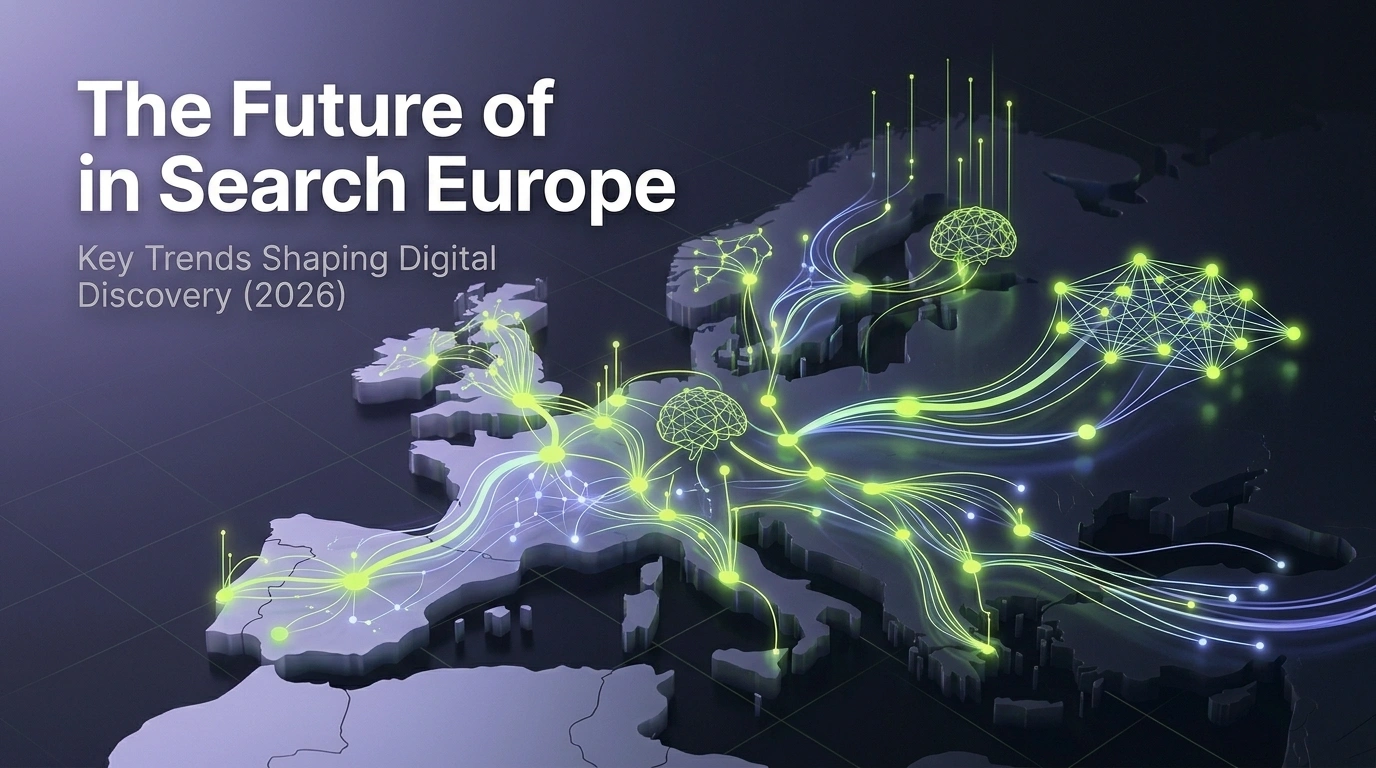
Search is undergoing one of the most significant transformations in its history. What was once a system of matching keywords to links is now evolving into an intelligent, AI-driven ecosystem that delivers direct answers, personalized experiences, and conversational interactions.
In Europe, this transformation is even more complex. Businesses must navigate multiple languages, diverse cultural behaviors, and strict regulatory frameworks while adapting to rapid technological change.
For companies operating across European markets, search is no longer just a marketing channel. It is a strategic function that directly impacts visibility, customer acquisition, and long-term growth.
Understanding where search is headed is not just useful. It is essential.
In this article, we explore how search has evolved, the key trends shaping its future in Europe, and how businesses can prepare for a landscape that is increasingly driven by artificial intelligence and user intent.
How Search Has Evolved
To understand the future, it is important to look at how search has changed over time.
In its early stages, search was primarily keyword-driven. Users entered short phrases, and search engines returned a list of relevant links. Optimization focused on matching these keywords as closely as possible.
As search engines became more advanced, they began to prioritize intent. This marked a shift toward understanding what users were actually looking for rather than simply matching words.
Today, search is entering a new phase. AI-driven systems can interpret complex queries, generate answers, and provide contextual responses. Users are no longer just searching. They are interacting.
This evolution sets the foundation for the trends shaping the future of search in Europe.
Key Trends Shaping the Future of Search in Europe
Rise of AI-Driven Search Experiences
AI is fundamentally redefining how search engines operate. Instead of presenting a list of links, platforms are increasingly delivering direct, synthesized answers.
For users, this reduces friction and speeds up decision-making. For businesses, it shifts the focus from ranking positions to being included in AI-generated responses.
This trend is likely to accelerate as AI capabilities continue to improve.
Growth of Zero-Click Searches
One of the most noticeable changes is the increase in zero-click searches. Users often find the information they need directly on the search results page or within AI-generated answers.
This has significant implications for traffic. Even high-ranking pages may see fewer clicks, forcing businesses to rethink how they measure success.
Visibility is no longer just about driving visits. It is about being present in the answer itself.
Multilingual and Localized Search Expansion
Europe’s linguistic diversity makes search more complex than in many other regions. Users search in different languages, often with unique cultural nuances.
As AI becomes more advanced, search engines are improving their ability to understand and process multilingual queries. However, businesses must still ensure that their content is properly localized.
Localization is not just about translation. It involves adapting content to reflect local intent, behavior, and expectations.
Personalization and Contextual Search
Search results are becoming increasingly personalized. AI systems analyze user behavior, preferences, and context to deliver tailored results.
This means that the same query can produce different outcomes depending on the user’s location, history, and intent.
For businesses, this adds complexity but also creates opportunities to target specific audiences more effectively.
Voice and Conversational Search
The rise of voice assistants and conversational interfaces is changing how users interact with search.
Instead of typing short queries, users are asking full questions in natural language. This requires content to be structured in a way that aligns with conversational patterns.
Businesses that adapt to this shift will be better positioned to capture emerging search opportunities.
Visual and Multimodal Search
Search is no longer limited to text. Users are increasingly using images, videos, and other formats to discover information.
AI enables search engines to interpret and connect these different formats, creating a more integrated experience.
For businesses, this means expanding beyond written content and optimizing for multiple formats.
Increased Focus on Trust and Regulation
Trust is becoming a central factor in search, particularly in Europe where data privacy and regulation play a significant role.
Frameworks such as GDPR influence how data is collected and used, which in turn affects personalization and targeting.
At the same time, search engines are placing greater emphasis on credibility and accuracy. Content that demonstrates expertise and reliability is more likely to be surfaced.
Impact on Businesses and Marketing Strategies
These trends are reshaping how businesses approach digital marketing.
First, content strategies must evolve. It is no longer enough to produce keyword-focused articles. Content must be comprehensive, structured, and aligned with user intent.
Second, performance metrics are changing. Traditional measures such as rankings and clicks are no longer sufficient. Businesses need to consider visibility within AI-generated answers and overall brand presence.
Finally, adaptability has become critical. The pace of change in search requires continuous learning and adjustment.
SEO vs AI Search: The New Balance
The relationship between traditional SEO and AI-driven search is not about replacement. It is about balance.
Insight:
SEO remains the foundation, but it must evolve to support a broader ecosystem that includes AI-driven discovery and conversational search.
Challenges for Businesses in Europe
While the future of search presents opportunities, it also introduces several challenges.
The European market is highly fragmented. Each country has its own language, cultural context, and competitive landscape.
Managing multilingual content at scale requires both technical capability and strategic planning.
Regulatory requirements add another layer of complexity, influencing how data is used and how personalization is implemented.
These factors make it essential for businesses to adopt flexible and localized strategies.
Opportunities in the Future of Search
Despite these challenges, the future of search offers significant opportunities.
Businesses that adopt AI-driven strategies early can gain a competitive advantage. They can respond faster to changes, scale their content efforts, and reach audiences more effectively.
AI also enables better targeting. By understanding user intent and behavior, businesses can create more relevant and engaging experiences.
Perhaps most importantly, the shift toward AI search creates space for innovation. Companies that experiment and adapt will be better positioned to lead.
How Businesses Can Prepare for the Future of Search
Preparing for the future of search requires a proactive approach.
Businesses should invest in AI-driven SEO strategies that prioritize intent, clarity, and authority. Content should be structured in a way that is easy for both users and AI systems to understand.
Localization must also be a priority, particularly for companies operating across multiple European markets.
In addition, businesses should focus on building strong brand presence and credibility. As search becomes more trust-driven, reputation will play a larger role in visibility.
Finally, continuous optimization is essential. The search landscape will continue to evolve, and strategies must evolve with it.
Future of Search for Businesses Expanding in Europe
For companies expanding into Europe, the future of search presents both complexity and opportunity.
A SaaS company entering Germany, for example, must consider language-specific queries, local competition, and regional user behavior. Similarly, an ecommerce business targeting the Netherlands needs to adapt its content and strategy to local preferences.
AI can help scale these efforts, but success depends on combining technology with localized insights.
Businesses that align their strategies with regional nuances will be better positioned to achieve sustainable growth.
The Next Phase of Search
Looking ahead, search is likely to become even more integrated into everyday experiences.
AI assistants may become the primary interface for information discovery, reducing reliance on traditional search result pages. Conversations, rather than queries, may define how users interact with information.
This shift will further emphasize the importance of clarity, relevance, and trust.
For businesses, the challenge will be to remain visible in an environment where the rules are still evolving.
Ready to Navigate the Future of Search?
The future of search in Europe is dynamic, complex, and full of opportunity. Businesses that understand these changes and adapt their strategies will be better positioned to succeed.
At UnFoldMart, we help startups, mid-size businesses, and enterprises build AI-driven SEO strategies that align with the evolving search landscape across European markets.
If you are looking to future-proof your digital growth and stay ahead of emerging trends, our team can help you build a strategy that delivers long-term results.
👉 Book a strategy call with UnFoldMart to explore your growth opportunities.
.jpeg)

FAQs
Got Questions? We’ve Got Answers – Clear, Simple, and Straight to the Point
Five priorities compound most reliably across European sub-regions. Native-language content per target market — the gap in AI-citation performance between native and translated content widens each year, and multi-language coverage in AI models improves at different speeds per language. Regulatory-aligned content practices — transparent authorship, clear source citation, verifiable claims align with the direction EU regulation is moving. Multi-surface visibility measurement — tracking presence in Google AI Overviews, ChatGPT, Perplexity, and privacy-first alternatives separately, not as a single aggregated number. Machine-readable structured data — the foundation for both current AI citations and future agentic AI transactions. And local entity signals per country — Handelsregister, KVK, KBO, and equivalent business registers reinforce trust in ways US-market SEO tactics don't require. UnFoldMart's European client planning is built around these five signals because they compound whether the next three years skew toward AI Overviews, agentic search, or privacy-first alternatives.
Meaningfully, and unevenly across the continent. Agentic AI — systems that complete multi-step tasks like booking, purchasing, or scheduling on the user's behalf — will reach European users through both US-headquartered platforms (OpenAI, Anthropic, Google, Microsoft) and emerging European alternatives (Mistral, LightOn, Aleph Alpha). Adoption will move fastest in categories where the buying task is well-defined: travel booking, product purchasing, service scheduling. Slower in sectors where regulation constrains autonomous transactions: finance, healthcare, insurance. Practical implication for brands: European sites need machine-readable service, pricing, and availability data (Product, Service, Offer schema) so agents can act on them, and clear entity signals so agents can verify trust. Sites without this infrastructure will simply be skipped by agentic systems regardless of classical ranking.
They will hold and likely grow share, but not dominate. Ecosia (Berlin, privacy-first, tree-planting funded), Startpage (Dutch, Google results with privacy), DuckDuckGo (US-based but strong European following), and Qwant (French) all target the privacy-conscious European audience that grew after GDPR and continues to grow as awareness of tracking increases. Their combined share is meaningful in DACH and Netherlands specifically — individually small, collectively significant enough that ignoring them costs measurable traffic. Google remains dominant across Europe by a wide margin and will for the foreseeable future. The realistic 2026–28 European search landscape is Google-dominant but no longer exclusive, with privacy-first alternatives holding stable-to-growing niches that brands need to include in visibility planning.
Substantially. The EU AI Act, DSA, and the EU Data Act collectively require AI systems operating in Europe to disclose training data sources, provide clear citation attribution in generative answers, and give users meaningful controls over data use. Practical outcomes: European AI answer engines cite sources more transparently and consistently than US-hosted equivalents; feature rollouts happen more slowly in EU markets as providers align with regulation; and publisher-facing rules on how AI systems can use news and editorial content are tightening, with active licensing negotiations across France, Germany, and Spain. For brands, the net effect is favourable — stricter citation and attribution requirements reward well-structured, verifiably-authored content, and the compliance environment penalises the scaled thin-content approaches that have polluted US search results.
Six shifts will define European search over the next two to three years. AI-mediated discovery expanding beyond early adopters — ChatGPT, Perplexity, and Google AI Overviews handling a growing share of European informational queries, with faster adoption in Nordics and UK, slower in Southern Europe. EU AI Act enforcement maturing — stricter source attribution, tighter training-data rules, more transparent citation requirements than US-hosted equivalents. Privacy-first alternatives (Ecosia, Startpage, DuckDuckGo, Qwant) holding and possibly growing share in privacy-conscious markets as GDPR-native alternatives become more visible. Agentic AI beginning to complete tasks on users' behalf across European e-commerce and services. Multi-language model coverage improving unevenly — German, French, Italian gaining faster; Nordic and Eastern European languages lagging. And a broader shift from search-as-links to search-as-answers that European regulators are watching closely for publisher-compensation implications.

Want to Turn Your Brand Into a Scalable Growth Engine?
We help modern businesses unify branding, websites, SEO, and paid media into one performance-driven system designed to scale.