Corporate video production: costs, process and how to brief an agency (2026)
What corporate video production costs, how the five-step process works, and a ready-to-use brief so agency quotes come back comparable. Updated 2026.
What corporate video production costs, how the five-step process works, and a ready-to-use brief so agency quotes come back comparable. Updated 2026.
Real projects across branding, packaging, websites and growth.
Straight answers on this topic from the UnFoldMart team.

From branding and packaging to Webflow websites, SEO, AEO and GEO, UnFoldMart brings strategy, design and growth under one team for 250+ brands across 10 markets. Tell us where you want to grow and we'll show you the fastest way there.
Corporate video production is the planning, scripting, filming or animating, and editing of videos a company uses for marketing, recruiting, training or investor communication. Most projects move through five steps: brief, script, storyboard, production and delivery. Clutch's client reviews put the average agency project at about $42,000, though most cost "just a few thousand dollars" (Clutch).
This guide is for the marketing, HR or communications lead who has to commission the video: what drives the price, what the steps are, and how to brief agencies so their quotes are comparable. It also covers what most guides skip: rights, releases, permits, captions and search.
Corporate video production is the planning, scripting, filming or animating, and editing of videos that a company uses for marketing, recruiting, training or investor communication. A video production company runs that work for you.
The terms below come up in every quote and schedule.
Corporate videos come in five production styles. These are the styles we work in on our video production service: whiteboard animation, 2D animation, 3D animation, live action and TV commercials.
The right type depends on what the viewer should do after watching.
| Type | Good for | Where it usually runs | Format note |
|---|---|---|---|
| Brand or company film | Showing who you are and why you exist | Home page, events, recruiting | Live action with real people and places |
| Explainer (2D or whiteboard) | Explaining an abstract service, process or software | Product pages, sales emails, onboarding | Animation stays on-brand and easy to update |
| Product or 3D visualisation | Products, machines or buildings that are hard to film | Product pages, trade fairs, investor decks | 3D shows inside views and moving parts |
| Recruiting / employer-brand film | Letting future colleagues see the team and workplace | Careers page, LinkedIn, job ads | Real employees; plan releases early |
| Customer story / testimonial | Proof from a real customer in their own words | Case study pages, sales decks, paid social | Live action; short cut-downs for ads |
| Training / internal comms | Teaching a process or explaining a change | Intranet, learning platform, town halls | Whiteboard or 2D; subtitles per language |
| Investor or factory tour | Showing a site to people who cannot visit | Investor relations, partner meetings, exhibitions | Live action or 3D |
| TV or online commercial | Launches, seasonal campaigns, brand awareness | TV, YouTube, paid social | Plan every length and ratio before the shoot |
An example from our own work: for VFlow Tech, a Singapore energy-storage company, the brief was to let investors and partners "see its new factory in India without travelling", so the whole site was modelled in 3D, with motion graphics, a script and a professional voiceover (UnFoldMart video production).
There is no official price list for corporate video, and most published price tables give no source. The most useful public figures come from Clutch, a B2B platform that collects verified client reviews of agencies. According to Clutch's Video Production Pricing Guide (updated 21 September 2026):
How to read these numbers. Clutch says it "compiles this pricing information from first-party reviews submitted by verified Video Production clients" (Clutch). That makes it review data, not a survey, and it leans towards US agencies. A few large projects pull the average up; a typical project costs much less. Clutch lists the UK hourly average as "Unknown", so there is no UK figure to quote.
Before you ask for a quote, decide on each of these ten cost factors, as listed on our video production page.
Leave a point open and each agency fills it with its own assumption.
These often appear later as extras:
We don't publish a price list. As our video production page puts it: "A 30-second 2D explainer and a TV commercial with a shoot day are very different jobs, so we don't publish a price list. You get one written quote after a free call." The steps are a free 30-minute call, then a written quote with "one fixed price for the scope, with the schedule", then the start with the script once you approve.
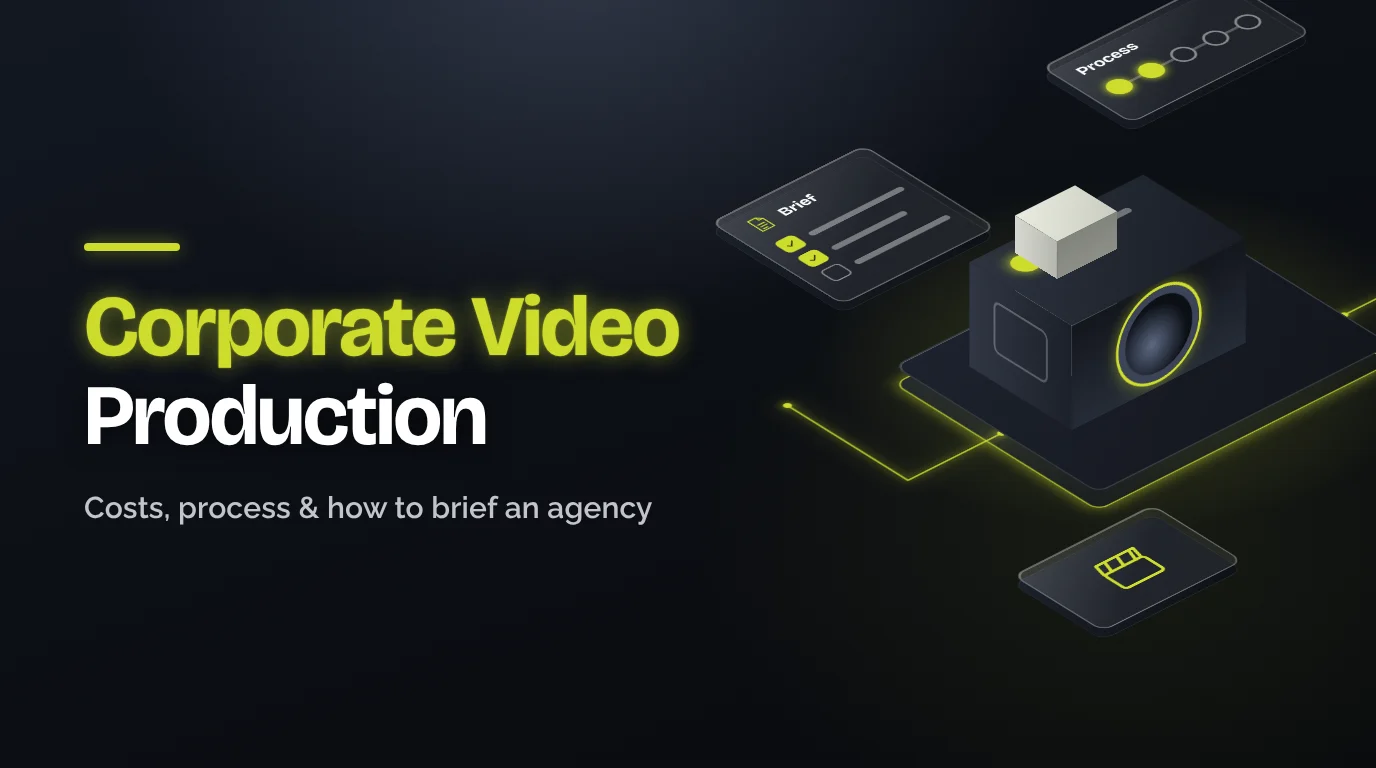
Most projects move through five steps. In our process, each step ends with the client's approval, "so nothing is drawn or filmed before you agree" (UnFoldMart video production).
You describe the goal, the audience, where the video will run and the deadline. The agency replies with a written quote and a schedule.
The agency writes what is said and shown, line by line, in your brand voice.
Every scene becomes a sketch with its words, plus style frames and voice and music direction.
This is the animation, the 3D work or the shoot day with crew and cast, followed by the edit, voiceover, music and sound. You review a first cut.
The agency delivers the final files in every format you need (website, ads, social, TV), with subtitles and a video page set up for search.
How long does it take? Clutch's review data puts the typical timeline at five months (Clutch). That is market context, not a rule. On our page, the time each step takes "depends on the video", and you get the full schedule with your quote.
A good brief is the cheapest way to a better video and comparable quotes. The UK's Institute of Practitioners in Advertising (IPA) published a guide, co-authored by BetterBriefs and Mark Ritson, called The Best Way for a Client to Brief an Agency (6 July 2022). It "aims to create a shared understanding between marketers and agencies as to what constitutes a good brief (and briefing)."
Fill in each line; write "open" where you want the agency to propose something.
| # | Section | What to write |
|---|---|---|
| 1 | Business goal and action | What the video must achieve, and the one action the viewer should take |
| 2 | Audience | Who watches, where, and what they already know |
| 3 | Placement and aspect ratios | Website, paid social, LinkedIn, event screen, TV; which of 16:9, 9:16, 1:1 |
| 4 | Key message and must-say facts | The one message, plus facts or claims that must appear |
| 5 | Tone and brand guidelines | Link to your guidelines (see our brand guidelines guide) and three words for the tone |
| 6 | Style preference | Live action, 2D, 3D or whiteboard; two or three reference videos you like, and why |
| 7 | Length and versions | Length of the main film, and every cut-down you need |
| 8 | Languages | Voiceover languages, subtitle languages, on-screen text |
| 9 | People on camera | Employees, actors, customers, presenters; how many |
| 10 | Locations | Your office, a plant, a customer site, a studio, a public place |
| 11 | Budget range | A range, even a wide one |
| 12 | Deadline and launch date | When final files are needed; any fixed event date |
| 13 | Approvers | Names, roles, and how many review rounds you expect |
| 14 | Usage | Channels, territories and how long the video will be used |
A downloadable version of this brief is available on request via the contact form.
Why the budget line matters. Without a range, one agency quotes a 60-second 2D explainer and another a two-day shoot, and the quotes cannot be compared.
Put every quote into one table before comparing prices. A lower price often means something is missing.
| Check | What to look for in each quote |
|---|---|
| What is included | Script? Storyboard? How many change rounds, at which stages? |
| Shoot days and crew | Number of shoot days, crew size, equipment, travel |
| Talent and voice | Fees for actors, presenters and voiceover, and the usage term covered |
| Music licence | Library or commissioned music; channels, territories and term of the licence |
| Versions and formats | Every length and aspect ratio, listed by name |
| Subtitles and languages | Which languages, whether voiceover or subtitles only |
| Files and ownership | Which final files you get; whether raw footage and project files are handed over |
| Payment milestones | Payments tied to approved steps (script, first cut, delivery) |
| Schedule | A written schedule with each review date |
Red flags
Make sure the contract states which channels, territories and term the music, stock footage and on-screen talent are cleared for. "Licensed music, stock footage, usage rights" is one of the ten cost factors on our video production page. If you might run the film on TV or in more countries later, say so in the brief so licences are quoted for it now.
Get written consent from everyone who can be identified on camera, including your own employees. Collect release forms on the shoot day, not afterwards. Rules on filming people differ between countries, so ask your legal team which form to use.
Filming in a public place may need a permit. New York City is a clear example. Its film office says a permit is required for "Productions with equipment packages, production vehicles requesting parking privileges ..., asserting exclusive use of City property, prop weapons, prop vehicles, actors in police uniform or stunts on set, or that require NYPD or FDNY assistance", and "Equipment" means anything more than a hand-held camera, a camera on a tripod or hand-held items (NYC Mayor's Office of Media and Entertainment).
In London, Film London handles filming permissions across the London boroughs, as noted on our London video production page. For Vancouver, the BC Film Commission at Creative BC supports productions in the province (Vancouver page). Check with the local film office before you book a location.
Captions make a video usable for people who are deaf or hard of hearing, and for anyone watching muted. The Web Content Accessibility Guidelines (WCAG 2.2) from the W3C include Success Criterion 1.2.2, Captions (Prerecorded), at Level A: "Captions are provided for all prerecorded audio content in synchronized media, except when the media is a media alternative for text and is clearly labeled as such" (W3C, Understanding SC 1.2.2). Level A is the baseline conformance level, so put subtitle files for every language on the delivery list.
Google's video best practices set out what a video needs to appear in video results:
Add a full transcript on the page as well. It gives search engines and AI assistants text they can read and quote. For a deeper guide, read our article on video and visual SEO in 2026.
Plan this page in the brief: the URL, who writes the title, description and transcript, and which key moments to mark.
UnFoldMart makes corporate videos alongside branding, websites and search. As described on our video production page:
Tell us what the video must do. Book a free 30-minute call, and we will recommend a type and send a written quote. If you would like the brief template as a file, ask for it via the contact form.
Got Questions? We’ve Got Answers – Clear, Simple, and Straight to the Point
For accessibility, yes. WCAG 2.2 Success Criterion 1.2.2 (Level A) requires captions for all prerecorded audio content in synchronized media, except a clearly labelled media alternative for text.
Yes, if the cut-downs and formats are planned in the brief and storyboard.
Often yes, as soon as you use more than hand-held equipment, park production vehicles or take exclusive use of public space. New York City's film office rules are one example. Check with the local film office before you book a location.
Only as far as the contract states. Ask for the usage scope of the music, stock footage and on-screen talent in writing, and agree whether raw footage and project files are handed over.
It depends on the goal. Animation works best to explain abstract products, processes and software. Live action works best to show real people, places and customers.
A brief should cover the goal, audience, placement and aspect ratios, key message, tone, style, length and versions, languages, people on camera, locations, budget range, deadline, approvers and usage rights.
Clutch's review data says a typical video production project takes about five months. Simple projects with fast approvals can be quicker.
Clutch's client reviews put the average video production agency project at about $42,000 ($42,280.92), but Clutch also says most projects cost just a few thousand dollars. Scope drives the price.