Brand Identity Systems for FMCG Companies: Building Brands That Scale From Shelf to Screen
Why FMCG Brands Need Systems, Not Just Logos
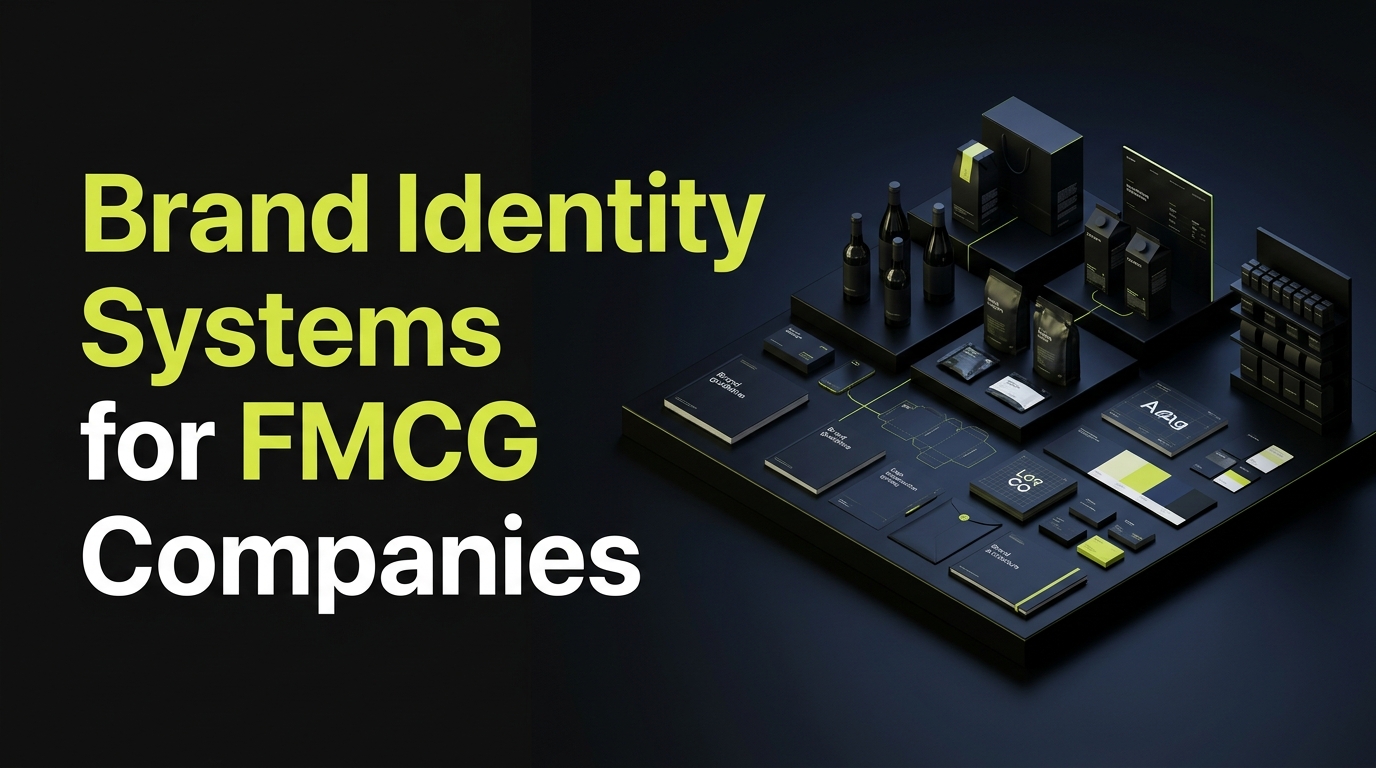
A logo is one asset. A brand identity system is the architecture that governs how the brand expresses itself across every touchpoint it will ever encounter. For FMCG companies, the distinction is not semantic. It is the difference between a brand that fragments as it grows and one that strengthens.
Most FMCG brands outgrow their original identity within three to five years. The logo designed for a single product line cannot accommodate three. The packaging colour system chosen for one market creates production conflicts in another. The typography that works on a shelf label becomes illegible on a mobile screen.
The FMCG-specific challenge is that the brand must work simultaneously across radically different surfaces. A 7cm packaging label. A billboard. A social media thumbnail at 50x50 pixels. A Shopify or Webflow storefront. An AI-generated search recommendation where the brand name appears as plain text alongside competitors.
For FMCG brands expanding across European markets, the system must accommodate multilingual packaging, country-specific regulatory text (ingredient lists per EU Regulation 1169/2011, allergen declarations, recycling symbols that vary by country), and culturally variable consumer expectations. The identity system must account for this through flexible rules that maintain brand coherence while allowing cultural adaptation.
Visual Identity Architecture
The foundation is the visual identity architecture. The logo system should include a primary mark, secondary mark, icon, monochrome variants, and minimum size specifications. For FMCG brands with multiple product lines, the system must define the relationship between parent brand and product line marks.
The colour system is more complex for FMCG than for most industries. A primary palette with documented CMYK values (print and packaging), Pantone references (production accuracy), and HEX/RGB values (digital). Packaging-specific colour application rules define which colours are reserved for which product categories.
Typography must serve two fundamentally different environments. The primary typeface for packaging must be legible at small sizes on curved surfaces. The secondary typeface for digital must perform across viewports and load efficiently for Core Web Vitals compliance.
Photography and illustration style guidelines define art direction for campaign, product, and lifestyle imagery. Without consistent art direction, the same product looks different on the brand's website than it does on Amazon or in a retailer's weekly circular.
Packaging Design System
The packaging hierarchy defines how the brand identity appears across primary packaging (the product container), secondary packaging (the box or sleeve), and tertiary packaging (shipping boxes, point-of-sale displays).
Label architecture for brands with 20+ SKUs requires a modular system: fixed zones (brand logo, tagline, quality marks) that remain constant, and variable zones (product name, variant descriptor, flavour colour coding) that change per SKU.
EU regulatory compliance in packaging design is non-negotiable. EU Regulation 1169/2011 mandates specific information presentation: ingredient lists in descending order by weight, allergen declarations in bold, nutrition tables in prescribed format, net quantity, country of origin, and storage instructions. Each EU member state may layer additional requirements. The packaging design system must define dedicated zones for regulatory text that do not compromise the brand design.
Printing production specifications ensure accurate reproduction: colour profiles per substrate type, die-cut templates with bleed and safety margins, barcode placement specifications, and minimum text size for legibility.
Digital Brand System
The bridge between packaging and digital is the design token system: documented specifications for colour (HEX values mapped to packaging CMYK), spacing, typography (web font equivalents of packaging typefaces), and component specifications that encode the brand's visual language into reusable interface elements.
Responsive behaviour defines how the brand identity adapts across desktop, tablet, and mobile viewports. The logo may shift from primary mark to icon. Typography scales must be defined for each breakpoint. Product imagery crops and aspect ratios must be specified for each device context.
Social media templates for Instagram, LinkedIn, and Facebook with locked zones (brand elements, logo placement) and editable zones (photography, copy) ensure on-brand content production at daily frequency without requiring a designer for every post.
Brand Voice and Messaging Framework
Tone of voice definition must cover three registers. Formal: packaging, legal text, investor communications. Semi-formal: website, email marketing, press releases. Casual: social media, community spaces, customer service.
The messaging hierarchy organizes what the brand says at each level. Brand tagline communicates the core promise. Category-level messaging explains distinctiveness. Product-level messaging describes individual products consistently. Campaign-level messaging adapts for time-limited promotions.
Multilingual brand voice is where most European FMCG brands struggle. The brand's personality must be recreated in each language, not translated word by word. A playful English tagline may land as childish in German. A direct German product claim may sound aggressive in Dutch.
Naming conventions define how the brand names new products, variants, and seasonal editions, preventing the naming chaos that accumulates when product managers choose names independently.
Brand Governance and Scalability
Brand guidelines documentation should be a living system, not a 120-page PDF. Platforms like Notion, Frontify, or a custom CMS-hosted brand portal allow teams to search, browse, and download assets with current specifications.
Asset management must be organized for team access. Logo files, photography library with usage rights, template files, and packaging artwork organized by SKU with version metadata.
Scalability testing is the most overlooked component. Will this colour system work at 100 SKUs? Will this label architecture accommodate a new product category? Will this digital brand system scale when the brand launches in three new EU markets simultaneously?
What This Looks Like in Practice
We built a comprehensive brand identity system for Haldiram's, one of the largest FMCG brands in Asia, spanning over 20 SKUs across multiple product categories. The challenge was decades of brand equity fragmented across inconsistent packaging, digital, and retail touchpoints.
Our engagement delivered a unified visual system bridging packaging and digital, a packaging design architecture with modular label templates for the full SKU range, a digital brand translation with design tokens documented for developer handoff, a Core Web Vitals-optimized web platform built on a scalable CMS, and brand guidelines documentation that the internal team could maintain independently. The result was a cohesive brand experience from shelf to screen and a web platform serving both consumer engagement and B2B wholesale inquiry generation.
In a separate engagement, we built a complete brand identity system for a European craft brewery undergoing a full rebrand. We designed the identity from logo to packaging to digital, with a colour system that translated from bottle label to tap handle to website to social media. The rebrand directly impacted SEO performance: updated packaging photography began ranking in Google Image results, branded query volume increased, and AI models began categorizing the brand entity more coherently.
Brand Identity and SEO: The Connection Most FMCG Brands Miss
Brand identity work directly feeds AI search visibility. Image search: consistent, high-quality packaging photography ranks in Google Image results and gets pulled into AI visual responses. Branded query volume: distinctive brand identity generates more branded searches, a direct ranking signal that technical SEO alone cannot manufacture. Entity recognition: consistent identity across the website, social media, Google Business Profile, and review platforms helps AI models build a coherent brand entity profile.
Understanding how AI models choose sources makes the connection clear. Structured data ties identity to the searchable entity graph. Organization schema with brand name, logo URL, social profile links. Brand schema linking product lines to the parent entity. Product schema on every SKU page. Strong E-E-A-T signals across AEO and GEO dimensions amplify this effect. The shift from optimizing for clicks to optimizing for AI citations makes brand identity investment a search visibility investment.
How We Approach FMCG Brand Identity Engagements
Phase 1: brand audit, competitive analysis, and stakeholder alignment (2-3 weeks). Phase 2: visual identity design including logo system, colour, typography, photography direction (3-4 weeks). Phase 3: packaging design system and production specifications (3-4 weeks). Phase 4: digital brand system and design token documentation (2-3 weeks). Phase 5: brand voice, messaging framework, and guidelines documentation (2 weeks). Phase 6: ongoing brand governance, asset management, and scalability review.
What we measure: brand consistency score across touchpoints, packaging production accuracy, digital implementation adherence, branded search volume growth, and AI citation frequency for brand-related queries.
Typical investment: €6,000 to €15,000 for a complete FMCG brand identity system targeting 2+ EU markets.
Working With Us
UnFoldMart specializes in brand identity systems, packaging design, web design, SEO, AEO, and GEO for FMCG companies and consumer brands across European markets. We operate from Frankfurt, Germany and Gurugram, India, with deep expertise in DACH and Benelux. Our branding work is backed by verified client results on Clutch.
We do not design logos in isolation. We build brand identity systems that scale from shelf to screen, from one market to ten, from 10 SKUs to 100.


.jpeg)
FAQs
Got Questions? We’ve Got Answers – Clear, Simple, and Straight to the Point
FMCG brands should look for a branding agency that understands packaging design, digital experiences, international expansion, and long-term scalability. Beyond creating a logo, the agency should develop systems that work across packaging, ecommerce, retail, advertising, and emerging AI-driven search environments. At UnFoldMart, we help FMCG brands build scalable brand identity systems that connect packaging, digital experiences, SEO, AEO, and GEO strategies, ensuring brands remain consistent as they grow across products and markets.
Brand identity plays an important role in how search engines and AI platforms understand and recognize a brand. Consistent branding across websites, packaging, social media profiles, review platforms, and business listings strengthens entity recognition. Search engines use these signals to connect brand assets and improve confidence in the brand entity. Strong visual consistency, structured data implementation, branded search demand, and authoritative content can increase visibility in search results, Google AI Overviews, and AI-powered recommendation systems.
An effective FMCG packaging design system should include logo placement rules, packaging hierarchy, color standards, typography specifications, regulatory information zones, barcode placement guidelines, and production-ready artwork standards. It should also define how packaging adapts across different product categories, sizes, and markets. For brands operating internationally, the system must accommodate multilingual packaging requirements, local regulations, and market-specific labeling standards while preserving overall brand consistency.
As FMCG companies expand their product portfolios, maintaining consistency becomes increasingly challenging. A brand identity system provides clear rules for packaging design, product naming, color coding, typography, and visual hierarchy across multiple SKUs. This ensures that new products feel connected to the parent brand while remaining easy for consumers to distinguish. A well-designed system reduces design inconsistencies, improves shelf recognition, and allows brands to launch new products more efficiently without reinventing their visual identity each time.
A brand identity system is a structured framework that defines how a brand appears and communicates across all customer touchpoints. It includes logos, color systems, typography, packaging guidelines, photography direction, messaging frameworks, and digital design standards. For FMCG brands, a brand identity system is essential because products must maintain consistency across packaging, retail shelves, ecommerce stores, social media, advertising campaigns, and international markets. Without a scalable identity system, brands often become fragmented as they introduce new products, expand into new regions, or grow their distribution network.

Want to Turn Your Brand Into a Scalable Growth Engine?
We help modern businesses unify branding, websites, SEO, and paid media into one performance-driven system designed to scale.