AI SEO Framework for DACH B2B Brands
Why AI requires a new SEO framework
Traditional SEO focused on a small set of signals: keywords, backlinks, technical health, and content quality. AI search adds more signals: citation trust, topic depth, entity signals, and structured content extraction.
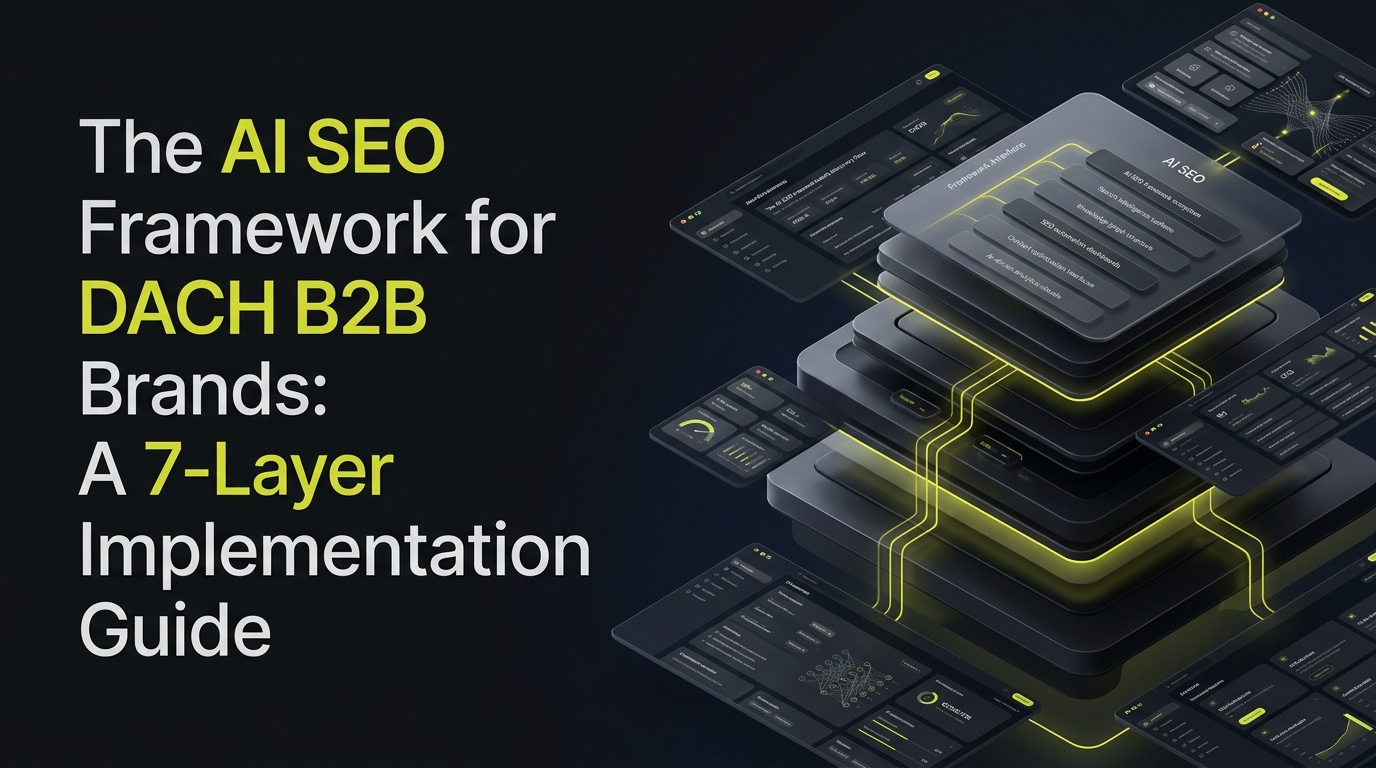
A 7-layer AI SEO framework gives teams a clear way to build visibility across search engine optimization, AEO, and GEO in tools like ChatGPT, Perplexity, and Google AI Overviews.
The 7-Layer AI SEO Framework
Layer 1: Technical foundation
Fast load times, clean site structure, proper canonical tags, and accurate XML sitemaps still matter. AI crawlers use the same access paths as classic search crawlers. A technically unreachable site cannot be indexed, no matter how strong the content is.
For DACH sites, use the right hreflang setup for German, Swiss, and Dutch variants. AI systems use language signals to route people to the right content.
Layer 2: Entity setup
AI systems map the world through entities: people, organisations, products, places, and ideas. Keep your brand name consistent across your site, social profiles, directories, and media mentions.
Structured data, such as Organization, Person, and Product schema, makes those links clear and machine-readable. That helps search rankings and AI citation rates.
Layer 3: Topical authority
AI systems focus on sources with deep, broad coverage of one topic. Topic clusters that cover your core areas signal authority.
A DACH SEO agency should have strong content on German-language SEO, local search SEO, hreflang setup, DACH directory systems, and AI search visibility - not just a single SEO service page.
Layer 4: Citation building
Trusted citations are one of the main ways AI systems judge credibility. Digital PR, thought leadership, industry memberships, and media coverage all create citations.
German-language citations from trusted DACH sources can be especially strong for German-speaking markets.
Layer 5: Content structure
AI systems pull data from clear patterns: simple headings, definition-style intros, FAQ sections, and direct factual lines. Structure content so it is easy to extract.
Do not hide key facts in long paragraphs. Give the direct answer first, then add detail. That helps both AI and human readers.
Layer 6: Answer design
Find the exact questions your audience asks and give direct, citable answers. Question-based headings with short, accurate answers are high-value for AI search visibility.
Use Q&A tools, Google People Also Ask, and DACH keyword tools to find question queries in German and Dutch.
Layer 7: Measurement and iteration
AI search visibility needs new tracking. Watch brand mentions in AI responses, track featured snippet positions, and measure the share of info queries where your content appears in AI-generated answers.
Classic rank tracking still matters, but it should be paired with AI-specific visibility tracking.
How UnFoldMart applies the AI SEO framework for DACH businesses
UnFoldMart uses this 7-layer framework for B2B clients in Germany, Switzerland, and the Netherlands. We combine technical SEO, German-language content strategy, structured data setup, and AI visibility tracking into one clear programme.
Book a free AI SEO strategy consultation - or visit our SEO agency page to learn more.


FAQs
Got Questions? We’ve Got Answers – Clear, Simple, and Straight to the Point
Realistic 2026 timelines: technical foundation layer (schema, entity graph, hreflang, Impressum compliance) can be fixed in 4–8 weeks. Native German content foundation for the top 15–25 buyer-journey pages usually takes 3–6 months. LinkedIn presence and B2B publisher relationships build over 6–12 months. Measurable AI-citation share improvement on target B2B prompts typically starts appearing in the 6–9 month window, with meaningful pipeline attribution by month 12. DACH B2B AI SEO compounds slower than consumer AI SEO because buyer cycles are longer, but the ranking gains are more durable once earned — established B2B entity trust in DACH tends to hold through algorithm shifts better than link-driven US-market equivalents. Programmes committing to less than nine months rarely see the compounding phase.
Meaningfully more than in consumer or US B2B markets. LinkedIn is the primary professional network in DACH — higher penetration among decision-makers, more active in thought-leadership content, and increasingly cited by AI answer engines when they compose B2B recommendations. B2B publishers matter almost as much: Handelsblatt, WirtschaftsWoche, Der Standard, NZZ, and vertical-specific trade press (t3n for tech, Lebensmittel Zeitung for FMCG, Elektronikpraxis for engineering) hold outsized citation weight in AI answers for DACH B2B queries. Brand mentions on these platforms, either through PR, guest content, or organic references, feed AI citation share alongside owned-content SEO. Ignoring the LinkedIn and B2B publisher layer usually leaves DACH B2B AI-visibility strategies underperforming even when on-page work is solid.
Almost non-negotiable for DACH B2B in 2026. Native German (or French for Romandie, Dutch-language for Belgian B2B where applicable) consistently outperforms translated equivalents on both AI-citation share and conversion. AI answer engines still cite more English-language sources than German ones because English training data dominates, which means a German-language B2B brand publishing only in English competes in an over-served pool without appearing in the underserved German-language answer set at all. Practical implication: for DACH B2B specifically, native-language content isn't a translation task — it's a parallel authoring stream with German copywriters who understand B2B decision-making culture. UnFoldMart's DACH B2B content programmes are built native-first for exactly this reason — the citation and conversion gap between native and translated content is measurable and widening.
Substantially. DACH B2B buyers rank verifiability and evidence higher than most other markets, so AI SEO for DACH B2B has to prioritise signals that map to that expectation: named authors with linked credentials (not anonymous content), Handelsregister-verified entity data, references to real cases and industry benchmarks, transparent methodology, and coverage on trusted publications rather than only content marketing sites. Consumer AI SEO can lean on lifestyle content, viral hooks, and social discovery; B2B AI SEO in DACH cannot. And non-DACH B2B markets tolerate more direct marketing tone — DACH B2B content that reads as promotional loses trust and, downstream, citation share. The framework layers apply universally; the emphasis shifts sharply for DACH B2B.
DACH B2B buying cycles are longer, more committee-driven, and more evidence-heavy than most other markets. Buyers cross-reference multiple sources before shortlisting — including AI answer engines, but also LinkedIn discussions, industry publications (Handelsblatt, WirtschaftsWoche, Der Standard, NZZ), trade associations, and peer references. Layered frameworks for DACH B2B AI SEO work because different signals compound at different points in the cycle: technical foundations qualify a site for citation, content depth builds authority, native-language execution earns local trust, entity signals get the brand mentioned across corroborating sources. A single-tactic push ("just add schema" or "just publish more content") rarely moves DACH B2B pipeline because the buyer looks for multiple aligned signals before acting.

Want to Turn Your Brand Into a Scalable Growth Engine?
We help modern businesses unify branding, websites, SEO, and paid media into one performance-driven system designed to scale.