How AI Is Changing Search in Europe in 2026
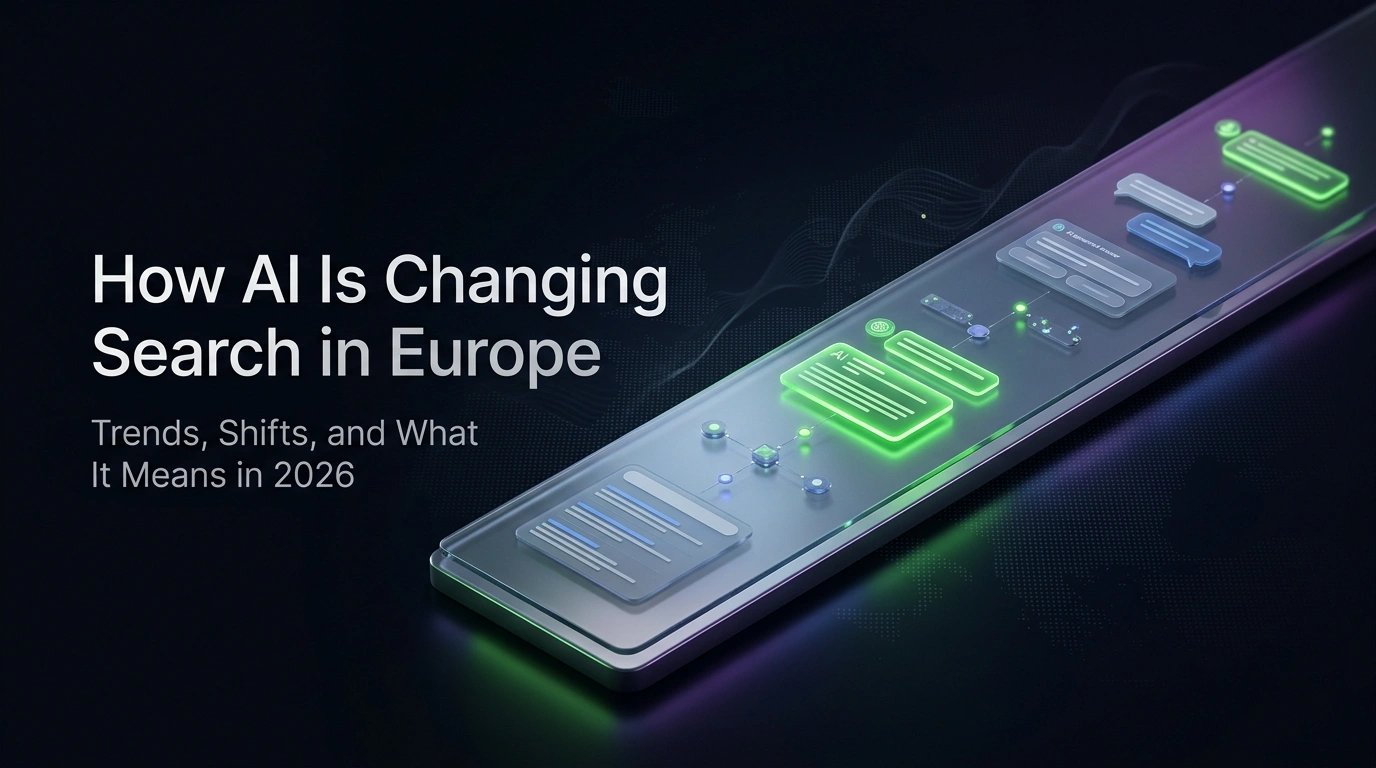
Search in Europe is undergoing a major transformation. Traditional keyword-based search is being replaced by AI-driven systems that understand context, intent, and user behavior more deeply.
Today, users are no longer just typing short queries. They are asking detailed questions and expecting direct, personalized answers. Search engines are responding with AI-generated summaries, conversational responses, and fewer traditional blue links.
This shift is especially visible in countries like Germany, the Netherlands, and the UK, where digital adoption is high and user expectations are evolving quickly.
Understanding how AI is changing search in Europe is essential for businesses that want to stay visible, relevant, and competitive in 2026 and beyond.
What Does AI-Driven Search Mean?
AI-driven search refers to the use of artificial intelligence technologies to understand user queries, interpret intent, and deliver more accurate and personalized results.
Unlike traditional search, which relies heavily on keywords, AI search focuses on meaning, context, and user behavior.
Key characteristics:
- Understanding natural language queries
- Generating direct answers instead of only listing links
- Using data and patterns to predict user intent
This makes search more intuitive and efficient for users.
How Is AI Changing Search Behavior in Europe?
Search behavior across Europe is becoming more conversational and intent-driven. Users are shifting from short keywords to detailed questions.
For example, instead of searching for “best bakery Berlin,” users might search for “where can I find fresh sourdough bread near Berlin Mitte.”
Key changes in behavior:
- Users ask longer and more specific queries
- Search is increasingly conversational
- Users expect instant answers
- Fewer clicks due to direct results
This change means businesses must create content that answers questions clearly and directly.
What Are the Key AI Search Trends in Europe?
Rise of AI-Powered Search Results
Search engines now provide AI-generated answers at the top of results. These answers summarize information from multiple sources.
Impact:
- Reduced need to click on websites
- Increased importance of being featured in AI responses
Growth of Conversational Search
Voice assistants and chat-based search are becoming more common across Europe.
Users interact with search engines in a more natural way, using full sentences instead of fragmented keywords.
Semantic and Intent-Based Search
AI enables search engines to understand the meaning behind queries rather than matching exact keywords.
This means:
- Content must cover topics in depth
- Context matters more than keyword repetition
Personalization and Context Awareness
Search results are increasingly tailored based on:
- user location
- search history
- preferences
In cities like Amsterdam or Berlin, results may vary significantly depending on the user’s exact location.
Multilingual Search Expansion
Europe’s multilingual nature makes AI especially important. Search engines now better understand and translate queries across languages.
This allows users to search in their preferred language while still receiving relevant results.
How Does AI Search Work in European Markets?
AI search uses technologies such as machine learning and natural language processing to analyze queries and deliver relevant results.
The process includes:
- Understanding the query context
- Identifying user intent
- Analyzing large datasets
- Generating or selecting the best possible answer
In European markets, this process is influenced by:
- language diversity
- local search behavior
- regional regulations
This makes AI search more complex but also more accurate.
How Is AI Search Impacting Businesses in Europe?
AI search is changing how businesses gain visibility and traffic.
Key impacts:
- Decline in traditional click-through rates
- Increased competition for top visibility
- Greater importance of authority and trust
Businesses must adapt to new realities:
- Content needs to be structured for AI extraction
- Clear and concise answers perform better
- Authority signals influence visibility
This shift requires a more strategic approach to content creation.
What Types of Content Perform Best in AI Search?
AI search favors content that is clear, structured, and informative.
Best-performing content types:
- Definitions that answer questions directly
- Step-by-step guides
- Frequently asked questions
- Comparison and analysis content
Key characteristics:
- Short and clear answers
- Logical structure with headings
- Informative and factual content
- Easy readability
Content that directly solves user queries has a higher chance of being featured in AI-generated responses.
How Should Businesses Adapt to AI Search in Europe?
Focus on Search Intent
Businesses must understand what users are actually looking for rather than focusing only on keywords.
Optimize for AI Answers
Content should include:
- clear definitions
- concise explanations
- structured sections
This improves chances of being selected for AI summaries.
Build Topical Authority
Instead of isolated content, businesses should create clusters of related topics.
Benefits:
- stronger relevance
- improved rankings
- better visibility in AI search
Create High-Quality Structured Content
Well-organized content helps both users and search engines.
Best practices:
- use clear headings
- include bullet points
- maintain logical flow
Strengthen Local and Regional Relevance
For European markets, localization is critical.
Include:
- city and country references
- local examples
- region-specific insights
How Does AI Search Differ Across European Countries?
Search behavior and AI adoption vary across countries.
Germany:
- Strong focus on accuracy and trust
- Users prefer detailed and reliable information
Netherlands:
- Highly digital and mobile-first
- Strong adoption of English-language content
United Kingdom:
- Rapid adoption of AI-driven search
- Growth in voice and conversational queries
France and Switzerland:
- Multilingual challenges
- Need for localized content strategies
Understanding these differences helps businesses tailor their approach.
What Are the Challenges of AI Search?
While AI search offers many advantages, it also creates challenges.
Key issues:
- Reduced website traffic due to zero-click results
- Increased dependence on search platforms
- Risk of inaccurate or incomplete AI-generated answers
- Need for continuous content updates
Businesses must balance visibility with long-term strategy.
What Is the Future of AI Search in Europe?
AI search will continue to evolve rapidly across European markets.
Expected developments:
- More AI-generated answers
- Higher personalization of results
- Growth of voice and conversational search
- Greater importance of trust and authority
Businesses that adapt early will gain a strong competitive advantage.
Conclusion
AI is fundamentally changing how search works in Europe. Users are moving toward conversational queries, and search engines are delivering faster, more personalized answers.
For businesses, this shift requires a new approach to content, visibility, and strategy. Those who understand how AI search works and adapt accordingly will be better positioned to succeed in competitive European markets.

FAQs
Got Questions? We’ve Got Answers – Clear, Simple, and Straight to the Point
Three moves compound most reliably: (1) native-language content per target market, not translations — the gap in AI-citation performance between native and translated content widens each year; (2) local entity signals that reference in-market competitors, regulatory frameworks, business registries, and press — AI engines use these to validate content authority per market; (3) market-specific citation tracking, since a single European report hides sharp differences between Nordics, DACH, Benelux, UK, and Southern Europe. Brands treating Europe as one market usually miss where AI adoption is highest and slowest to move. UnFoldMart's European engagements are built around market-by-market prioritisation rather than a single continental strategy.
Meaningfully. UK-based sites lost EU-specific AI-search advantages after Brexit — GDPR alignment continues, but the UK is increasingly treated as a separate regulatory market by AI providers, sometimes delaying feature rollouts. For UK brands selling into the EU, hreflang targeting to specific EU markets matters more than it did pre-Brexit, and native-language EU content typically outperforms UK-authored English content for EU AI citations. For EU brands selling into the UK, a UK-hosted English version with UK-specific entity signals (Companies House, UK regulators, GBP pricing) outperforms a generic EU-English page. Cross-border AI search in 2026 rewards market-specific presence more than any prior period of SEO.
Yes — substantially. English-language content still dominates AI training data, which means LLMs perform best on English queries even when they're asked in other European languages. Local-language coverage varies: German, French, and Dutch have improving but incomplete coverage; Italian, Spanish, and Polish sit further behind; smaller languages (Finnish, Greek, Portuguese) have the widest gaps. Brands publishing native content in the target language consistently earn higher AI-citation share than those relying on translation. UnFoldMart's European content programmes prioritise native-language production for exactly this reason — translated pages usually underperform locally-authored ones on both citation and conversion.
The EU AI Act, DSA, GDPR, and the EU Data Act have collectively shaped a stricter operating environment for AI search than in the US or UK. Practical effects: mandatory source attribution in AI answers, stronger consent frameworks for using data in AI training, and slower rollouts of new AI features in EU markets while providers align with regulation. For brands, this actually favours transparent, well-attributed content — EU AI models cite sources more explicitly than US-hosted equivalents, which rewards sites with strong entity signals and clear authorship. Regulatory clarity is a structural advantage, not just an operational cost.
AI search adoption varies sharply across European sub-regions. The Nordics (Sweden, Denmark, Norway, Finland) sit at the leading edge, with ChatGPT and Perplexity penetration close to US levels and high English-language fluency easing tool adoption. The UK follows closely, particularly in B2B and professional services. DACH and Benelux adopt more conservatively, with strong privacy-native alternatives (Ecosia, Startpage) still holding meaningful share. Southern Europe (Italy, Spain, Portugal, Greece) adopts more slowly and leans heavier on Google AI Overviews than on standalone AI engines. Eastern Europe skews toward local-language specialised tools alongside global platforms. One European AI-search strategy rarely fits all sub-regions.

Want to Turn Your Brand Into a Scalable Growth Engine?
We help modern businesses unify branding, websites, SEO, and paid media into one performance-driven system designed to scale.