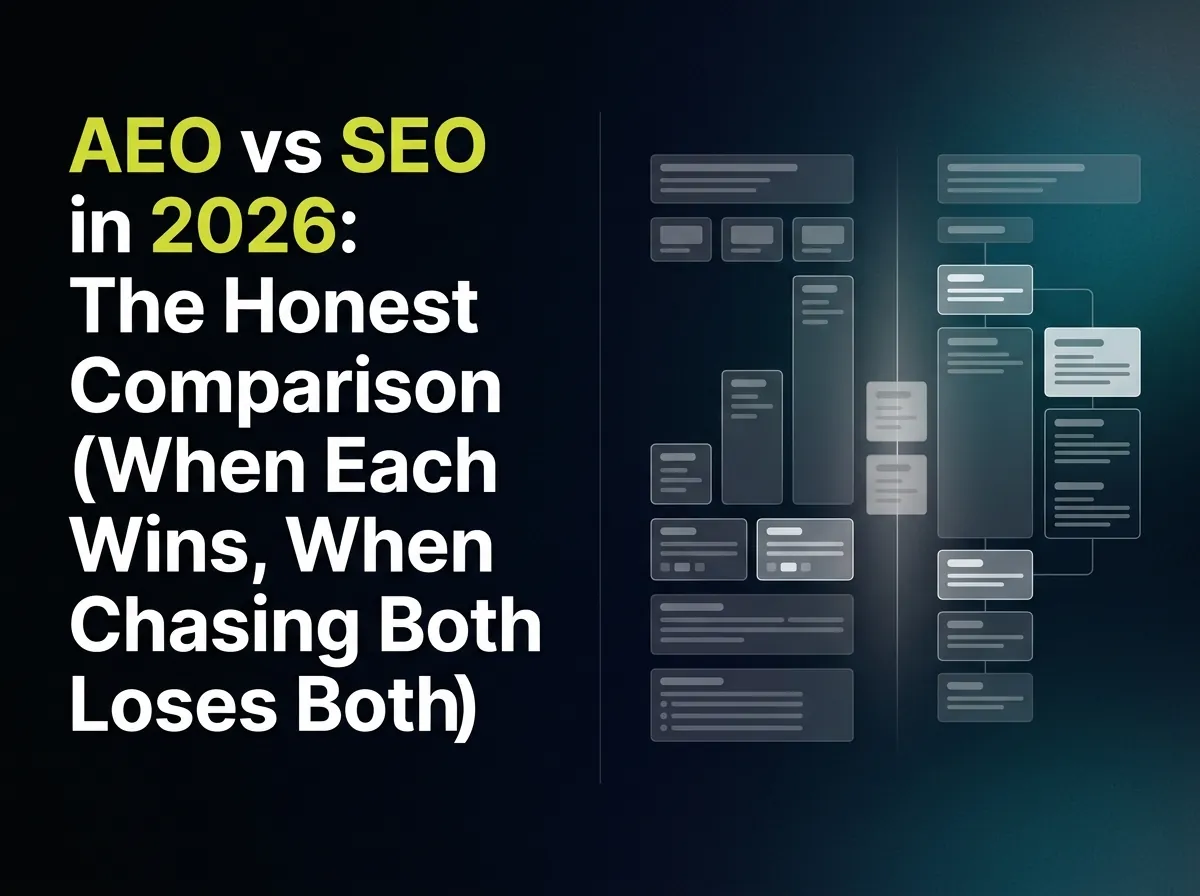
AEO vs SEO in 2026: The Honest Comparison (When Each Wins, When Chasing Both Loses Both)
SEO drives clicks. AEO drives AI citations. Learn the real differences, when each wins, and how to allocate budget across query types in 2026.

SEO drives clicks. AEO drives AI citations. Learn the real differences, when each wins, and how to allocate budget across query types in 2026.
Real projects across branding, packaging, websites and growth.
Straight answers on this topic from the UnFoldMart team.
From branding and packaging to Webflow websites, SEO, AEO and GEO, UnFoldMart brings strategy, design and growth under one team for 250+ brands across 10 markets. Tell us where you want to grow and we'll show you the fastest way there.
SEO optimises pages to rank in Google's organic results. AEO optimises pages to be cited in AI-generated answers from ChatGPT, Perplexity, and Google AI Overviews. They overlap in foundations (technical health, content quality, authority) but diverge in measurement, format, and user journey. Run both; allocate budget by query type, not by ratio. This guide explains exactly how.
SEO and AEO solve different visibility problems. SEO ranks your pages in the list of organic results, where users click through to your site. AEO gets your content cited inside the AI-generated answer that appears above those results, where users often get the information without clicking. In 2026, brands serious about organic visibility need both. The strategic question is not which to choose, but how to allocate budget across query types.
Both disciplines depend on the same content foundations. The differences show up in how content is structured, what success looks like, and how the user actually receives your information. Most guides on this topic conclude "do both." That answer is technically correct and strategically useless. By the end of this article, you will have a 4-bucket query framework that tells you exactly where the next$5,000 of budget should go.
The reason this comparison is on every CMO's desk in 2026 is not theoretical. The numbers describe a SERP that has fundamentally changed in the past 24 months, and the change is accelerating.
Each of those numbers points the same direction. The traditional click-based SERP, where 10blue links competed for a user's next move, is now sharing space with an AI-generated answer that resolves many queries before any click happens. Pew Research found a 46.7% relative click decline across 68,000 queries when AI Overviews appeared. Seer Interactive measured CTR drops between 49.4% and65.2%, and notably, even queries without AI Overviews saw a 41% CTR decline as user behaviour shifted across the board.
Amsive Digital's study of 700,000 keywords found a 15.49% average CTR drop across all positions ,with a compounding 37.04% drop when featured snippets and AI Overviews-occur. The pattern repeats in every independent study published in late 2025and early 2026: when AI takes the top of the page, traditional SEO outcomes shift downward, and they do not return.
At the same time, AI engines are still routing meaningful traffic to brands that get cited. AI traffic converts at 4.4 times the rate of standard organic visitors and spends68% more time on site, according to Frase's 2026 analysis. The visitors who do click through from AI citations are higher-intent because they have already seen your brand vetted by an AI synthesis. The opportunity is not gone. It has moved.
SEO (Search Engine Optimization) is the practice of structuring a website and its content so that search engines can crawl it, understand it, rank it well, and send users to it. The goal has always been simple: be the page a user clicks when they search for something relevant to your business.
In 2026, the discipline still works, but the rules have evolved. The fundamentals from a decade ago, technical health, on-page relevance, authority through backlinks, mobile UX, page speed, are still ranking factors and still required. What has changed is what those fundamentals are competing for.
Three things have evolved meaningfully in modern SEO. First, E-E-A-T (Experience, Expertise, Authoritativeness, Trust) carries more weight than it did five years ago. Google’s quality rater guidelines treat author authority and content provenance as primary ranking factors, especially for YMYL (Your Money, Your Life) topics in finance, health, and legal verticals. Second, entity recognition has become foundational. Google’s Knowledge Graph contains roughly 500 billion facts about 5 billion entities, and the algorithm increasingly thinks in terms of entities and their relationships rather than keyword strings alone. Third, freshness signals matter more for certain query classes; quarterly content refreshes now beat once-and-done publishing for topics where the underlying facts evolve.
A common mistake in 2026 is treating SEO as either dead or unchanged. Both framings are wrong. SEO is alive, still drives roughly 96% of total search traffic by volume, and still delivers meaningful organic visibility for brands that get the work right. The honest framing is that SEO now operates inside a broader visibility system, with AEO and answer engine surfaces as additional layers.
AEO (Answer Engine Optimisation) is the practice of structuring content and digital presence so that AI-powered answer engines- ChatGPT, Perplexity, Google AI Overviews, Microsoft Copilot, and Google AI Mode - cite your brand when users ask questions. The goal is no longer just appearing in a list of options. The goal is being selected as the source.
Mechanically, AI engines work differently from traditional search engines. They use a process called Retrieval-Augmented Generation (RAG), which proceeds in stages. First, the engine interprets the user’s query and converts it into a semantic representation, not a keyword match. Second, it retrieves relevant content from indexed sources or live web results. Third, it synthesises a single coherent answer by drawing from multiple sources. Fourth, it cites the sources it considers most authoritative. Each stage is an optimisation surface for AEO.
Two distinct factors determine whether your brand appears in an AI answer. The first is whether AI models have encountered your brand across enough sources during training to recognise it as a meaningful entity in your domain. Reddit threads, YouTube descriptions, Wikipedia entries, review platforms, press coverage, and third-party listicles feed this layer. You cannot inject yourself directly into training data, but you can generate the offsite mentions that feed it over time. This is sometimes called the “seen” dimension of AEO.
The second factor is whether your pages are structured well enough, factually clear enough, and trusted enough that when AI systems perform live web retrieval to ground their answers, your content is selected as a citation. This is the “trusted” dimension. It depends on schema markup, content extractability, factual density, named author authority, and freshness signals. A brand can be highly seen but poorly trusted, or vice versa. Both layers need work.
This is also where AEO sits in relation to GEO (Generative Engine Optimisation). The terminology is unsettled across the industry, but the operational distinction we use at UnFoldMart is this: AEO focuses on direct answer-retrieval optimisation (being cited as the source for a specific fact, definition, or recommendation), while GEO is the broader discipline that includes AEO plus brand-level optimisation across all generative AI surfaces. For most buyers, AEO is the entry point and GEO is the long-term programme
Roughly 70% of the technical and content work that makes a brand visible in AI engines is the same work that makes it visible in traditional search. AI engines do not bypass bad infrastructure; they inherit it. If your pages are slow, broken, hidden behind JavaScript that fails to render, or missing schema, both Google and ChatGPT will struggle to use them.
The foundation layer being shared is also why brands with strong existing SEO programmes have a significant head start in AEO. Ahrefs' research from 2025 found that citation overlap between ChatGPT and Google's top-10 organic results is roughly 12%. The overlap is much higher for Google AI Overviews specifically, at 76%, which makes sense: AI Overviews pull from Google's existing index. Cross-platform AEO requires more than ranking, but ranking is still the table stakes for being eligible for citation in the first place. Position 1 has a 58% chance of being cited in AI engines, while position 10 drops to 14% (Growth Memo, April 2026).
For UnFoldMart clients moving from SEO-only to integrated SEO+AEO, the foundation work, technical audits, schema deployment, internal linking, content depth, is largely the same investment. We covered this fully in our guide to SEO agency pricing in 2026. The new work in AEO sits on top of that foundation, not in place of it.
The remaining 30%is where the strategic decisions happen. The two disciplines diverge across sixdimensions that affect content production, measurement, and team structure.
Content format. SEO rewards depth: long-form pages that comprehensively cover a topic, rank for primary terms and dozens of variations, and accumulate links over time. AEO rewards extractability: clear 40 to 60-word direct answers near the top of the page, structured Q&A blocks, scannable comparisons, and content chunks that AI engines can lift cleanly. The good news is these formats are compatible. A long-form SEO page that opens with an answer-first paragraph and uses question-format H2s satisfies both disciplines simultaneously. The bad news is most existing SEO content does not, because it was written for human readers scrolling through long introductions.
Authority signal. SEO authority comes primarily from earned backlinks: the number, quality, and relevance of domains pointing at your pages. AEO authority comes primarily from cross-platform mentions: the spread of your brand name across Reddit, YouTube, Wikipedia, industry forums, and review platforms that feed AI training data. A B2B SaaS brand with strong backlinks but no Reddit presence will rank well on Google and remain invisible on ChatGPT. The reverse also happens: 28.3% of ChatGPT’s most-cited pages have zero organic Google visibility. Different authority pipelines.
Update cadence and freshness. Traditional SEO rewards compounding: a well-optimised page slowly gains authority and traffic over 12 to 24 months. AEO rewards freshness more aggressively. Industry data suggests content updated within the past 13 weeks is meaningfully more likely to be cited by answer engines, particularly for topics where the underlying facts evolve. This means SEO’s “set and forget” approach to evergreen content does not transfer cleanly. AEO programmes need a refresh model: which pages get updated, how often, and who owns the cadence.
Most guides on this topic stop at “do both.” That advice is correct in the same way “eat well and exercise” is correct: technically true, operationally useless. To allocate the next quarter’s budget, you need a framework that maps your actual queries to specific spend. We classify every priority query a client cares about into one of four buckets, based on whether AI Overviews dominate the SERP and whether users still want to click. The bucket determines the allocation.
These are SERPs dominated by AI Overviews, where users mostly want an answer, not a click. Examples include “what is AEO,” “how does RAG work,” “AEO vs SEO,” and “ChatGPT vs Perplexity comparison.” For informational keywords, AI Overviews now appear in 99.9% of cases (Ahrefs, November 2025). Position 1 click-through has collapsed for these queries, so optimising primarily for SEO ranking is fighting the previous war.
Allocation in this bucket should be roughly 70% AEO and 30% SEO. The success metric is being cited inside the AI answer, not necessarily ranking in the top three organic results. Practical work includes answer-first openings, question-format H2s, schema markup, original data points that AI engines reward, and entity consistency across third-party platforms.
These are SERPs where AI Overviews increasingly appear, but users still have click intent because they want to compare specific options or make a purchase. Examples include “best CRM for B2B SaaS,” “X agency pricing,” “X vs Y reviews,” and “best tool for [specific use case].” The user wants information and wants to evaluate options.
Allocation here is closer to 50/50 between SEO and AEO. You need to rank in the top three (because users do click) and get cited (because AI shapes which options they consider). This is the most demanding bucket in resource terms but often the most commercially valuable.
Practical work includes long-form comparison content with an answer-first structure, listicle formats (45.48% of informational queries cite articles, and 40.86% of commercial queries cite listicles, per Wix’s March 2026 data), and cross-platform reviews and mentions.
These are SERPs that still show ten blue links because AI Overviews would not be useful. Examples include “buy [product],” “[brand] login,” “[service] near me,” branded queries, and most transactional commerce. Only 7.9% of local searches trigger an AI Overview (Ahrefs, November 2025), and shopping queries trigger them just 3.2% of the time. The click is the goal here.
Allocation: 80% SEO and 20% AEO. Success metrics are clicks, conversions, and revenue. Practical work includes traditional technical SEO, schema markup for products and local businesses, conversion rate optimisation on landing pages, and Google Business Profile management for local. AEO investment in this bucket is minimal because the queries do not synthesise.
These are queries with low direct click value but high citation and trust value. Examples include original research pieces, glossary entries, methodology pages, and benchmark studies. They might never drive direct sales, but they support brand inclusion in AI Overviews, LLM citations, and broader topical trust signals. The most-cited pages on the web in their categories are often pieces like these.
Allocation: AEO plus brand investment, with SEO as a side benefit. Success metrics include citations across AI engines, branded search lift, and references from third parties. Wix’s March 2026 data shows that 45.48% of informational queries cite articles specifically, suggesting article-format authority pieces win this bucket.
Practical work includes original surveys, market analyses, transparent methodology pages, expert interviews, and primary research that nobody else has.
Once query buckets are mapped and budget is allocated, the actual AEO work becomes specific. Some tactics deliver outsized impact for the effort. Others sound sophisticated but barely move citation rates. Here are seven AEO tactics ranked by ROI, based on what we have seen work across UnFoldMart client engagements and what published research confirms.
Why answer-first structure matters most. AI engines parse content in chunks. They retrieve a passage that answers a query, evaluate its quality, and cite the source if it is good enough. A page that buries its answer 600 words deep in preamble loses the citation to a competitor that answers in the first paragraph. The 50-word rule (40 to 60 words at the top of every section that directly answers the question that section is about) is the highest-leverage AEO tactic available.
Why entity consistency matters more than people think. AI engines build their model of who you are from how the web describes you. If your brand name appears as “UnFoldMart” on your site, “UnfoldMart” on LinkedIn, “Unfoldmart Agency” on G2, and “UFM” in industry roundups, you are diluting your own entity. Pick one canonical brand name and audit every third-party listing for consistency. This is unglamorous work that compounds for years.
Why original data wins citations. AI engines reward content that contains information they cannot retrieve elsewhere. A blog post summarising what other sources said adds nothing to the AI’s available knowledge. A blog post with proprietary survey data, benchmark numbers, or customer research findings adds something new, and AI engines preferentially cite new factual content because it makes their answers more useful. SeoProfy noted that their original SEO pricing research is now cited “in almost every related question” by ChatGPT. Original data is the closest thing to a moat in AEO.
What about FAQPage schema? Skip it. Google restricted FAQPage schema to government and health sites in August 2023, and using it on agency or commercial content creates manual action risk. The good news is the underlying value of well-structured Q&A content does not depend on schema markup. Plain HTML FAQs with question H3s and clear answers below them are read by AI engines just as well, without the risk. Article schema and Organization schema are the safe defaults for most pages.
Modern SEO has not abandoned its fundamentals; it has integrated new ones. The five priorities that still matter most:
Technical health. Crawlability, indexability, mobile UX, page speed, Core Web Vitals, and internal linking architecture. None of this is new, and all of it is non-negotiable. AI engines inherit these signals: a slow page that fails to load reliably is invisible to both Google and ChatGPT. Audit quarterly.
Content depth integrated with answer-first structure. The old SEO wisdom said long-form content ranks better. The new wisdom says long-form content ranks and gets cited if it opens with a direct answer and uses question-format H2s. Most existing 2,500-word blog posts can be made AEO-compatible with a 30-minute editorial pass that adds an answer-first opening paragraph and rewrites H2s into questions.
Link building shifted toward digital PR. Real outreach to journalists, original research distribution, and earning mentions from established publications now matter more than guest-post link networks. Cheap link building is also expensive in a different way: it can permanently damage domain authority. Spend the budget on fewer, higher-quality placements.
Internal linking with entity-first thinking. Internal links pass authority and establish topical clusters. The 2026 evolution is to think about internal links as connections between named entities (concepts, people, products, places), not just keyword-anchored references. Service pages, glossary pages, methodology pages, and case studies should form an internal entity graph that AI engines can traverse.
Freshness model for evergreen content. Pick the 20% of content that drives 80% of organic value, and put it on a quarterly refresh cadence. Update statistics, examples, screenshots, and any time-sensitive references. This single discipline keeps content competitive in both SEO rankings and AEO citations, where freshness is rewarded directly.
You cannot manage what you do not measure, and the two disciplines need different scorecards. Tracking AEO performance with SEO KPIs makes the work look like it is failing when it is actually working. The reverse also happens: a team focused only on AEO citations might ignore the steady SEO traffic that pays the bills.
A few honest notes on what is measurable in 2026 and what is not. SEO measurement is mature: rankings, traffic, CTR, and conversions are all trackable in Google Search Console, GA4, and any SEO platform. AEO measurement is younger and rougher. Tools from Semrush, Profound, Conductor, and specialised platforms now track citations across major AI engines, but the category is still maturing.
Currently unmeasurable: prompt volume (AI platforms do not share query data publicly), why specific content gets cited (LLMs are opaque about selection criteria), and how individual sources are weighted when answers blend multiple inputs.
For practical AEO measurement, we recommend a manual prompt-testing baseline. Pick 20 priority queries. Each month, run them through ChatGPT, Perplexity, Gemini, and Google AI Overviews. Record whether your brand is cited and whether the citation is accurate. This takes about an hour per month and gives you a real signal that no automated tool can fully replicate.
We covered the broader measurement framework in our SEO Agency Pricing 2026 guide.
Also worth tracking, even though they are not strictly AEO metrics: branded search lift (people Googling your brand name after AI exposure) and AI referral traffic (chatgpt.com, perplexity.ai, copilot.microsoft.com showing up in your GA4 referrer reports). Major publishers like Reuters and The Guardian receive less than 1% of referral traffic from AI platforms despite being frequently cited (Similarweb, 2026), so absolute AI referral volumes will look small for most brands.
Treat citation rate and branded search lift as the leading indicators; AI referral traffic is the lagging confirmation.
Most pricing guides and strategy posts assume that doing both SEO and AEO is automatically the right move. We do not. There are predictable failure modes when teams attempt to run both without resourcing them properly, and the result is often worse than choosing one well.
Failure mode 1: doubling the brief without doubling the budget. A team that previously produced four 1,500-word SEO blog posts per month gets told to also do AEO. Without new resources, they now produce four blog posts that try to satisfy two disciplines at half the depth. The SEO content gets thinner. The AEO structure is bolted on awkwardly. Quality drops on both fronts. The honest answer is that doing AEO well costs roughly 20% more on top of an SEO programme, not zero, because the work is genuinely different. Brands that try to absorb AEO into existing budgets without expanding scope are buying half a service.
Failure mode 2: abandoning SEO foundation in pursuit of AEO. The opposite mistake: a team reads about AI search and decides traditional SEO is dead. They stop maintaining technical health, let the link profile decay, and pour everything into AEO-specific tactics. Within six months, both their organic traffic and their AI citations decline. Why? Because 92.36% of AI Overview citations come from domains ranking in the top 10. AEO without an SEO foundation has nothing to stand on. The brands that win in AEO are almost always brands that already had strong SEO and added AEO discipline on top.
Failure mode 3: tool-stack sprawl. A team subscribes to Ahrefs, Semrush, Surfer, Clearscope, Profound, Peec AI, AthenaHQ, and a citation-monitoring service. Monthly tool costs hit $3,000. Nobody actually has time to use all of them, so they use one or two superficially. The right answer is fewer tools, deeper use. For most brands, Search Console plus one comprehensive platform (Ahrefs or Semrush), one citation tracker, and a manual prompt-testing routine cover what is needed for the first 12 months of integrated SEO + AEO work. Scale tools when there is bandwidth to use them.
What to do instead. Pick the bucket from the framework above where you can win this quarter. Ship that work. Build measurable citations or rankings, then expand. The compounding effect of one well-executed bucket beats the dilution of trying all four poorly.
We integrate AEO into every SEO engagement at no separate charge. The reason is straightforward:in 2026, buying SEO without AEO is buying half a service. The work is roughly70% shared at the foundation layer, and the remaining 30% (answer-first structure ,entity consistency, AEO-specific content tactics, citation tracking) costs usabout 20% more on top of the traditional SEO scope. We absorb that into the retainer rather than charging it as an add-on, because we think pricingtransparency is the right call for the buyer.
Practically, our approach mirrors the 4-bucket framework above. We start every engagement by classifying the client's priority queries into the four buckets, then allocate the retainer accordingly. Some clients spend most of their budget in Bucket 2(high-AIO commercial). Others sit primarily in Bucket 4 (authority-building)because they are early-stage and need to be cited before they can be ranked. The bucket distribution drives the content calendar, the link-building plan, and the measurement framework. We covered the broader pricing structure in our SEO Agency Pricing 2026 guide.
You can read more about our specific service breakdown on our AEO services page (the answer-engineoptimisation programme), our GEO services page (the broader generative-engine programme), and our SEO services page (the foundation layer that everything sits on).
If you would like an honest assessment of which of the four buckets your priority queries fall into, and what allocation makes sense for your business, we offer a free 30-minute strategy call. We will look at 5 to 10 of your most important queries, classify them, and share where we think the next quarter of budget should go.
Got Questions? We’ve Got Answers – Clear, Simple, and Straight to the Point
AEO signals appear faster than traditional SEO. AI engines reward freshness, so well-optimized content can earn citations within 4 to 8 weeks of publication, particularly for less-competitive long-tail queries. Highly competitive commercial queries take 3 to 6 months to build consistent citation rates. Compare this to SEO, where new content typically takes 3 to 12 months to reach stable rankings. The trade-off: AEO citations are also less stable; AI engines re-evaluate sources more frequently than Google re-ranks pages.
For most brands, the priority order in 2026 is: Google AI Overviews first (because they sit on top of your existing search visibility and pull from Google's index), then ChatGPT (883 million monthly users, 70% of AI search market share), then Perplexity (smaller user base but high- intent commercial queries), then Gemini and Microsoft Copilot. The work to optimize for each is largely the same: answer-first content, entity consistency, original data, schema markup. You do not need separate strategies per engine.
Practically, no. AEO depends on the SEO foundation in two ways. First, AI engines need to crawl, parse, and trust your pages, all of which require the technical SEO basics (page speed, schema, mobile UX, internal linking). Second, ranking position correlates strongly with citation: position 1 has a 58% chance of being cited in AI engines, while position 10 drops to 14%. Brands trying to skip SEO and pursue AEO directly almost always fail at both.
AEO done well typically costs about 20% more on top of an SEO programme, not double. The reason: 70% of the underlying work (technical audits, schema, content depth, internal linking) is shared between the two disciplines. The remaining 30% of AEO-specific work covers answer- first content structure, entity consistency audits, citation tracking, and cross-platform brand mentions. At UnFoldMart we absorb that cost into the SEO retainer rather than charging it as an add-on.
No. AEO is not replacing SEO; it is a new layer that sits on top of it. Traditional SEO still drives roughly 96% of total search traffic by volume, and 92.36% of AI Overview citations come from domains ranked in Google's top 10. The two disciplines share roughly 70% of their underlying work (technical health, content quality, authority signals). The honest framing is: SEO is the foundation, AEO is the citation layer that determines whether AI engines select you as a source.

.webp)