How to Optimize Website Architecture for Topic Authority
Learn how to structure your website for topic authority. Discover pillar-cluster models, internal linking strategies, and SEO architecture best practices for 2026.
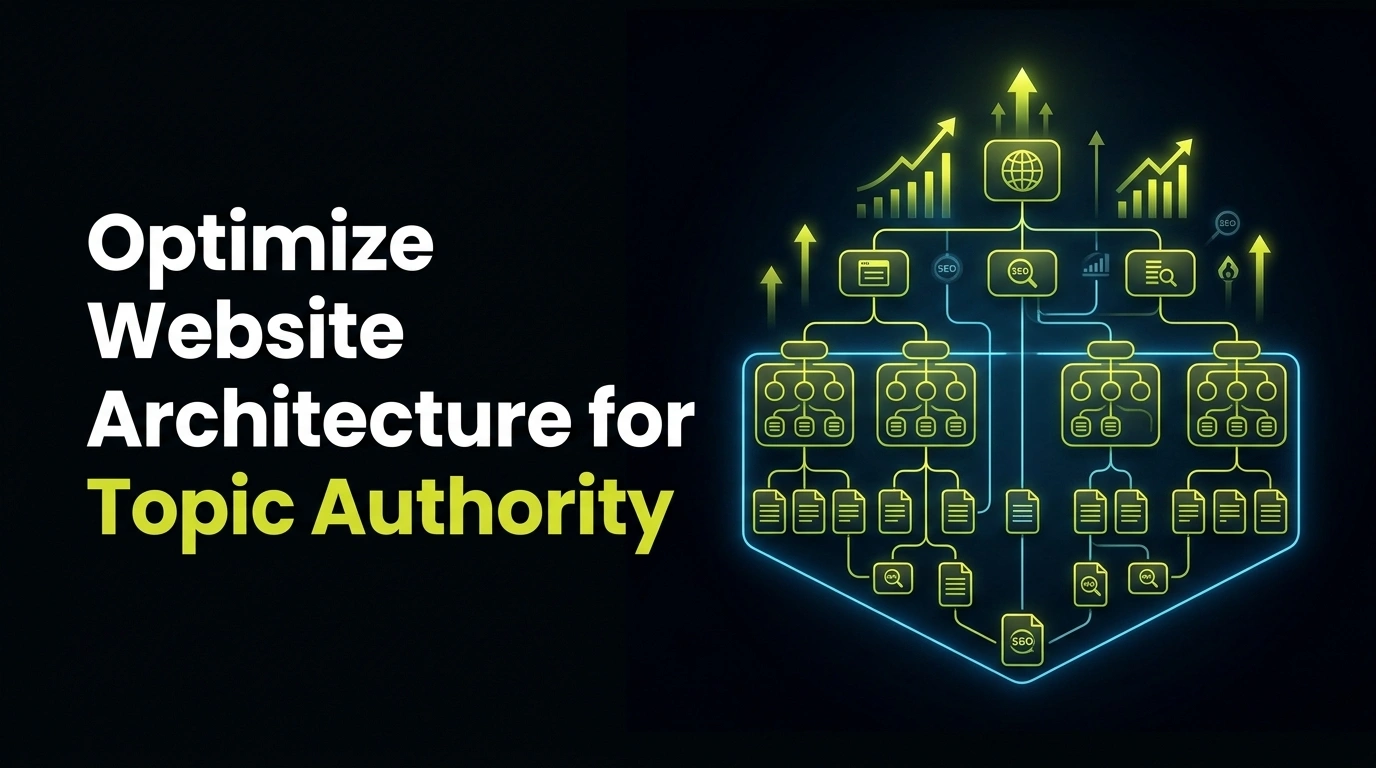
Learn how to structure your website for topic authority. Discover pillar-cluster models, internal linking strategies, and SEO architecture best practices for 2026.
Real projects across branding, packaging, websites and growth.
Straight answers on this topic from the UnFoldMart team.





From branding and packaging to Webflow websites, SEO, AEO and GEO, UnFoldMart brings strategy, design and growth under one team for 250+ brands across 8 markets. Tell us where you want to grow and we'll show you the fastest way there.
Publishing more content does not automatically build authority.
Many businesses produce dozens or even hundreds of blog posts without seeing meaningful improvements in rankings, visibility, or leads. The problem is rarely effort. It is structure.
Search engines and AI systems do not evaluate content in isolation. They assess relationships, depth, hierarchy, and consistency across an entire domain.
Authority is not about volume. It is about organized expertise.
Website architecture determines whether your content feels like scattered articles or a coherent knowledge system.
In 2026, topic authority is one of the strongest signals influencing both traditional rankings and AI-driven citations.
Optimizing your architecture is no longer optional. It is foundational.
Topic authority refers to the depth and breadth of expertise demonstrated across an entire subject area.
Instead of ranking for isolated keywords, authoritative websites dominate clusters of related queries because they provide comprehensive coverage.
Signals of topic authority include:
Authority differs from single-page ranking success.
One well-optimized article can rank temporarily. Sustained dominance requires systematic coverage of a topic.
AI search systems particularly favor authoritative sources because they reduce uncertainty when generating summaries.
Architecture communicates relationships between content pieces.
When topics are organized logically, search engines can understand how pages connect and reinforce one another.
Strong architecture provides:
Poor architecture creates confusion.
If similar topics are scattered across unrelated categories, authority signals weaken.
Search systems rely on structural clues to determine whether a site demonstrates genuine expertise or random publication.
Authority requires concentration.
Websites attempting to cover unrelated industries dilute credibility.
Select core themes aligned with your expertise and business objectives.
Depth in selected areas outperforms shallow coverage across many topics.
Structure content from broad to specific.
For example:
This hierarchy mirrors how knowledge is organized conceptually.
Clear categorization supports both machine understanding and human navigation.
Publishing ten superficial posts rarely builds authority.
Publishing one comprehensive pillar page supported by detailed cluster content strengthens signals significantly.
Coverage should address:
Comprehensive ecosystems outperform fragmented efforts.
Architecture must accommodate growth.
Adding new subtopics should enhance structure rather than disrupt it.
Planning expansion pathways prevents structural clutter.
Pillar pages serve as comprehensive overviews of core subjects.
Characteristics include:
A pillar page positions your website as a central resource on a given theme.
Cluster articles dive deeper into specific subtopics.
For example, under a “Performance Marketing” pillar, clusters might include:
Each cluster links back to the pillar, reinforcing the primary topic.
Bidirectional linking strengthens relationships.
Clusters link to the pillar, and the pillar links to clusters.
This structure creates a clear thematic map that search engines interpret as organized expertise.
Architecture should reflect hierarchy in menus and category pages.
If navigation contradicts internal linking, signals weaken.
Consistency across structure reinforces clarity.
Two common approaches exist.
Content is grouped into clearly defined thematic sections.
Benefits include strong topical relevance, clear contextual boundaries, and improved authority signals.
Pages are connected broadly without strict categorization.
This simplifies navigation but may weaken thematic reinforcement.
Hybrid models often work best.
The goal is clarity rather than rigid rules.
Links embedded within relevant paragraphs are more powerful than footer or sidebar links because they indicate topical relationships.
Descriptive anchor text clarifies what the linked page covers.
Avoid generic phrases such as “click here.”
Important pages should not be buried several layers deep.
Ensure key resources are accessible within a few clicks.
Strategically channel internal links toward priority pages to reinforce their importance.
URL paths should reflect hierarchy clearly.
Example:
/seo/topic-authority/
/seo/topic-authority/internal-linking-strategy/
Descriptive URLs provide contextual clues.
Breadcrumb navigation enhances both usability and machine interpretation.
Category pages should summarize and connect related content effectively.
Regular audits help maintain structural integrity.
AI systems aim to deliver reliable and comprehensive answers.
Websites demonstrating clear topical ecosystems are safer to reference.
Benefits include:
Authority-driven architecture signals expertise beyond individual pages.
Authority grows gradually.
Key strategies include:
Long-term consistency builds recognition.
Indicators of improving topic authority include:
Authority compounds over time as coverage expands.
Content alone does not create authority.
Architecture transforms information into organized knowledge.
When topics are structured logically, connected internally, and expanded strategically, search engines and AI systems recognize expertise.
Businesses that invest in authority-driven architecture position themselves for sustained visibility, stronger brand recognition, and consistent lead generation.
Structure is the difference between publishing content and building influence.
If your website publishes valuable content but struggles to generate predictable qualified leads, weak architecture may be limiting your authority.
Book a strategy consultation with UnFoldMart to transform your content into a scalable growth engine.
Got Questions? We’ve Got Answers – Clear, Simple, and Straight to the Point
Both, treated as separate systems. Categories should be a small, curated set (usually 5–12 total) that maps to your core topic pillars — they signal the site's topic focus. Tags should be a wider but disciplined vocabulary describing specific entities, tools, or sub-concepts — they reinforce entity coverage inside each pillar. Sites that let tags proliferate uncontrolled (hundreds of one-post tags) dilute topic authority; sites without tags at all miss entity coverage signals. The strongest architecture uses categories for navigation and pillar structure, tags for entity coverage and internal linking depth, and periodic pruning of both to remove dead terms.
Schema wiring across pages materially amplifies topic authority signals. The essentials: every content page uses Article or BlogPosting schema, each with an author property linking to a full Person schema (bio, credentials, sameAs to LinkedIn or other verifiable profiles); every page references the site's Organization schema via publisher; and topic-hub pages use CollectionPage or an appropriate related-type. AI engines follow these schema links to validate that content belongs to a coherent, named entity with real expertise. Sites where each page carries its own isolated schema without cross-references get treated as loose collections rather than authoritative topic sources. UnFoldMart's technical audits include this cross-page schema graph audit before recommending content changes.
Internal linking is one of the highest-leverage topic-authority signals, especially in 2026. Effective patterns: link every cluster page to its pillar with anchor text that reflects the topic (not "click here"); link laterally between cluster pages when they cover adjacent sub-topics; link from pillar pages down to at least the top 8–12 cluster pages, not just the newest; and link older cluster pages up to newer pillar refreshes when relevant. Ineffective patterns: linking everything to everything (dilutes signal), using generic anchor text, or leaving cluster pages orphaned from the pillar. Sites with disciplined internal linking often outrank sites with more content but weaker link patterns.
Consistent, topic-descriptive slugs matter more than deep nesting. A flat structure (/topic-slug/) usually outperforms deeply nested paths (/blog/2024/category/subcategory/slug/) for both classical SEO and AI-search extraction. What matters most is that URLs are stable, human-readable, and semantically connected to the page content — not the depth of the folder hierarchy. Sites that migrate from deep to flat structures usually see modest short-term ranking volatility followed by improved crawl efficiency and stronger topic clustering. The largest URL mistake in 2026 is still using auto-generated slugs (page-id numbers, dates, or random hashes) that carry no semantic signal.
The pillar-cluster (hub-spoke) model remains the strongest architecture for topic authority in 2026, with two updates for AI search. A pillar page anchors the topic and covers it broadly; cluster pages go deep on specific sub-topics and link back to the pillar; supporting pages fill entity coverage gaps. The 2026 updates: pillars should be genuinely comprehensive rather than shallow overview pages (AI engines demote thin hubs), and internal links between cluster pages should form a lateral network, not just a hub-and-spoke fan. Sites that build lateral inter-cluster links see stronger topic-authority signals than sites relying only on pillar-to-cluster links.

.webp)