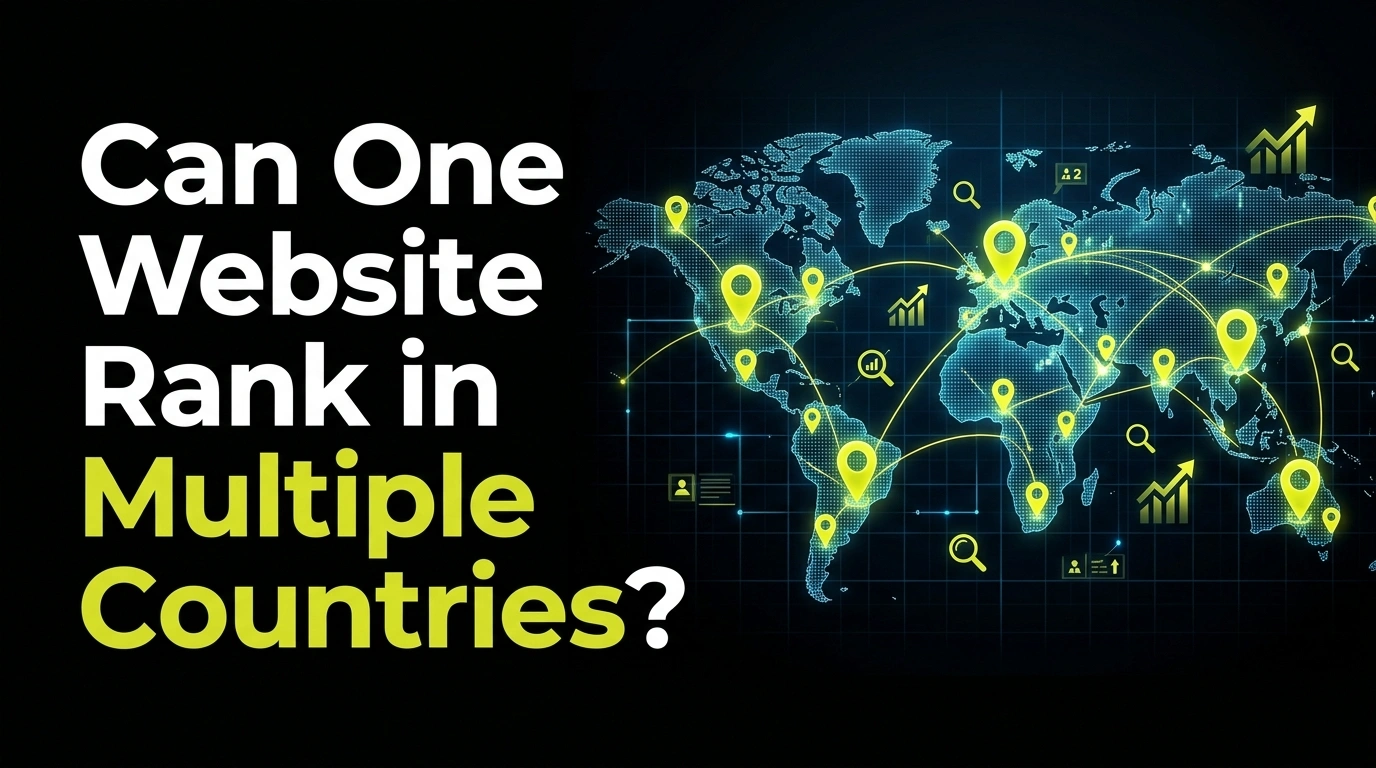
Can a Single Website Rank in Multiple Countries?
Learn how a single website can rank in multiple countries using smart international SEO strategies, hreflang setup, localization, and authority building.
Learn how a single website can rank in multiple countries using smart international SEO strategies, hreflang setup, localization, and authority building.
Real projects across branding, packaging, websites and growth.
Straight answers on this topic from the UnFoldMart team.





From branding and packaging to Webflow websites, SEO, AEO and GEO, UnFoldMart brings strategy, design and growth under one team for 250+ brands across 8 markets. Tell us where you want to grow and we'll show you the fastest way there.


If you’re expanding globally, you’ve probably asked this:
“Do we need a separate website for each country?”
Or can one domain rank everywhere?
It’s a smart question.
Because building multiple sites:
But relying on one site without the right setup can limit growth.
So here’s the clear answer:
Yes, a single website can rank in multiple countries.
But only if you approach international SEO correctly.
Let’s break down how it works - and when one site is enough.
Before deciding on structure, you need to understand how Google decides where your site ranks.
Google uses several signals:
For example:
A .co.uk domain strongly signals UK targeting.
A .com domain is considered global.
But here’s the key:
Google doesn’t just look at domain endings anymore.
It evaluates intent, structure, and content depth.
So ranking globally isn’t about buying more domains.
It’s about sending the right signals.
A single .com domain can rank in multiple countries if:
Many SaaS companies operate on one global domain and rank across:
The secret isn’t duplication.
It’s intelligent targeting.
One domain usually works well for:
Digital products that serve global audiences.
If targeting US, UK, and Australia, one structured domain often works.
Especially if services are digital.
Where physical location doesn’t matter.
In these cases, creating multiple domains often adds unnecessary complexity.
A single, well-optimized domain builds authority faster.
There are situations where country-level targeting becomes necessary.
If you’re targeting “plumber in Toronto” vs “plumber in London,” local signals matter.
Different currencies, shipping rules, or taxes require localized content.
Financial or medical services often need country-specific compliance messaging.
Some markets are competitive enough to justify separate targeting.
In these cases, you don’t always need separate domains.
But you do need separate pages.
You generally have three options:
example.co.uk
example.ca
Strong local signal.
But splits domain authority.
uk.example.com
Separate sections under same brand.
Moderate authority sharing.
example.com/uk/
Shares full domain authority.
Easier management.
Often preferred for startups.
For most growing companies, subfolders strike the best balance between scalability and SEO strength.
If you target multiple countries or languages, hreflang is essential.
Hreflang tells Google:
“This page is for UK users.”
“This version is for US users.”
Without it, Google may:
Common mistakes include:
When implemented properly, hreflang prevents confusion and improves regional rankings.
This is where many businesses fail.
Translation ≠ localization.
For example:
“Digital marketing agency pricing” in the US may differ in intent from “digital marketing agency cost” in the UK.
Localization includes:
If your content feels foreign to users, conversion drops.
Google also recognizes contextual mismatches.
Localization improves both rankings and conversions.
Even with one website, local authority still matters.
If you want to rank in Canada, Canadian backlinks help.
Regional mentions and citations strengthen geographic relevance.
So international SEO isn’t just about pages.
It’s about:
Authority grows through local signals.
Here’s a practical checklist:
Most startups benefit from a .com with country subfolders.
Search intent differs by country.
Don’t duplicate. Adapt.
Test thoroughly.
Partner with local platforms.
Use tools like Google Search Console to monitor country-level impressions and clicks.
International SEO isn’t about cloning.
It’s about tailoring.
Avoid these:
Complexity without strategy hurts rankings.
Simplicity with structure wins.
For most startups?
No.
Multiple domains:
Unless there’s a strong legal or regional reason, one well-structured domain usually performs better.
Consolidated authority compounds faster.
And authority is hard to build.
International expansion is exciting.
But without the right structure, you risk spreading your authority too thin.
At UnFoldMart, we help startups design international SEO strategies that balance technical precision with localized growth.
From URL structure to hreflang to content strategy - we make global scaling structured, not chaotic.
👉 Talk to our team and build a global SEO strategy that scales the right way.
Got Questions? We’ve Got Answers – Clear, Simple, and Straight to the Point
Typically three to six months for noticeable traction, depending on competition.
Yes. Search results vary based on user location and intent.
It’s a tag that tells Google which language or country version of a page to show.
Usually no. Subfolders often work better for startups.
Yes. With proper localization and hreflang setup, a .com can rank globally.

We help modern businesses unify branding, websites, SEO, and paid media into one performance-driven system designed to scale.




Taunustor 1, Frankfurt am Main, 60310, Germany

Huis te Landelaan 130-a Zuid, 2283 SJ Rijswijk, Netherlands
Basisweg 10, 1043 AP Amsterdam, Netherlands

32 London Bridge St, London SE1 9SG, United Kingdom

75 Avenue de la Grande Armée, 75016 Paris, France

P.º de la Castellana, 259C, Planta 19, Fuencarral-El Pardo, 28046 Madrid, Spain

plac Europejski 1, 00-844 Warszawa, Poland

555 Burrard St Vancouver, BC, V7X 1M8, Canada

604 Elias Rd, #03-200, Singapore 510604

Suite 18, Level 18 The Executive Centre, Tower A, DLF Epitome, DLF Cyber City, Gurugram, 122002











.jpeg)
.jpeg)
.jpeg)















.jpeg)

.jpeg)



.jpeg)

.jpeg)



.jpeg)
.jpeg)



.jpeg)
.jpeg)
.jpeg)
.jpeg)


.jpeg)


.jpeg)