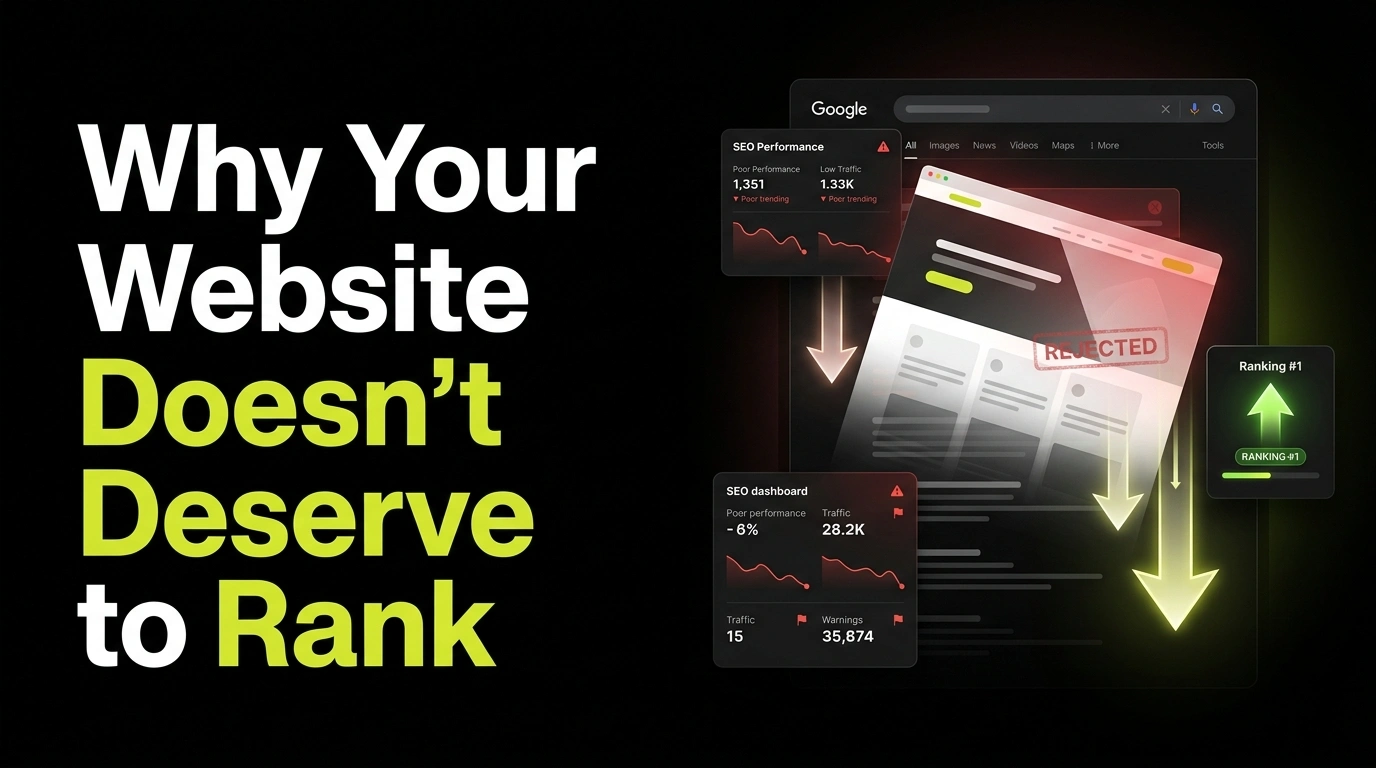
Why Your Website Doesn’t Deserve to Rank
Struggling to rank on Google? Discover the real reasons your website isn’t ranking and how to build authority, improve content, and earn top positions.
Struggling to rank on Google? Discover the real reasons your website isn’t ranking and how to build authority, improve content, and earn top positions.
Real projects across branding, packaging, websites and growth.
Straight answers on this topic from the UnFoldMart team.





From branding and packaging to Webflow websites, SEO, AEO and GEO, UnFoldMart brings strategy, design and growth under one team for 250+ brands across 8 markets. Tell us where you want to grow and we'll show you the fastest way there.


This might sound harsh.
But it needs to be said.
If your website isn’t ranking, it might not be Google’s fault.
Every business wants page one.
Every founder believes their content should get traffic.
Every marketing team wonders why competitors outrank them.
But here’s the truth:
Publishing content doesn’t automatically make you worthy of rankings.
Google doesn’t owe you visibility.
Rankings are earned.
Let’s talk about why most websites don’t deserve to rank - yet.
And what changes that.
Search engines don’t reward effort.
They reward value.
Google’s goal is simple:
Deliver the most relevant, useful, trustworthy answer for the user.
Not the newest site.
Not the site that “tries harder.”
Not the one that just launched.
If your page isn’t the best result available, it won’t rank.
And that’s not personal.
It’s competitive.
Be honest.
Is your content:
If your article says the same thing as the top 10 results - why should Google rank it?
AI tools have made publishing easy.
But easy doesn’t equal valuable.
Generic content is invisible in 2026.
If your site doesn’t add unique perspective, data, examples, or experience, it’s replaceable.
And replaceable content doesn’t deserve top rankings.
Authority isn’t about confidence.
It’s about signals.
Does your site have:
If not, you’re asking Google to trust you without evidence.
Authority is earned externally.
If nobody references you, why should search engines elevate you?
Even great content struggles without authority.
Trust is built - not assumed.
Ranking isn’t just about words.
If your website:
It doesn’t deserve to rank above optimized competitors.
User experience matters.
Search engines measure:
If your technical foundation is weak, your rankings will be too.
This one is huge.
Are you writing what you want to publish?
Or what users are actually searching for?
Search intent defines format.
If someone searches:
“Best CRM software”
And you publish a 500-word definition of CRM - you won’t rank.
Because the user wants comparison, not explanation.
Intent alignment beats keyword stuffing.
If your content doesn’t match what users expect, it won’t deserve visibility.
This part hurts.
Sometimes your competitors outrank you because:
SEO isn’t about fairness.
It’s about comparison.
If the top three pages provide more depth, better structure, and stronger trust signals - they deserve the ranking more than you.
Instead of blaming algorithms, study competitors.
What are they doing better?
Ranking is relative.
Many businesses think SEO works like this:
Write blog → Publish → Wait → Rank.
That’s not how it works.
High-performing sites:
SEO is ongoing.
If you publish once and disappear, you’re not competing.
Visibility compounds through consistency.
There’s no switch.
No shortcut.
No secret plugin.
Strong rankings are built through:
Websites that deserve to rank usually:
SEO rewards effort - but only the right kind of effort.
Let’s flip this.
A website deserves to rank when it:
It’s not about length.
It’s not about volume.
It’s about usefulness.
If your content genuinely helps users more than alternatives, rankings follow.
Ask yourself:
If most answers are “not yet,” that’s okay.
But it explains the rankings.
SEO isn’t emotional.
It’s logical.
Here’s the encouraging part.
Google isn’t biased.
It doesn’t favor big brands forever.
Smaller sites outrank giants all the time.
But only when they:
SEO rewards improvement.
It’s one of the few marketing channels where long-term effort compounds predictably.
If your site doesn’t deserve to rank today, that can change.
But only through intentional strategy.
Ranking isn’t about luck.
It’s about structure, authority, and clarity.
At UnFoldMart, we help businesses build SEO systems designed to compete - not just publish.
From technical foundations to authority-building strategies, we focus on making your website genuinely valuable in your niche.
Because rankings follow value.
👉 Talk to our team and build a website that actually deserves to rank.
Got Questions? We’ve Got Answers – Clear, Simple, and Straight to the Point
Fix technical issues, improve content quality, and build high-authority backlinks consistently.
Absolutely. But it requires depth, not shortcuts.
Yes - but only if it adds unique value and isn’t generic or repetitive.
Typically 3–6 months for noticeable improvements, depending on competition.
Common reasons include weak authority, generic content, technical issues, or misaligned search intent.

We help modern businesses unify branding, websites, SEO, and paid media into one performance-driven system designed to scale.




Taunustor 1, Frankfurt am Main, 60310, Germany

Huis te Landelaan 130-a Zuid, 2283 SJ Rijswijk, Netherlands
Basisweg 10, 1043 AP Amsterdam, Netherlands

32 London Bridge St, London SE1 9SG, United Kingdom

75 Avenue de la Grande Armée, 75016 Paris, France

P.º de la Castellana, 259C, Planta 19, Fuencarral-El Pardo, 28046 Madrid, Spain

plac Europejski 1, 00-844 Warszawa, Poland

555 Burrard St Vancouver, BC, V7X 1M8, Canada

604 Elias Rd, #03-200, Singapore 510604

Suite 18, Level 18 The Executive Centre, Tower A, DLF Epitome, DLF Cyber City, Gurugram, 122002








.jpeg)
.jpeg)
.jpeg)













.jpeg)

.jpeg)



.jpeg)

.jpeg)



.jpeg)
.jpeg)



.jpeg)
.jpeg)
.jpeg)
.jpeg)


.jpeg)

.jpeg)