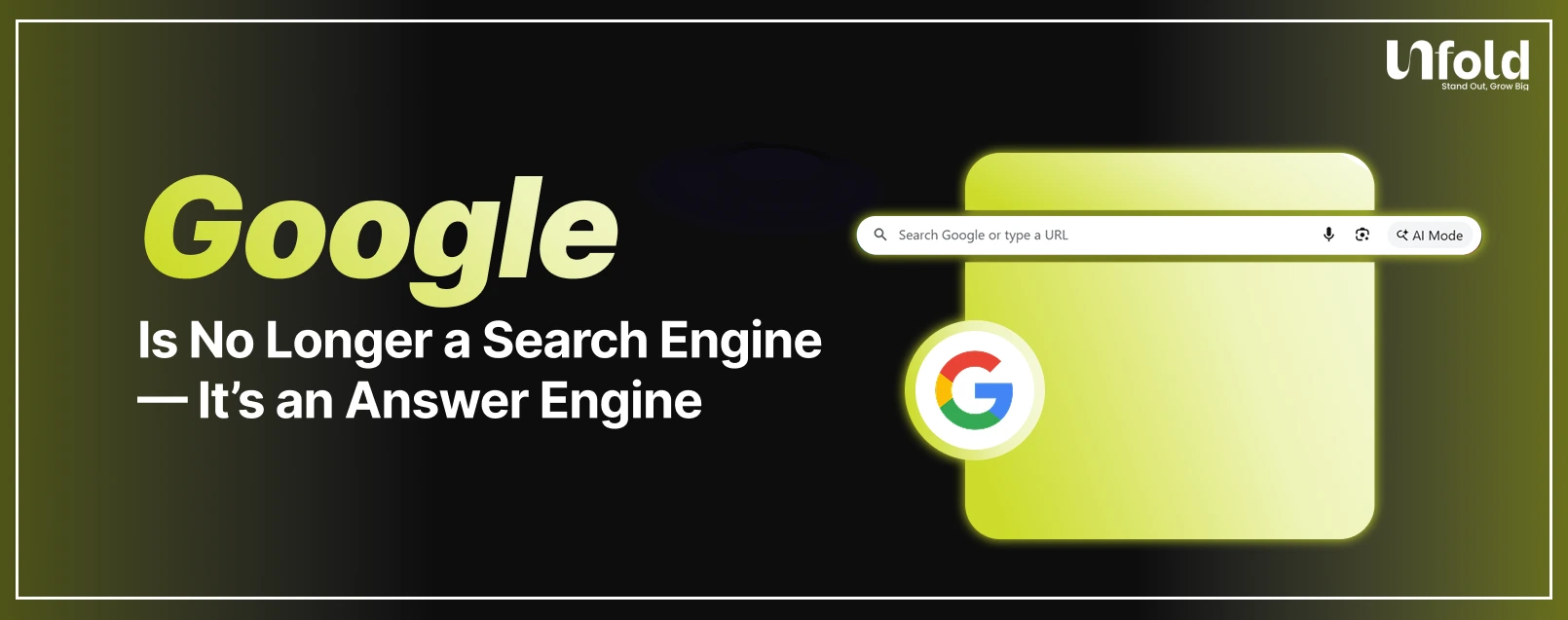
Google Is No Longer a Search Engine. It’s an Answer Engine
For years, Google was known as a search engine. You typed a query, scanned a list of blue links, clicked a website, and explored information on your own. That experience shaped how websites were built, how SEO worked, and how businesses earned traffic.
That model is changing fast.
Today, Google is no longer focused only on helping users find information. It is focused on giving the answer instantly. Users often get what they need without clicking a single link. This shift is not subtle. It is redefining how visibility, traffic, and SEO work.
Google is becoming an answer engine.
Understanding this shift is critical for businesses, marketers, and website owners who want to stay relevant in the age of AI-driven search.
How Google Originally Worked as a Search Engine
In its early days, Google’s mission was simple. Crawl the web, index pages, and rank them based on relevance and authority.
Users searched using keywords. Google returned a list of results. Websites competed for rankings, and clicks were the main reward. SEO focused on keywords, backlinks, and on-page optimization.
The search journey looked like this:
- User searches
- Google lists results
- User clicks a website
- Website delivers information
Traffic was the currency. More clicks meant more visibility, more leads, and more revenue.
That foundation still exists, but it is no longer the full picture.
What Does “Answer Engine” Actually Mean?
An answer engine does not just point users to information. It delivers the information directly.
Instead of asking users to explore multiple websites, Google now tries to understand the intent behind a query and present a clear answer immediately. This could be a definition, a list, a summary, or a recommendation.
An answer engine prioritizes speed, clarity, and convenience. The goal is not exploration. The goal is resolution.
When users get answers directly on Google, the role of websites changes. Websites become sources, not destinations.
Google Features That Prove the Shift
Several Google features clearly show how search has evolved into an answer-first experience.
Featured Snippets
These appear at the top of results and provide direct answers pulled from websites. Users often do not need to click further.
People Also Ask
Expandable questions that answer follow-up queries within the search page itself.
Knowledge Panels
Entity-based information boxes that summarize people, brands, places, and concepts instantly.
AI Overviews
AI-generated summaries that combine information from multiple sources into one response.
Zero-Click Results
Searches where users find what they need without clicking any website.
Together, these features reduce dependence on traditional organic clicks and increase Google’s role as the final destination.
The Role of AI in Google’s Transformation
Artificial intelligence is the engine behind this shift.
Google now focuses on understanding meaning and intent, not just matching keywords. AI models analyze context, user behavior, and semantic relationships to decide what the best answer looks like.
Instead of ranking pages alone, Google synthesizes information. It extracts insights, summarizes content, and presents conclusions.
This is part of the broader AI strategy by Google to keep users engaged within its ecosystem while delivering faster and more useful results.
Search is becoming conversational, predictive, and context-aware.
How User Behavior Has Changed
User behavior has evolved alongside Google.
People now expect:
- Immediate answers
- Fewer clicks
- Less effort
- Clear explanations
Search sessions are shorter. Queries are more conversational. Trust in Google-provided answers is increasing.
Many users no longer explore multiple websites. They skim answers, validate quickly, and move on.
This behavior shift directly impacts how websites attract and retain attention.
What This Means for Website Traffic
One of the biggest concerns for businesses is traffic loss.
Informational content is most affected. Many how-to articles, definitions, and explanations no longer receive the same number of clicks because Google answers those queries directly.
This does not mean websites are obsolete. It means traffic quality matters more than traffic quantity.
Visibility inside Google’s answers is becoming just as important as ranking on page one. If your content feeds the answer engine, your brand still gains exposure, trust, and authority.
The KPI is shifting from clicks alone to presence and influence.
SEO in the Age of Answer Engines
SEO is not dead. It is evolving.
Ranking is no longer the only goal. The new goal is to become the best answer source.
Modern SEO focuses on:
- Clear and structured content
- Direct answers to specific questions
- Strong topical authority
- Trust signals and expertise
- Entity-based optimization
- Schema markup for clarity
Content that is vague, generic, or written only for keywords struggles. Content that demonstrates expertise and clarity performs better.
SEO now works hand in hand with branding and authority building.
How Brands Can Still Win Visibility
Brands that succeed in this environment adapt their strategy.
They focus on becoming trusted sources in their niche. They publish original insights instead of recycled information. They create content that explains concepts better than competitors.
Brand recognition matters more than ever. When users see a familiar brand referenced in answers, trust increases.
Winning visibility today means owning topics, not just keywords.
Is Google Replacing Websites?
No, but it is redefining their role.
Websites are still essential for:
- Depth and detailed explanations
- Conversions and lead generation
- Brand storytelling
- Trust building
- User experience
Google provides answers. Websites provide experiences.
The relationship is shifting from competition to collaboration. Google surfaces answers. Websites support, expand, and convert.
What Businesses Should Do Next
Businesses must adjust their content and SEO strategy.
Focus on expertise-led content instead of volume. Build topic clusters instead of isolated blogs. Optimize content to answer real user questions clearly.
Invest in brand authority, not just rankings. Prepare for AI-driven discovery by structuring content for machines and humans alike.
The businesses that adapt early gain long-term visibility.
Final Thoughts
Google is no longer just helping users find information. It is helping them finish their search instantly.
This shift changes how visibility works, how content is valued, and how SEO delivers results. Businesses that understand this evolution can position themselves as trusted sources rather than just ranked pages.
Search is changing. Strategy must change with it.
Ready to Future-Proof Your SEO and Content Strategy?
As Google moves toward AI-driven answers, businesses need smarter content, stronger branding, and modern SEO strategies.
At UnFoldMart, we help brands adapt to AI-first search through expert-led content, SEO, and digital strategy.
👉 Talk to our team and prepare your website for the future of Google search today.

FAQs
Got Questions? We’ve Got Answers – Clear, Simple, and Straight to the Point
Websites must focus on expertise, structured content, brand authority, and content that supports Google’s AI answers.
Yes. SEO now focuses on visibility, authority, and being referenced inside Google’s answer features rather than only driving clicks.
Zero click searches occur when users get their answer directly on Google and do not click on any website result.
An answer engine delivers instant answers to user queries instead of directing users to multiple websites to find information.
Yes. Google increasingly provides direct answers using AI features like AI Overviews, featured snippets, and knowledge panels instead of only showing links.

Want to Turn Your Brand Into a Scalable Growth Engine?
We help modern businesses unify branding, websites, SEO, and paid media into one performance-driven system designed to scale.