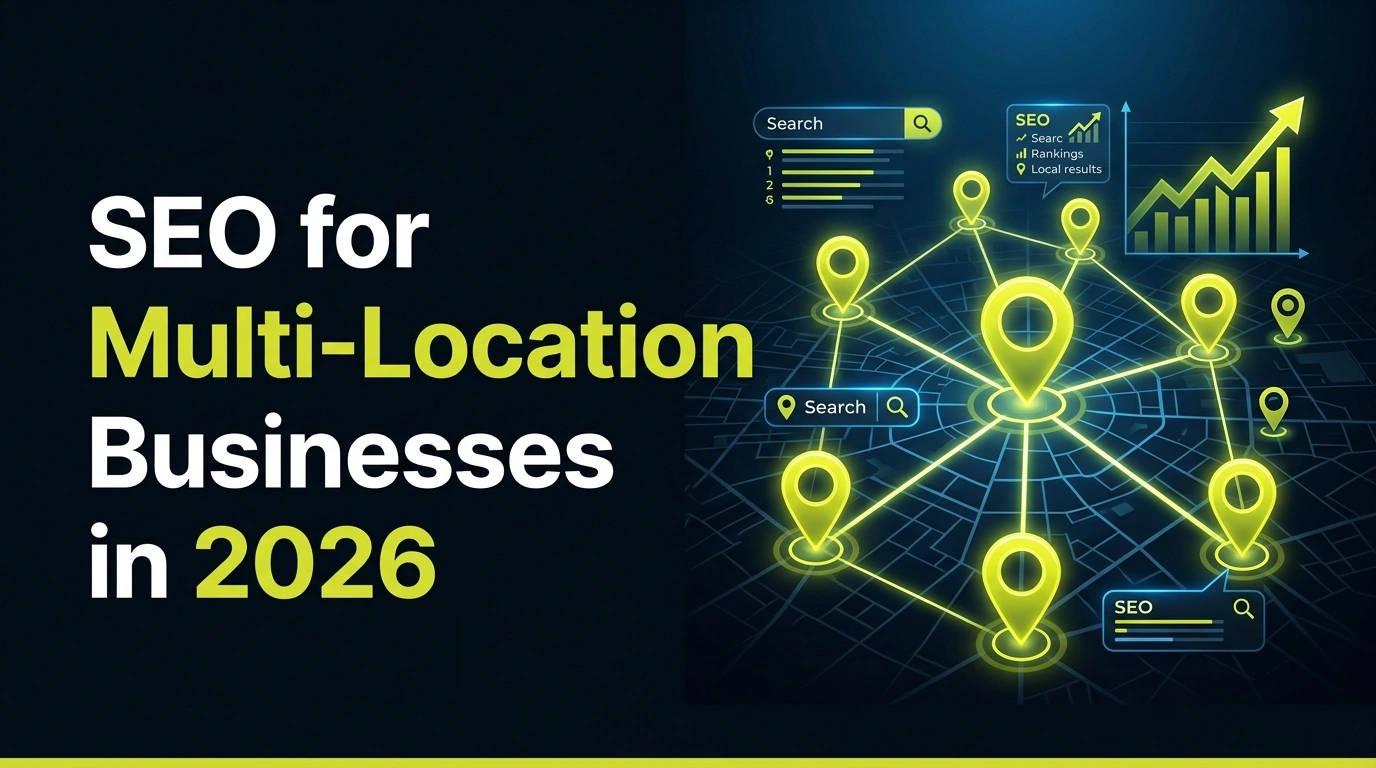
SEO for Multi-Location Businesses in 2026
Learn how to scale SEO across multiple cities in 2026 with the right structure, local content, Google Business optimization, and authority-building strategy.
Learn how to scale SEO across multiple cities in 2026 with the right structure, local content, Google Business optimization, and authority-building strategy.
Real projects across branding, packaging, websites and growth.
Straight answers on this topic from the UnFoldMart team.




From branding and packaging to Webflow websites, SEO, AEO and GEO, UnFoldMart brings strategy, design and growth under one team for 250+ brands across 8 markets. Tell us where you want to grow and we'll show you the fastest way there.


Ranking in one city is hard.
Ranking in five cities is complex.
Ranking in twenty cities?
That’s a system.
Multi-location businesses in 2026 face a unique challenge. You’re not just competing with national brands. You’re competing with hyper-local businesses that dominate map results, collect reviews aggressively, and optimize specifically for one area.
If you try to “copy-paste” your SEO across cities, you won’t scale.
Because multi-location SEO isn’t duplication.
It’s architecture.
Let’s break down how to do it correctly.
Local SEO today is shaped by:
When someone searches:
“dentist near me”
“real estate agent in Miami”
“best gym in Austin”
Google prioritizes:
Organic rankings still matter - but map visibility often drives the majority of local clicks.
For multi-location businesses, that means each branch must build its own presence — while still benefiting from central brand authority.
Structure determines scalability.
You generally have three options:
example-newyork.com
example-chicago.com
This splits authority and is hard to manage.
ny.example.com
la.example.com
Moderate authority sharing, but still fragmented.
example.com/new-york/
example.com/chicago/
This keeps all authority centralized while allowing location targeting.
For most multi-location businesses, subfolders are the best long-term choice.
They allow:
Authority compounds faster when it isn’t split.
Here’s where many businesses go wrong.
They create 20 city pages and change only the city name.
That doesn’t work in 2026.
Each location page should include:
The goal is to prove local relevance.
Search engines recognize thin duplication instantly.
If your Chicago page looks identical to your Dallas page, rankings suffer.
Depth wins.
Your website is only half the equation.
Each location must have its own optimized Google Business Profile.
That includes:
Reviews heavily influence map rankings.
Each branch must collect and respond to reviews consistently.
The map pack is often where the majority of local clicks happen - so neglecting GBP means leaving traffic on the table.
NAP consistency still matters.
Your Name, Address, and Phone number must match across:
Inconsistent listings create confusion.
And confusion weakens local trust signals.
Local citation building helps validate location legitimacy.
Especially for new branches.
If you want to dominate multiple cities, go beyond service pages.
Create localized content such as:
Localized content builds topical authority within each region.
It also attracts local backlinks naturally.
Content builds local relevance.
Not just keywords.
Local backlinks matter.
Examples include:
While your main domain builds national authority, each location benefits from regional signals.
Think of it as:
Central authority + local validation.
Both are needed.
Reviews directly impact:
Multi-location businesses should create systems to:
Don’t centralize responses from one account.
Each location should feel personal and responsive.
Reputation is local.
Technical optimization ensures your structure supports growth.
Key areas include:
Link location pages strategically from your main navigation and service pages.
Use LocalBusiness schema for each branch.
Local users search on mobile. Speed impacts rankings and conversions.
Mobile-first indexing makes responsive design mandatory.
Clear technical structure ensures search engines understand your location hierarchy.
You cannot optimize what you don’t measure.
Use tools like:
Track:
Some cities may outperform others.
Data shows where to invest more effort.
Avoid these common errors:
Multi-location SEO fails when businesses treat it like template work.
It requires planning.
Here’s a practical system:
Consistency across locations matters more than perfection in one.
Systems scale.
Shortcuts don’t.
Managing SEO for multiple locations isn’t about more pages.
It’s about better structure.
At UnFoldMart, we help multi-location businesses design scalable local SEO systems from technical architecture to location content to review management.
Because growth across cities requires strategy, not duplication.
👉 Talk to our team and scale your local SEO the right way in 2026.
Got Questions? We’ve Got Answers – Clear, Simple, and Straight to the Point
Typically 3–6 months for measurable traction, depending on competition.
Extremely important. They directly impact map rankings and trust.
No. Thin duplication harms rankings.
Usually no. Subfolders under one strong domain are more efficient.
Create unique location pages, optimize Google Business Profiles, and build local backlinks.

We help modern businesses unify branding, websites, SEO, and paid media into one performance-driven system designed to scale.




Taunustor 1, Frankfurt am Main, 60310, Germany

Huis te Landelaan 130-a Zuid, 2283 SJ Rijswijk, Netherlands
Basisweg 10, 1043 AP Amsterdam, Netherlands

32 London Bridge St, London SE1 9SG, United Kingdom

75 Avenue de la Grande Armée, 75016 Paris, France

P.º de la Castellana, 259C, Planta 19, Fuencarral-El Pardo, 28046 Madrid, Spain

plac Europejski 1, 00-844 Warszawa, Poland

555 Burrard St Vancouver, BC, V7X 1M8, Canada

604 Elias Rd, #03-200, Singapore 510604

Suite 18, Level 18 The Executive Centre, Tower A, DLF Epitome, DLF Cyber City, Gurugram, 122002










.jpeg)
.jpeg)
.jpeg)















.jpeg)

.jpeg)



.jpeg)

.jpeg)


.jpeg)
.jpeg)



.jpeg)
.jpeg)
.jpeg)
.jpeg)


.jpeg)

.jpeg)