One-Page Websites vs Multi-Page Websites in 2026
Compare one-page and multi-page websites in 2026. Discover which structure is better for SEO, conversions, scalability, and long-term growth.
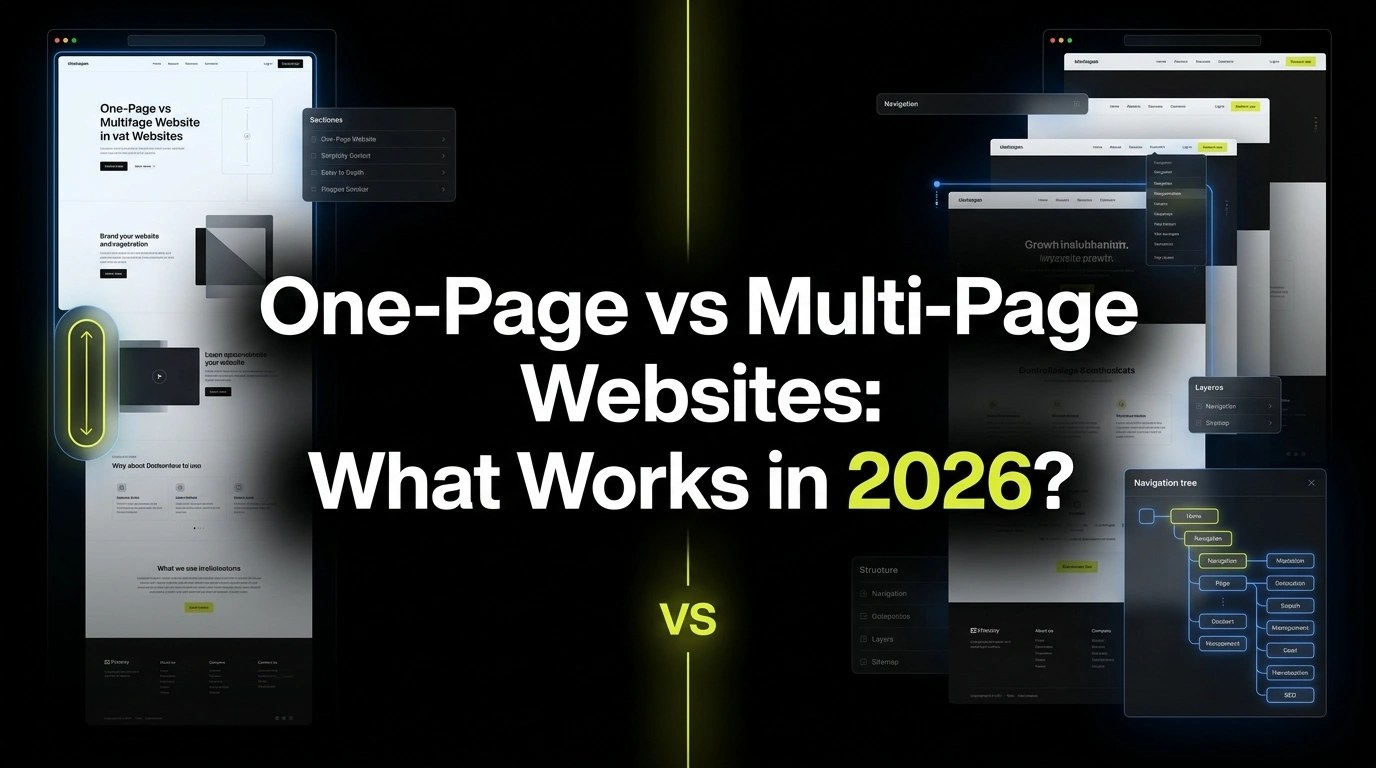
Compare one-page and multi-page websites in 2026. Discover which structure is better for SEO, conversions, scalability, and long-term growth.
Real projects across branding, packaging, websites and growth.
Straight answers on this topic from the UnFoldMart team.




From branding and packaging to Webflow websites, SEO, AEO and GEO, UnFoldMart brings strategy, design and growth under one team for 250+ brands across 8 markets. Tell us where you want to grow and we'll show you the fastest way there.


In 2026, website design trends are pulling in two different directions.
On one side, we have minimalist one-page websites. Clean, focused, simple.
On the other side, we have structured multi-page websites built for scale, SEO, and authority.
Founders, marketers, and startups are constantly asking:
Is one page enough?
Or do we need a full multi-page structure to grow?
The answer depends on your business model, growth goals, and SEO strategy.
Let’s break this down clearly and strategically.
A one-page website contains all its content on a single page.
Navigation typically uses anchor links that scroll users to different sections such as:
Everything lives on one URL.
One-page websites are commonly used for:
The goal is focus. One story. One journey. One primary call to action.
They are visually clean and often designed for conversion simplicity.
But simplicity has trade-offs.
A multi-page website uses separate URLs for different sections.
For example:
Each page can target specific keywords, user intent, and audiences.
Multi-page structures are common for:
They allow depth and scalability.
Instead of one long scroll, the user navigates through different layers of information.
SEO is often where the biggest difference appears.
A one-page website has only one URL. That means it has limited ability to rank for multiple keywords across different topics.
You can include multiple sections targeting different phrases, but search engines still see it as one page.
That makes it harder to build topical authority.
A multi-page website allows you to:
Using tools like Google Search Console, you can see how different pages rank for different queries. That level of granularity is almost impossible with a single page.
If SEO is a primary growth channel, multi-page structures provide far more flexibility.
One-page websites create a guided experience.
The user scrolls through a carefully designed narrative. This works well when:
The journey feels smooth and focused.
Multi-page websites offer something different. They allow users to explore at their own pace.
Different users have different needs. Some want quick summaries. Others want deep details.
Multi-page structures allow segmentation. For example:
For complex decision-making, multi-page sites usually convert better because they provide layered information.
This is where long-term growth matters.
A one-page website becomes crowded quickly. Adding new services or sections makes the page longer and more difficult to navigate.
Content expansion feels forced.
A multi-page website scales naturally.
You can:
This makes it easier to grow content strategy over time.
If you plan to scale marketing, multi-page architecture supports that growth more effectively.
Many assume one-page sites are faster.
That is not always true.
If a one-page site contains heavy animations, large images, and long content, it can actually become slower.
Multi-page websites load content in smaller chunks. Each page contains focused information.
This can improve perceived speed and navigation clarity.
Speed matters in 2026 because mobile search dominates. Users expect quick loading experiences regardless of structure.
Tracking user behavior is easier with multi-page websites.
You can analyze:
With one-page websites, you rely heavily on scroll tracking and event tracking.
That data is useful, but less structured.
Multi-page analytics provide clearer funnel visibility.
For growth-focused businesses, that insight becomes critical.
A one-page website can work well if:
It works best when clarity and speed matter more than scale.
For early validation or short-term campaigns, one page can be enough.
A multi-page website is better if:
Multi-page structures support keyword depth, internal linking, and topical expansion.
If your website is meant to be a long-term growth engine, multi-page architecture usually wins.
In 2026, many successful brands combine both structures.
They create:
This hybrid model delivers:
You do not have to choose one extreme.
You can design strategically.
AI-driven search results prioritize clarity and topical authority.
Multi-page websites often perform better because:
One-page sites struggle to demonstrate depth across multiple topics.
In the AI search era, authority and structure matter more than ever.
If organic visibility is important, multi-page usually provides stronger foundations.
Ask yourself:
If most answers are yes, a multi-page structure is likely the better choice.
If you are validating a single offer or building a personal portfolio, one page may be enough.
Your website is not just a design asset.
It is your growth infrastructure.
At UnFoldMart, we design websites that align structure with long-term business goals. Whether you need a focused landing experience or a scalable SEO-driven architecture, we build systems designed for mea surable growth.
Talk to our team and choose a website structure that supports your next stage of expansion.
Got Questions? We’ve Got Answers – Clear, Simple, and Straight to the Point
Startups planning long-term organic growth often benefit more from multi-page structures.
Yes, but it requires careful URL planning to protect SEO value.
It depends on complexity. Simple offers may convert better with one page. Complex services usually benefit from multiple pages.
Yes, especially for branded searches or niche queries.
Not necessarily. They can rank for focused keywords but struggle to target multiple topics.

We help modern businesses unify branding, websites, SEO, and paid media into one performance-driven system designed to scale.




Taunustor 1, Frankfurt am Main, 60310, Germany

Huis te Landelaan 130-a Zuid, 2283 SJ Rijswijk, Netherlands
Basisweg 10, 1043 AP Amsterdam, Netherlands

32 London Bridge St, London SE1 9SG, United Kingdom

75 Avenue de la Grande Armée, 75016 Paris, France

P.º de la Castellana, 259C, Planta 19, Fuencarral-El Pardo, 28046 Madrid, Spain

plac Europejski 1, 00-844 Warszawa, Poland

555 Burrard St Vancouver, BC, V7X 1M8, Canada

604 Elias Rd, #03-200, Singapore 510604

Suite 18, Level 18 The Executive Centre, Tower A, DLF Epitome, DLF Cyber City, Gurugram, 122002







.jpeg)
.jpeg)
.jpeg)








.jpeg)

.jpeg)

.jpeg)

.jpeg)

.jpeg)
.jpeg)



.jpeg)
.jpeg)
.jpeg)
.jpeg)

.jpeg)
.jpeg)