Was bringt Menschen dazu, Ihre Website in 5 Sekunden zu verlassen?
Erfahren Sie, warum Nutzer Websites innerhalb von Sekunden verlassen und wie Probleme mit UX, Klarheit, Geschwindigkeit und Vertrauen zu hohen Absprungraten führen.
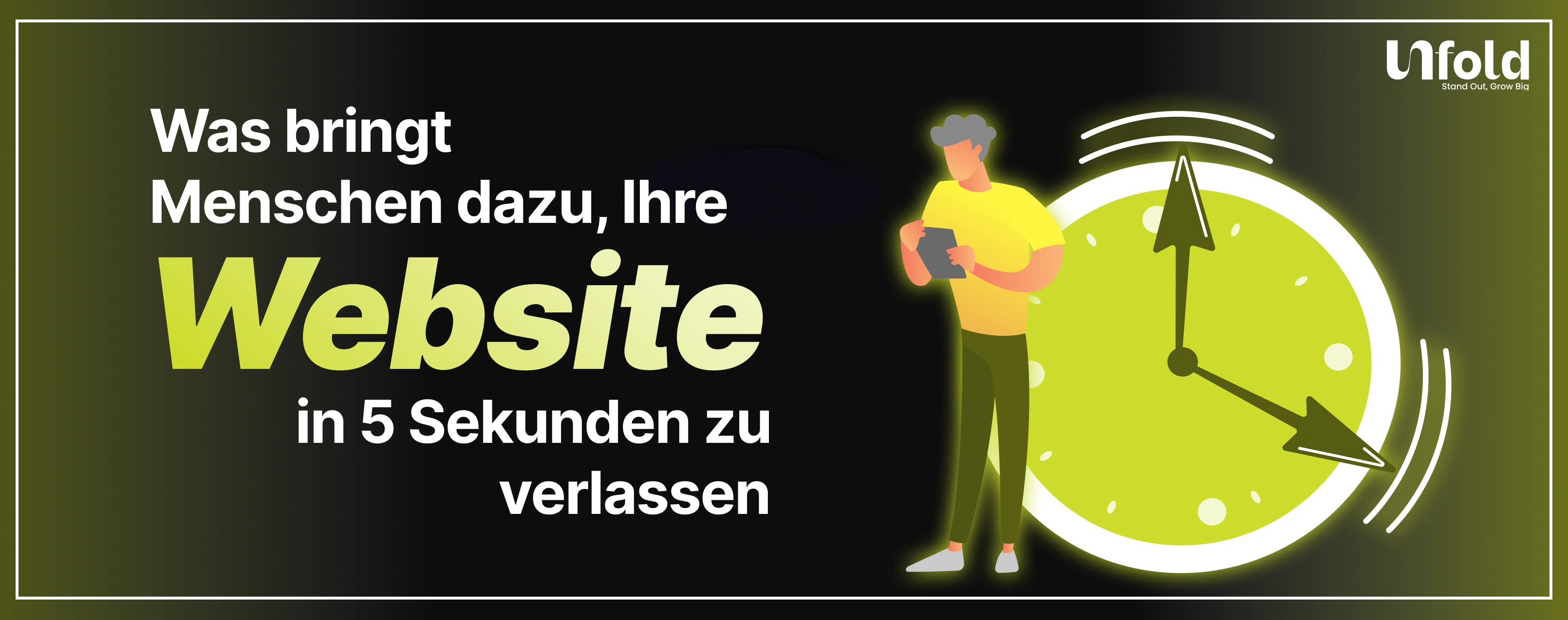
Erfahren Sie, warum Nutzer Websites innerhalb von Sekunden verlassen und wie Probleme mit UX, Klarheit, Geschwindigkeit und Vertrauen zu hohen Absprungraten führen.
Real projects across branding, packaging, websites and growth.
Straight answers on this topic from the UnFoldMart team.





From branding and packaging to Webflow websites, SEO, AEO and GEO, UnFoldMart brings strategy, design and growth under one team for 250+ brands across 8 markets. Tell us where you want to grow and we'll show you the fastest way there.


You worked hard to bring people to your website.
Ads, SEO, social media, referrals. The traffic is there. But most visitors leave almost instantly.
Not in minutes.
Not after scrolling.
In five seconds or less.
This is not because users are impatient. It is because your website failed to answer one simple question fast enough:
“Is this for me?”
If the answer is not immediately clear, people leave. Understanding why this happens is the first step to fixing it.
Research consistently shows that users form an opinion about a website almost instantly. Within a few seconds, they decide whether to stay or leave.
In those first moments, visitors are not reading paragraphs or analyzing features. They are scanning.
They are looking for:
If your site feels confusing, slow, or untrustworthy, they do not wait around.
First impressions decide everything.
The famous 5 second test is not about design beauty. It measures comprehension.
After five seconds, a user should be able to answer:
If users cannot answer these questions quickly, the website has already failed, no matter how good the product is.
Most high bounce rates are clarity problems, not traffic problems.
This is the biggest reason people leave.
If your headline is vague, clever, or filled with jargon, users will not work to understand it.
Statements like:
Mean nothing to a first-time visitor.
Your value proposition must clearly explain who you help and how in one glance. If users have to scroll to understand what you do, you are already losing them.
When everything screams for attention, nothing gets attention.
Many websites overwhelm users with:
This creates cognitive overload.
Users should immediately see:
If the eye does not know where to go first, the user leaves.
Speed is non-negotiable.
If your website takes more than a few seconds to load, many users will leave before they even see your content. This is especially true on mobile.
Slow sites signal:
Even a great design cannot compensate for slow performance. Speed is part of user experience, not a technical detail.
Visitors are cautious.
They do not know you. They do not trust you yet. If your website does not help them feel safe, they leave.
Common missing trust signals include:
People look for reassurance subconsciously. Without it, hesitation turns into exit.
If users arrive from an ad or search result and the page does not match their expectation, they bounce immediately.
This happens when:
This breaks trust instantly.
Message continuity between traffic source and landing page is critical for retention.
Most traffic today is mobile, yet many websites are still designed desktop-first.
Common mobile issues include:
If mobile users struggle even slightly, they leave. They will not pinch, zoom, or fight your layout.
Mobile experience is first impression experience.
Nothing frustrates users faster than being interrupted before they understand the page.
Popups that appear immediately asking for:
Disrupt the natural flow.
Bevor du um Aufmerksamkeit bittest, musst du sie dir verdienen. Frühe Unterbrechungen fühlen sich aufdringlich und verzweifelt an, was die Leute abschreckt.
Auch wenn den Nutzern gefällt, was sie sehen, können sie es trotzdem verlassen, wenn sie nicht wissen, was sie als Nächstes tun sollen.
Zu den häufigsten Problemen gehören:
Benutzer wollen nicht nachdenken. Sie wollen Führung.
Ein klarer Weg nach vorne sorgt dafür, dass die Nutzer auch nach den ersten Sekunden beschäftigt bleiben.
Um schnelle Ausfahrten zu beheben, müssen Sie das Verhalten beobachten und nicht raten.
Zu den nützlichen Methoden gehören:
Stellen Sie den Testern eine Frage:
„Worum geht es Ihrer Meinung nach auf dieser Website?“
Wenn ihre Antwort nicht Ihrer Absicht entspricht, haben Sie das Problem gefunden.
Sie benötigen nicht immer ein vollständiges Redesign.
Zu den wichtigsten Korrekturen gehören:
Kleine Verbesserungen der Klarheit führen oft zu großen Ergebnissen.
Kreativität ist wichtig, aber erst nach Klarheit.
Nutzer belohnen Klugheit nicht, wenn sie verwirrt sind. Sie belohnen Verständnis.
In den ersten fünf Sekunden geht es darum, grundlegende Fragen zu beantworten. Kreativität kommt erst später zum Vorschein, wenn Vertrauen aufgebaut ist.
Die besten Websites fühlen sich offensichtlich an, nicht beeindruckend.
Benutzer gehen nicht, weil sie ungeduldig sind.
Sie gehen, weil:
Wenn Sie diese drei Dinge korrigieren, sinken die Absprungraten auf natürliche Weise.
Ihre Website muss nicht alles schnell sagen.
Es muss nur sagen, dass richtige Sache schnell.
Wenn Benutzer Ihre Website innerhalb von Sekunden verlassen, ist das Problem nicht der Traffic.
Es ist Erfahrung.
Bei UnfoldMart, wir helfen Marken dabei, Probleme in Bezug auf Klarheit, Vertrauen und Nutzerfreundlichkeit zu beheben, die im Hintergrund Konversionen zum Erliegen bringen.
👉 Holen Sie sich ein UX- und Konversions-Audit Ihrer Website und machen Sie Besucher zu Kunden.
Got Questions? We’ve Got Answers – Clear, Simple, and Straight to the Point

Wir helfen modernen Unternehmen dabei, Branding, Websites, SEO und Paid Media in einem leistungsorientierten System zu vereinen, das skalierbar ist.




Taunustor 1, Frankfurt am Main, 60310, Deutschland

Huis te Landelaan 130-a Zuid, 2283 SJ Rijswijk, Niederlande
Basisweg 10, 1043 AP Amsterdam, Niederlande

32 London Bridge St, London SE1 9SG, Vereinigtes Königreich

75 Avenue de la Grande Armée, 75016 Paris, Frankreich

P.º de la Castellana, 259C, Planta 19, Fuencarral-El Pardo, 28046 Madrid, Spanien

plac Europejski 1, 00-844 Warszawa, Polen

555 Burrard St Vancouver, BC, V7X 1M8, Kanada

604 Elias Rd, #03-200, Singapore 510604

Suite 18, 18. Etage, The Executive Centre, Tower A, DLF Epitome, DLF Cyber City, Gurugram, 122002



















.jpeg)
.jpeg)

.jpeg)


.jpeg)







.jpeg)