How ChatGPT Selects Sources: What Determines Visibility in AI Answers?
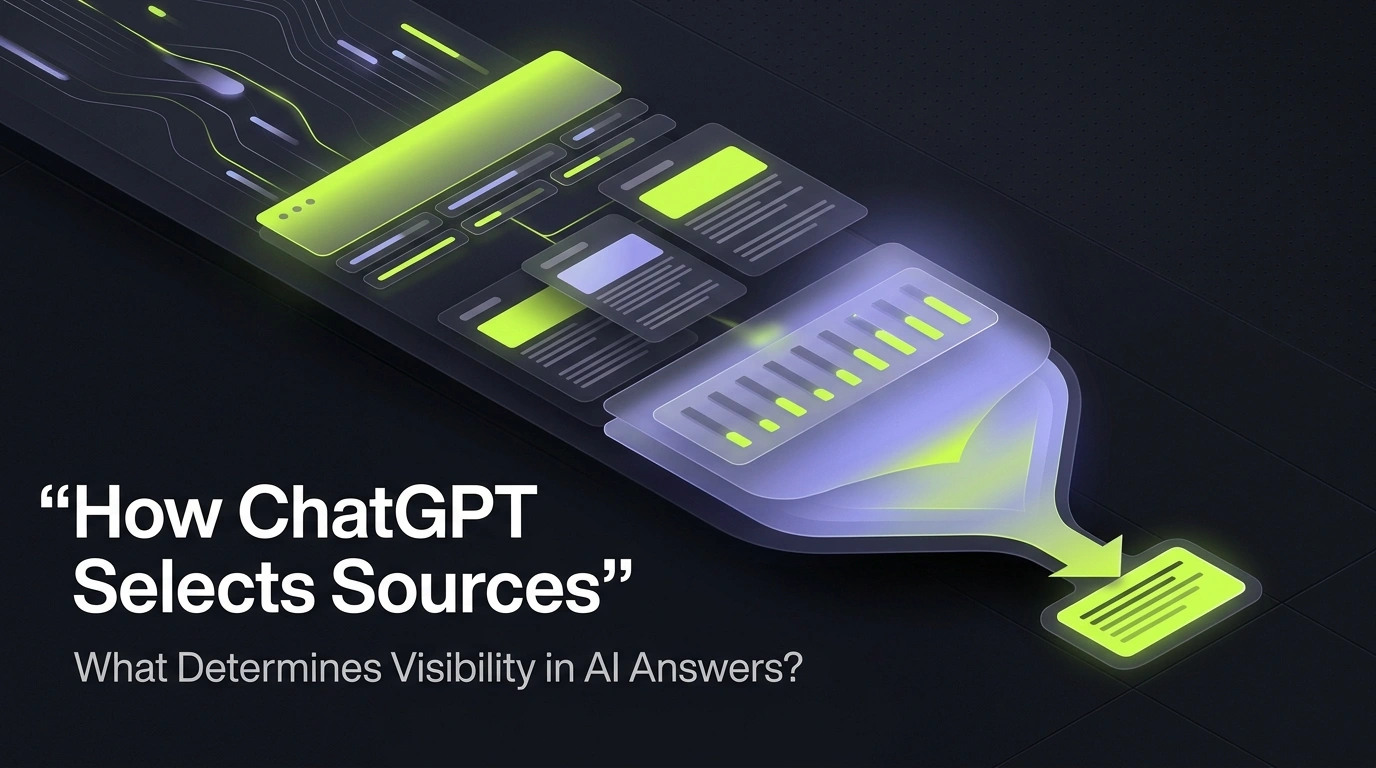
Search behavior is changing rapidly. Instead of relying only on traditional search engines, users are increasingly turning to AI tools like ChatGPT to ask questions, explore topics, and make decisions.
This shift introduces a new kind of visibility challenge for businesses. It is no longer just about ranking on Google. It is about being referenced, summarized, or reflected in AI-generated answers.
A common question arises from this change. Why do some brands, websites, or ideas show up in AI responses while others are completely absent?
Understanding how ChatGPT selects and reflects information is essential for businesses that want to stay visible in an AI-driven ecosystem, especially in competitive and diverse markets like Europe.
In this guide, we will break down how ChatGPT generates answers, what influences source selection, and how businesses can optimize their content for AI visibility.
Does ChatGPT Actually “Select Sources”?
One of the biggest misconceptions is that ChatGPT works like a traditional search engine that selects and ranks sources in real time.
In reality, ChatGPT does not operate as a ranking engine. It does not crawl the web in the same way as search engines, nor does it maintain a live index of pages to rank.
Instead, ChatGPT generates responses based on patterns learned during training, combined with contextual understanding of the query. When connected to retrieval systems or browsing capabilities, it may incorporate external information, but the core mechanism remains generative rather than ranking-based.
This means that “source selection” in ChatGPT is not about choosing the top-ranked page. It is about synthesizing information that aligns with the query, based on patterns of credible and relevant content.
How AI Systems Like ChatGPT Generate Answers
To understand how visibility works in AI-generated responses, it is important to look at how these systems produce answers.
At a high level, ChatGPT analyzes the user’s query and interprets its intent. It then draws on learned knowledge, language patterns, and contextual signals to generate a response that is coherent and relevant.
This process involves several layers. First, the model identifies the topic and intent behind the question. Next, it predicts what kind of answer would best satisfy the user. Finally, it constructs a response by combining relevant concepts into a clear and structured explanation.
Unlike traditional search, which presents multiple links, ChatGPT delivers a synthesized answer. This makes clarity, consistency, and authority in content more important than ever.
Key Factors That Influence Source Selection in AI Responses
Although ChatGPT does not “rank” sources in the traditional sense, certain characteristics strongly influence whether content, ideas, or brands are reflected in AI-generated answers.
Content Authority and Credibility
AI systems tend to reflect information that is widely recognized as credible. Content from authoritative sources, well-established brands, and trusted domains is more likely to shape the patterns the model relies on.
For businesses, this highlights the importance of building long-term authority rather than focusing only on short-term optimization tactics.
Clarity and Structured Information
Content that is clearly written and well-structured is easier for AI systems to interpret and reuse. Information that is presented logically, with clear explanations and defined sections, is more likely to be reflected in generated responses.
In practice, this means avoiding overly complex language and focusing on clarity.
Topical Relevance
Relevance remains a core factor. Content that directly addresses specific topics and aligns closely with user intent is more likely to influence AI-generated answers.
This requires a deep understanding of what users are searching for and why.
Consistency Across the Web
AI models learn from patterns that appear consistently across multiple sources. When similar information is repeated across credible platforms, it reinforces its reliability.
This means that being mentioned or referenced across different channels can increase visibility in AI systems.
Contextual Depth
Surface-level content is less effective in an AI-driven environment. Content that explores topics in depth, connects related ideas, and provides comprehensive insights is more valuable.
AI systems are designed to deliver meaningful answers, which makes depth a key factor.
Brand Mentions and Digital Presence
Brands that appear frequently across the web are more likely to be recognized and included in AI-generated responses. This includes mentions in articles, directories, social platforms, and industry discussions.
A strong digital footprint increases the likelihood of visibility.
Freshness and Relevance
For topics that evolve quickly, such as technology or market trends, freshness plays an important role. Updated and relevant information is more likely to be reflected in AI responses, especially when retrieval systems are involved.
ChatGPT vs Google: Source Selection Differences
While both ChatGPT and Google aim to deliver relevant information, the way they handle sources is fundamentally different.
Verdict:
Google rewards pages that rank well. ChatGPT reflects content that is clear, authoritative, and contextually relevant. This makes the approach to optimization significantly different.
Why Some Websites Get Referenced and Others Do Not
Many businesses invest in content but still struggle to gain visibility in AI-generated answers. This is often due to a combination of factors.
Content that lacks depth or originality is less likely to stand out. Similarly, poorly structured information makes it harder for AI systems to interpret and reuse content.
Another common issue is weak authority. Websites that are not widely recognized or referenced may not contribute strongly to the patterns AI models rely on.
Finally, inconsistency across platforms can limit visibility. If a brand has a fragmented presence, it becomes harder to establish credibility.
How to Optimize Content for AI Source Selection
Optimizing for AI visibility requires a shift in mindset. Instead of focusing only on rankings, businesses need to focus on influence and presence.
A strong approach includes:
- Building authority through consistent, high-quality content
- Structuring content in a clear and logical way
- Covering topics comprehensively rather than superficially
- Maintaining consistency across multiple platforms
- Strengthening brand presence through mentions and collaborations
In essence, the goal is to create content that is not only discoverable but also usable by AI systems.
ChatGPT and AI Visibility in Europe
The dynamics of AI visibility become more complex in the European market.
Businesses must consider multiple languages, regional variations in search behavior, and cultural differences. Content that works in one country may not resonate in another.
Localization is therefore critical. It is not enough to translate content. It must be adapted to reflect local intent and context.
Additionally, regulatory frameworks influence how data is used, which can impact how AI systems interpret and personalize information.
For companies expanding across Europe, combining AI optimization with localized strategies is essential for success.
The Future of AI Source Selection
AI systems are evolving rapidly, and the way they handle sources is expected to become more sophisticated over time.
Future developments may include improved transparency around how information is sourced, better citation mechanisms, and more refined methods for evaluating credibility.
At the same time, competition for visibility will increase as more businesses invest in AI-driven content strategies.
This makes it important to act early and build a strong foundation.
Ready to Improve Your AI Visibility?
As AI continues to reshape how information is discovered, businesses need to adapt their strategies to remain visible and relevant.
At UnFoldMart, we help startups, mid-size businesses, and enterprises build AI-driven SEO and GEO strategies that improve visibility across both search engines and AI platforms, with a strong focus on European markets.
If you are looking to strengthen your digital presence and stay ahead of the curve, our team can help you build a strategy that delivers long-term results.
👉 Book a strategy call with UnFoldMart to explore your growth opportunities.
FAQs
Got Questions? We’ve Got Answers – Clear, Simple, and Straight to the Point
Still have questions?
No question is too small—let’s talk

Want to Turn Your Brand Into a Scalable Growth Engine?
We help modern businesses unify branding, websites, SEO, and paid media into one performance-driven system designed to scale.