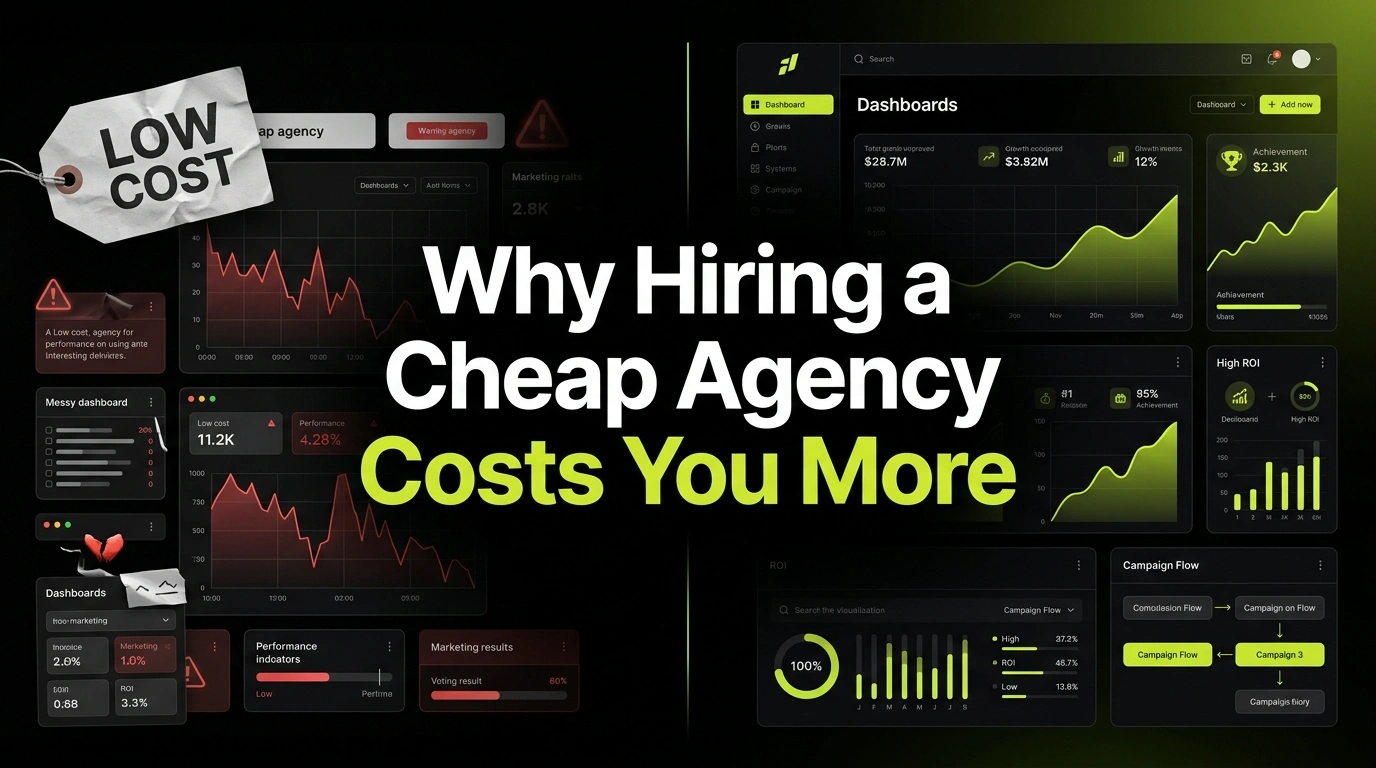
Why Hiring a Cheap Agency Costs You More
Thinking of hiring a low-cost marketing agency? Discover the hidden costs of cheap agencies and why strategic investment drives better long-term growth.
Thinking of hiring a low-cost marketing agency? Discover the hidden costs of cheap agencies and why strategic investment drives better long-term growth.
Real projects across branding, packaging, websites and growth.
Straight answers on this topic from the UnFoldMart team.





From branding and packaging to Webflow websites, SEO, AEO and GEO, UnFoldMart brings strategy, design and growth under one team for 250+ brands across 8 markets. Tell us where you want to grow and we'll show you the fastest way there.


Every founder has been there.
You receive two proposals.
One costs $1,000 per month.
The other costs $4,000 per month.
Naturally, you think:
“Why would I pay 4x more?”
Startups need to protect cash.
Budgets are tight.
Every expense feels heavy.
So the cheaper agency wins.
Three months later, you’re frustrated.
Six months later, you’re restarting from scratch.
And suddenly, that “cheap” decision becomes very expensive.
Here’s the uncomfortable truth:
The cheapest proposal is rarely the cheapest outcome.
Let’s break down why.
It’s not irrational.
Founders choose cheap agencies because:
When two proposals promise “SEO” or “ads management,” it’s tempting to compare only the price.
But marketing isn’t a commodity.
You’re not buying a product.
You’re buying thinking, execution, and growth direction.
And that’s where the hidden costs begin.
Cheap agencies often focus on tasks, not strategy.
They’ll:
But without a strong roadmap, everything feels random.
You end up with:
Six months pass.
You switch agencies.
And the new team has to redo everything.
Time is your most expensive asset.
Wasted months cost more than higher retainers.
Cheap agencies cut corners.
It shows in:
The damage isn’t immediate.
But over time, it hurts:
Cleaning up bad SEO work later can cost more than doing it right from the start.
Cheap execution often creates long-term problems.
Low-cost agencies survive by reducing internal costs.
That usually means:
You might never work with the strategist who pitched you.
Instead, you get:
Lack of ownership slows growth.
And inconsistency kills momentum.
The monthly fee is just the visible number.
The hidden costs include:
You pay twice.
Once for the cheap service.
Then again to fix it.
The second payment is always higher.
Cheap agencies often juggle too many clients.
That leads to:
In fast-moving industries, timing matters.
Launching ads two months late.
Publishing content too slowly.
Missing seasonal opportunities.
Those losses don’t show up on invoices.
But they show up in revenue gaps.
One of the biggest red flags?
Vague reporting.
Cheap agencies often focus on:
But rarely connect performance to revenue.
Without clear KPIs, you can’t measure real ROI.
And without ROI, you’re guessing.
Good agencies obsess over outcomes.
Cheap agencies report activity.
There’s a big difference.
Now let’s flip the lens.
A strong agency typically:
They don’t promise overnight miracles.
They build predictable growth engines.
They care about sustainability.
And that mindset changes everything.
Let’s compare honestly.
Cheap Agency:
Total cost:
Quality Agency:
Total cost:
When you factor in time and opportunity, the expensive agency often costs less long-term.
ROI > Retainer.
Always.
Instead of asking, “How much do you charge?”
Ask:
Price is one variable.
Clarity and competence matter more.
To be fair, cheap doesn’t always mean bad.
Budget services can work for:
But when growth is the priority, cutting corners becomes risky.
Especially in SEO, branding, and performance marketing.
Marketing isn’t a cost center.
It’s a growth lever.
If done well, it multiplies revenue.
If done poorly, it drains resources quietly.
At UnFoldMart, we focus on strategy first - because execution without direction wastes time and money.
We build marketing systems designed for long-term ROI, not short-term activity.
👉 Talk to our team and invest in growth, not quick fixes.
Got Questions? We’ve Got Answers – Clear, Simple, and Straight to the Point
Vague deliverables, no clear KPIs, unrealistic promises, and high team turnover.
Yes, but rebuilding and restarting often costs more than expected.
Look for strategy clarity, experienced teams, transparent reporting, and real case studies.
It depends on goals, but ROI and long-term value matter more than raw cost.
Not always. But low pricing often means reduced expertise or resources.

We help modern businesses unify branding, websites, SEO, and paid media into one performance-driven system designed to scale.




Taunustor 1, Frankfurt am Main, 60310, Germany

Huis te Landelaan 130-a Zuid, 2283 SJ Rijswijk, Netherlands
Basisweg 10, 1043 AP Amsterdam, Netherlands

32 London Bridge St, London SE1 9SG, United Kingdom

75 Avenue de la Grande Armée, 75016 Paris, France

P.º de la Castellana, 259C, Planta 19, Fuencarral-El Pardo, 28046 Madrid, Spain

plac Europejski 1, 00-844 Warszawa, Poland

555 Burrard St Vancouver, BC, V7X 1M8, Canada

604 Elias Rd, #03-200, Singapore 510604

Suite 18, Level 18 The Executive Centre, Tower A, DLF Epitome, DLF Cyber City, Gurugram, 122002







.jpeg)
.jpeg)
.jpeg)










.jpeg)

.jpeg)


.jpeg)

.jpeg)


.jpeg)
.jpeg)



.jpeg)
.jpeg)
.jpeg)
.jpeg)


.jpeg)
.jpeg)