Rebranding in 2026: When Is the Right Time?
Thinking about rebranding in 2026? Discover the signs it is time to rebrand, when to avoid it, and how strategic repositioning drives long-term growth.
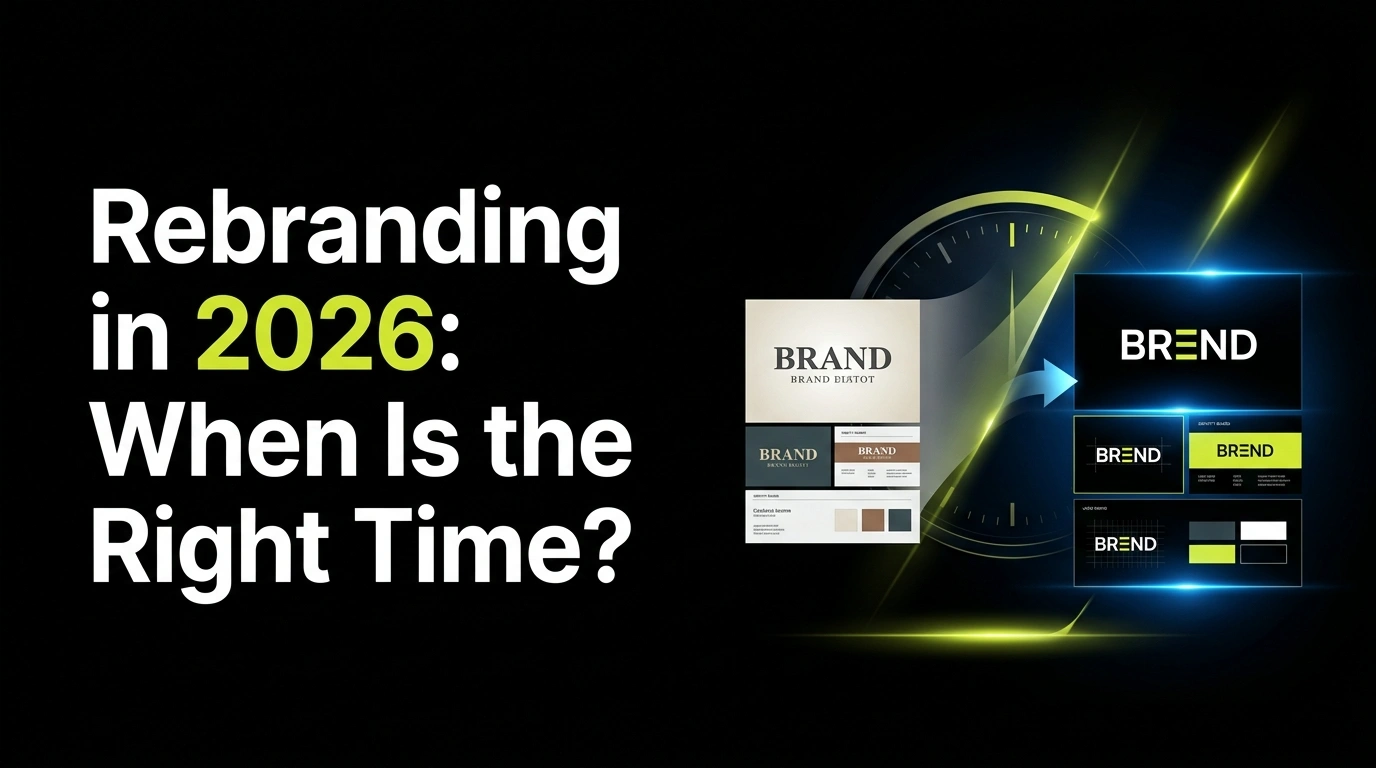
Thinking about rebranding in 2026? Discover the signs it is time to rebrand, when to avoid it, and how strategic repositioning drives long-term growth.
Real projects across branding, packaging, websites and growth.
Straight answers on this topic from the UnFoldMart team.





From branding and packaging to Webflow websites, SEO, AEO and GEO, UnFoldMart brings strategy, design and growth under one team for 250+ brands across 8 markets. Tell us where you want to grow and we'll show you the fastest way there.


Rebranding is often misunderstood.
Many businesses think it means changing a logo, refreshing colors, or updating a website layout.
In reality, rebranding is a strategic decision. It reshapes how your company is positioned, perceived, and experienced in the market.
And timing matters.
Rebranding too early can confuse your audience and waste resources. Rebranding too late can leave you irrelevant.
So how do you know when it is the right time?
Let’s break it down.
In 2026, a brand is not just a visual identity. It is a full ecosystem.
Rebranding can involve:
Modern brands exist across multiple touchpoints. Website, social platforms, search results, paid ads, AI-driven search summaries, email marketing, and community channels all shape perception.
Rebranding today is not cosmetic. It is strategic alignment between your business reality and how the market sees you.
Not every slow quarter means you need a rebrand. But certain signals clearly indicate misalignment.
If you started as a service provider and now offer a SaaS product, your original brand may no longer fit.
If you pivoted markets or expanded offerings, your messaging may still reflect your old identity.
When your business evolves, your brand must evolve with it.
If your leads consistently:
The issue may not be sales. It may be brand positioning.
Your brand sets expectations. If the wrong audience keeps showing up, your messaging likely needs recalibration.
Markets move quickly.
If your website looks dated, your visuals feel old, or your tone feels disconnected from modern expectations, perception suffers.
In digital-first industries, brand freshness directly impacts credibility.
Outdated does not mean minimal. It means misaligned with current market standards.
If your brand sounds like everyone else, you become replaceable.
Generic positioning leads to:
Rebranding can clarify your unique value proposition and sharpen differentiation.
Many startups scale revenue faster than brand maturity.
What worked for a small startup may not work when:
Your brand must match your current level, not your early stage.
Sometimes rebranding is corrective.
If your brand has:
A strategic rebrand can reposition perception.
But it must be backed by operational improvements. A new logo alone does not fix trust issues.
International expansion or premium repositioning often requires strategic brand shifts.
Cultural nuances, audience expectations, and competitive landscapes differ across markets.
A rebrand ensures your messaging resonates globally.
Rebranding is powerful, but it is not a solution for everything.
You should not rebrand if:
Sometimes the problem is distribution, not identity.
Rebranding without solving deeper operational issues creates distraction instead of growth.
Rebranding prematurely can:
Brand recognition compounds over time.
If you change identity too often, you lose accumulated familiarity.
Consistency builds trust. Constant change disrupts it.
On the other hand, waiting too long can create:
If your brand no longer reflects your value, it limits pricing power and credibility.
Brands that fail to evolve risk being outpaced by sharper competitors.
In 2026, brand perception is shaped heavily by digital signals.
AI-driven search experiences summarize brands instantly.
Your website often acts as the central brand hub.
If your messaging is unclear, fragmented, or outdated, it impacts:
Consistency across all digital touchpoints matters more than ever.
A strong rebrand aligns messaging across:
Rebranding now is about coherence, not decoration.
Not every update requires a full rebrand.
A refresh typically includes:
A full rebrand involves:
If your foundation is solid but visuals feel outdated, a refresh may be enough.
If your identity no longer matches your business reality, you need a rebrand.
Before committing to rebranding, ask:
If multiple answers are yes, it may be time.
Rebranding should solve strategic friction, not aesthetic fatigue.
A successful rebrand achieves:
It is communicated clearly to customers.
It is implemented consistently across platforms.
And most importantly, it supports long-term growth.
Rebranding without strategy is expensive.
Rebranding with clarity creates momentum.
Rebranding is not about trends. It is about alignment.
At UnFoldMart, we approach rebranding as a growth strategy. From positioning clarity to digital execution, we help brands evolve with purpose and precision.
If your brand no longer reflects your ambition, it may be time to act.
Talk to our team and rebrand with purpose, not panic.
Got Questions? We’ve Got Answers – Clear, Simple, and Straight to the Point
Six failure patterns show up most often. Rebranding without a clear strategic reason — the visual system changes but the underlying business problems don't. Skipping the strategy phase and going straight to visual design — usually produces something that looks new without solving anything. Poor stakeholder alignment before launch — the CEO signs off then key leaders reject the work publicly. No SEO or AI-visibility migration plan — traffic drops after launch and takes quarters to recover. Underestimating internal rollout — sales collateral, product UI, partner materials, and legal documents take longer to update than most timelines assume. And chasing design trends instead of building a durable identity — the rebrand looks dated within two years. UnFoldMart's rebrand playbook builds guardrails against each of these because any one alone can undermine the whole project.
Substantially, and often more than teams anticipate. Domain changes, URL restructures, and messaging shifts can drop organic traffic 20–60% in the first quarter after launch if the SEO migration isn't planned in parallel with the rebrand. AI answer engines also lose track of the brand for 2–6 months as they update entity associations — during that window citation share on brand-adjacent queries usually drops. Mitigation requires an SEO and AI-visibility migration plan built alongside the rebrand: 301 redirects for every changed URL, updated Organization and sameAs schema everywhere, coordinated updates to Wikipedia and major directory entries, and proactive outreach to sources that cite the brand. UnFoldMart's rebrand engagements build the SEO migration plan into the rebrand timeline rather than leaving it as post-launch cleanup.
Realistic 2026 ranges. Small business or startup refresh (visual system update, no name change): €8,000–25,000, 4–8 weeks. Mid-market refresh with strategy phase: €25,000–75,000, 8–16 weeks. Full mid-market rebrand (strategy, identity system, applications, rollout): €60,000–200,000, 16–28 weeks. Enterprise rebrand across multiple product lines or geographies: €200,000+ and 6–12 months minimum. Add 3–6 months of internal rollout time for larger organisations beyond the agency work. What separates good outcomes isn't budget alone — it's whether the process includes a genuine strategy phase, whether stakeholder alignment is built into the timeline, and whether technical delivery (all file formats, guidelines, digital and print applications) is completed rather than treated as an afterthought.
The distinction matters because the cost and risk gap between them is large. A refresh keeps the core identity (name, logo mark, brand promise) and updates the execution — typography, colour palette refinement, photography style, digital applications. A full rebrand changes the core identity itself — potentially the name, always the logo mark, the positioning, the visual system, and the messaging architecture. Refreshes usually cost 20–40% of a full rebrand and carry meaningfully less risk to existing brand equity. Most businesses that think they need a rebrand actually need a refresh; the ones that genuinely need a rebrand usually have one of the six signals above and can articulate exactly what won't work about keeping the current identity.
Six signals usually indicate a genuine rebrand rather than a refresh. The brand no longer reflects the products, audience, or positioning the business has grown into. The visual identity looks dated compared with the category in a way customers actually notice. A merger, acquisition, or major pivot has changed what the business does. The name causes ongoing friction — legal disputes, pronunciation issues in target markets, or misalignment with new categories. Growth is stalling in ways that connect to brand perception rather than product or distribution. And competitors have moved to more contemporary identities that make the current brand look weak by comparison. Rebranding for reasons less concrete than these usually costs more than it returns.

We help modern businesses unify branding, websites, SEO, and paid media into one performance-driven system designed to scale.




Taunustor 1, Frankfurt am Main, 60310, Germany

Huis te Landelaan 130-a Zuid, 2283 SJ Rijswijk, Netherlands
Basisweg 10, 1043 AP Amsterdam, Netherlands

32 London Bridge St, London SE1 9SG, United Kingdom

75 Avenue de la Grande Armée, 75016 Paris, France

P.º de la Castellana, 259C, Planta 19, Fuencarral-El Pardo, 28046 Madrid, Spain

plac Europejski 1, 00-844 Warszawa, Poland

555 Burrard St Vancouver, BC, V7X 1M8, Canada

604 Elias Rd, #03-200, Singapore 510604

Suite 18, Level 18 The Executive Centre, Tower A, DLF Epitome, DLF Cyber City, Gurugram, 122002







.jpeg)
.jpeg)
.jpeg)








.jpeg)

.jpeg)
.jpeg)

.jpeg)

.jpeg)
.jpeg)



.jpeg)
.jpeg)
.jpeg)
.jpeg)

.jpeg)
.jpeg)