Personal Branding vs Company Branding in 2026
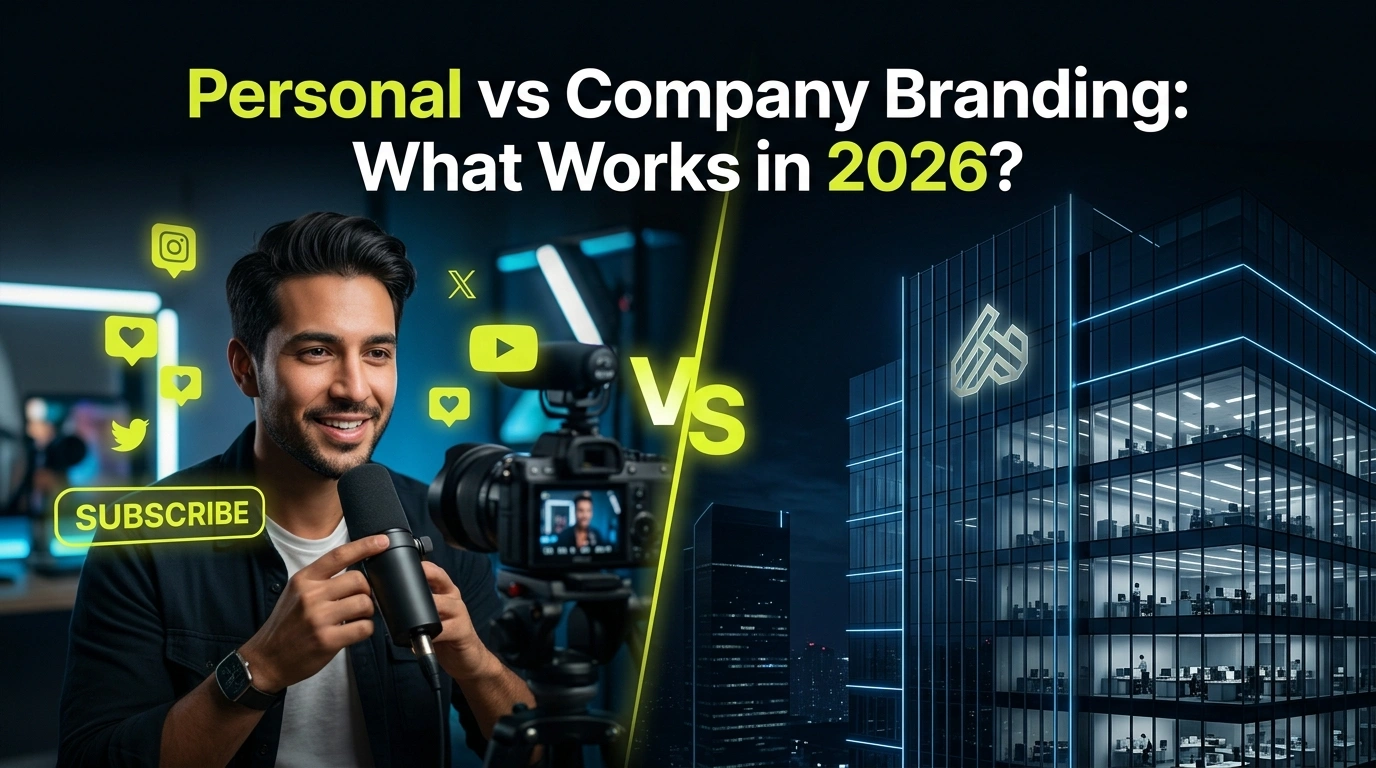
Personal brand or company brand? Discover what works best in 2026 and how founders can balance both to drive trust, growth, and long-term value.
Personal brand or company brand? Discover what works best in 2026 and how founders can balance both to drive trust, growth, and long-term value.
Real projects across branding, packaging, websites and growth.
Straight answers on this topic from the UnFoldMart team.




From branding and packaging to Webflow websites, SEO, AEO and GEO, UnFoldMart brings strategy, design and growth under one team for 250+ brands across 8 markets. Tell us where you want to grow and we'll show you the fastest way there.


If you’re a founder or marketer in 2026, you’ve probably felt this tension.
Should you invest time in building your personal brand?
Or focus entirely on your company brand?
Post on LinkedIn every day… or polish your website and product messaging?
Become the face of the business… or stay behind the scenes?
It’s a real dilemma.
Because both work.
And both take time.
The problem is, most startups don’t have enough time to do both properly.
So where should you focus?
The answer isn’t as obvious as it used to be.
Let’s break it down practically.
Branding has changed.
AI content is everywhere.
Ads are expensive.
Everyone sounds the same.
Trust has become the real currency.
And here’s the shift:
People trust people more than logos.
At the same time, investors and customers still buy from companies, not individuals.
So now you need:
Which creates a new question:
Do you build the person first or the company first?
Personal branding is simple.
It’s your reputation at scale.
It’s how people know you for:
It usually shows up as:
People follow you, not your logo.
And when they trust you, they’re more likely to trust what you build.
In 2026, personal brands often grow faster than company pages because algorithms reward real humans, not corporate posts.
Company branding is different.
It’s about building something bigger than one person.
It includes:
It’s what makes your company recognizable and credible even if the founder isn’t visible.
A strong company brand becomes an asset.
Something that:
Personal brands create attention.
Company brands create equity.
Both matter. But for different reasons.
Personal brands win trust faster.
A real person sharing insights feels authentic.
People relate to faces, stories, and opinions.
It’s easier to trust “Disha sharing growth tips” than “Company XYZ Marketing Solutions.”
But company brands build deeper trust over time.
They signal:
Personal brand = fast trust
Company brand = long-term credibility
Ideally, you want both.
Personal branding usually grows quicker.
You post.
You engage.
You show up consistently.
And within months, you can build visibility.
Company brands grow slower.
They rely on:
Which take longer to compound.
So if you need early traction or awareness, personal branding often delivers faster.
Here’s where things get tricky.
If everything depends on the founder’s face, what happens when:
The brand weakens.
That’s the risk of over-relying on personal branding.
On the flip side, faceless companies often struggle with:
Too corporate. Too distant.
Both extremes have risks.
Balance matters.
This one is interesting.
Personal brands drive conversations.
People DM you.
They ask questions.
They trust your recommendations.
It’s warm traffic.
Company brands drive conversions.
People search, compare, and buy based on:
It’s structured traffic.
Personal branding warms leads.
Company branding closes them.
Together, they’re powerful.
Separately, they’re incomplete.
Top talent often joins people, not logos.
A visible founder with strong values attracts:
But a strong company brand signals stability and growth potential.
Employees want both inspiration and security.
A known founder plus a respected company is the ideal combination.
This is where company branding clearly wins.
Investors don’t buy personal brands.
They buy businesses.
If your startup’s success depends entirely on you, valuation drops.
Because the asset isn’t transferable.
A strong company brand becomes:
It survives beyond the founder.
That’s critical for long-term value.
Let’s make it practical.
Prioritize personal branding if you’re:
Personal visibility helps you:
It’s often the quickest growth lever early on.
Focus more on company branding if you’re:
You need assets that exist beyond one person.
Systems matter more than personality.
Here’s the honest answer.
It’s not either/or anymore.
The best-performing startups use a hybrid model.
Founder builds trust.
Company builds equity.
Founder shares:
Company delivers:
The founder attracts attention.
The brand captures and scales it.
That’s the winning formula today.
Try this:
Founder:
Company:
Let personal brand drive traffic.
Let company brand convert it.
That keeps things sustainable.
Balancing personal and company branding sounds easy in theory.
Execution is where most teams struggle.
At UnFoldMart, we help founders build clear positioning, messaging, and growth systems that strengthen both personal authority and company equity.
Not just design. Not just content. Real brand strategy that drives growth.
👉 Talk to our team and build a brand that grows you and your business together.
Got Questions? We’ve Got Answers – Clear, Simple, and Straight to the Point
A mix. Founder authority builds trust, company brand closes deals.
A few consistent hours weekly is enough.
Yes, but growth is usually slower.
Only if everything depends on one person. Balance it with company assets.
Early on, yes. It builds trust and visibility faster.

We help modern businesses unify branding, websites, SEO, and paid media into one performance-driven system designed to scale.




Taunustor 1, Frankfurt am Main, 60310, Germany

Huis te Landelaan 130-a Zuid, 2283 SJ Rijswijk, Netherlands
Basisweg 10, 1043 AP Amsterdam, Netherlands

32 London Bridge St, London SE1 9SG, United Kingdom

75 Avenue de la Grande Armée, 75016 Paris, France

P.º de la Castellana, 259C, Planta 19, Fuencarral-El Pardo, 28046 Madrid, Spain

plac Europejski 1, 00-844 Warszawa, Poland

555 Burrard St Vancouver, BC, V7X 1M8, Canada

604 Elias Rd, #03-200, Singapore 510604

Suite 18, Level 18 The Executive Centre, Tower A, DLF Epitome, DLF Cyber City, Gurugram, 122002





.jpeg)
.jpeg)
.jpeg)







.jpeg)
.jpeg)

.jpeg)

.jpeg)

.jpeg)
.jpeg)


.jpeg)
.jpeg)
.jpeg)
.jpeg)


.jpeg)
.jpeg)